
Our take on the latest Monetary policy review (Wed 9 Oct 2024)



OCR cut 50bp to 4.75%
Potential for a 75bp cut in Nov
No clear reason for choosing 50 over 25bp cut today
The key numbers...
- The Reserve Bank accelerated the pace of interest rate cuts, reducing the official cash rate (OCR) by 0.50% to 4.75%.
- The Monetary Policy Committee noted that “domestic [economic] activity is weak”, although the “New Zealand economy has evolved largely as expected.”
- The Committee appears to be happier with domestic price-setting behaviour, but it also noted that “while domestic price-setting behaviour is now more in line with its mandate, there are still risks that further adjustments might be faster or slower than currently expected.”
- The Committee “discussed the respective benefits of a 25-basis point versus a 50-basis point cut”, finding that “a 50-basis point cut at this time is most consistent with the Committee’s mandate”.
- The Committee also noted that the new OCR is “still restrictive and leaves monetary policy well-placed to deal with any near-term surprises,” and that “future changes to the OCR would depend on [the Committee’s] evolving assessment of the economy.”
- No new forecasts were issued, as is usual for a Monetary Policy Review (rather than the full Monetary Policy Statements).
Interest rates to continue to fall
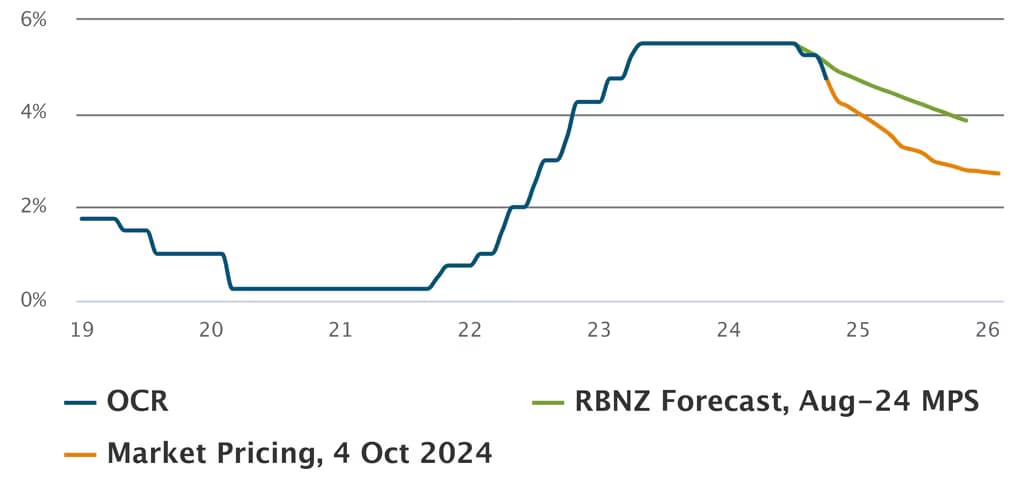
Official cash rate, at month end, RBNZ forecasts and implied by market pricing
...and our reaction
- The Reserve Bank has decided a faster pace of interest rate normalisation is needed, accelerating the pace of cuts to a “double-up” 50 basis point (bp) cut.
- It’s hard to understand why the Bank opted for a larger 50bp cut rather than the usual 25bp cut – the discussion of the decision is limited and essentially says that 50bp was the better call, without pointing to anything specific. Given the economy has evolved largely as expected, and next week’s data will show inflation already close to 2.0%pa, the Bank seems to be looking at current data and is now concerned that it hadn’t started cutting rates early enough.
- It’s hard to read the decision any other way – the Bank appears to have realised that the economy is weaker and doesn’t require as much interest rate restraint, and that the Bank needs to cut faster to normalise interest rates – a clear, if only implied, admission that the Bank may have been too slow to act. It still could be too far behind, if inflation is already back close to the mid-point of the Bank’s target, and interest rate settings are still quite restrictive.
- The Bank does seem to feel unconstrained from following its previously held views too closely – and that flexibility might well be appropriate. But it does leave everyone hanging a bit when it comes to assessing where to next.
- If the Bank does generally think it needs to move faster to bring interest rates down – as today’s evidence suggests – we’d find it hard to believe it would then slow to a “normal” 25bp cut in November. After November, the Committee takes a three-month summer break, and so we think there’s real potential for the Bank to consider a 75bp cut in November, to maintain the faster pace of easing, and as insurance over the longer break. The Committee can then come back in late February, assess how cuts to date have influenced the economy, and provide a fresh steer of where to next.
- We expect the next OCR move to remain data dependent, with inflation data (out next week), labour market data (6 November), and the survey of expectations (11 November) key to movements from here. But given today’s view of a need for a faster pace of normalisation, we’d need to see data showing much more cost or pricing risks for the Reserve Bank to pull back into the slow lane.
Latest updates
Premium

Monetary policy review
OCR up for first time in three years, as expected
Wed 8 Jul 2026
 2.5% Official cash rate from 2.25%
 Inflation now expected by the Bank to peak at 3.9%paFurther rate rises likely but uncertainty about the timing
Premium
Monetary policy review
Split decision keeps OCR at 2.25% for now
Wed 27 May 2026
 2.25% Official cash rate unchangedCasting vote made by Governor with a 3-3 vote split among Committee membersRBNZ forecast OCR to reach 3% by end of 2026
Monetary policy review
Reserve Bank holds at 2.25%, but watches vigilantly
Wed 8 Apr 2026
2.25% Official cash rate unchangedBank places more emphasis on potential inflationary risks4.2% Annual inflation forecast to accelerate by June this yearMonetary policy review
OCR on hold, but set to lift slightly quicker
Wed 18 Feb 2026
2.25% Official cash rate (OCR) unchangedDec-26 qtr First OCR rise now expected a quarter earlier than last MPS Sep or Oct Financial markets picking for the first increase