Monetary policy review
OCR unchanged, but surprise discussion of an increase
22 May 2024

Our take on the latest Monetary policy review (Wed 22 May 2024)


OCR stays at 5.50%
An increase in interest rates was considered
Forecast timing of first OCR cut pushed back to Sep 2025 quarter
The key numbers...
- The Reserve Bank met market expectations by keeping the official cash rate (OCR) at 5.5% today. However, the Bank continued to push against hopes of an interest rate cut before the end of this year, with the Monetary Policy Committee discussing a rate increase as a live option.
- The Bank’s consideration of a rate increase was based on “persistent domestic inflation, weaker productivity growth, and uncertainty regarding the pace of normalisation in wage and price-setting behaviour”. Despite these predominantly near-term concerns, the Bank concluded that it is more confident that inflation will return to the 1-3%pa target range over the medium term, especially given that monetary policy is clearly restricting demand in the economy.
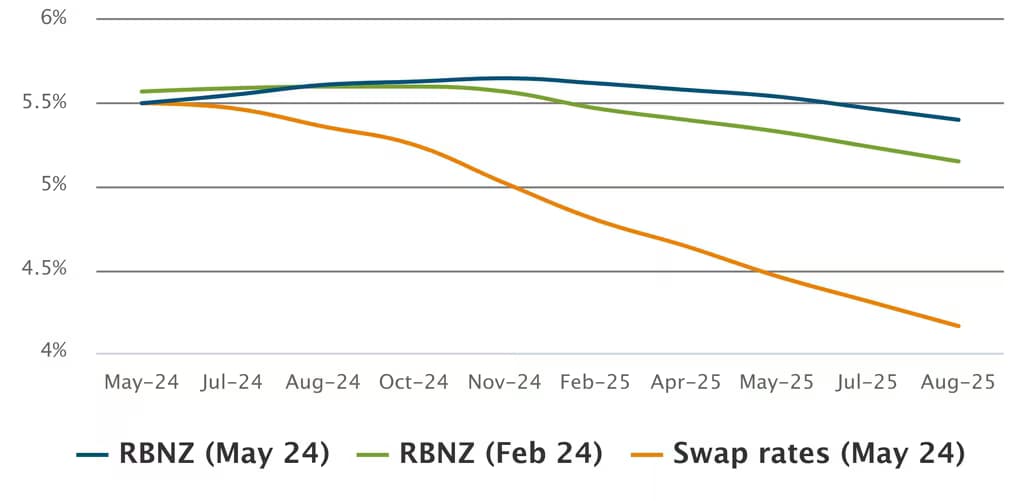
- Even so, the Bank’s forecasts for the OCR now peak at 5.65% in the December 2024 quarter. At face value, this forecast track implies that another interest rate rise is more likely than not before the end of this year.
- The timing of the first OCR cut in the Bank’s forecasts has also been pushed back from the June 2025 quarter to the September 2025 quarter. This delayed timing is at odds with private sector forecasts, with just three of 30 contributors to a recent Reuters poll expecting the rate cut to be as late as the June quarter next year.
Forget rate cuts, the Bank's thinking about tightening
OCR expectations
...and our reaction
- Following today’s statement, we are reconsidering our interest rate forecasts. We are likely to remove our expectation of a rate cut in November this year, with sticky domestic inflation and the Reserve Bank’s seeming inability to set monetary policy in a forward-looking manner meaning that rate cuts could be delayed until early 2025.
- The Reserve Bank’s worries about domestic inflation are no surprise, given that non-tradable inflation has only moderated from 6.8% to 5.8%pa over the last year. However, the Bank’s other heightened concerns are less expected, given they relate to more structural issues with the New Zealand economy.
- The Bank made the curious statement that monetary policy “may need to tighten and/or remain restrictive for longer if wage and price setters do not align with weaker productivity growth rates.” In essence, the Bank is worried that continued wage inflation might lead to more persistent consumer price inflation if people are simply getting pay increases because of cost-of-living pressures or because it’s what happens every year. In reality, few businesses are likely to explicitly consider productivity at a micro level when setting wages and salaries, so the fact that recent economy-wide productivity data was poor will be of little relevance to decision-makers in the human resources space.
- The Reserve Bank has revised down its future estimates of potential output by between 0.8% and 1.2% due to recent poor productivity data, which has also led to a 25-point increase in its estimate of the neutral OCR. The fact the Bank has made these revisions based on historical productivity data raises questions about the Bank’s ability to accurately estimate how fast the economy can grow without generating inflation, which makes it very difficult to set monetary conditions appropriately.
- The Bank still expects headline inflation to be under 3.0%pa by the end of this year, and the Bank’s forecasts imply it would have data showing inflation at 2.6%pa in June next year before it starts to cut interest rates in the September 2025 quarter. In our view, given the clear stresses the economy is currently coming under from high interest rates and rising unemployment, and that monetary policy is clearly constraining demand, such an extended wait to start cutting interest rates is far too long.
- Finally, we note that the Bank was forced to make today’s decision based on “officially available information on the Government’s fiscal intentions to date, which includes the most recent fiscal update and ‘mini budget’.” We believe the Bank would have been better served by delaying its meeting for two weeks to incorporate information from next week’s Budget, which will fully outline a significant change in fiscal settings from the last six years, and potentially have important implications for economic outcomes.
Latest updates
Premium

Monetary policy review
OCR up for first time in three years, as expected
Wed 8 Jul 2026
 2.5% Official cash rate from 2.25%
 Inflation now expected by the Bank to peak at 3.9%pa
 Further rate rises likely but uncertainty about the timing
Premium
Monetary policy review
Split decision keeps OCR at 2.25% for now
Wed 27 May 2026
2.25% Official cash rate unchangedCasting vote made by Governor with a 3-3 vote split among Committee membersRBNZ forecast OCR to reach 3% by end of 2026Monetary policy review
Reserve Bank holds at 2.25%, but watches vigilantly
Wed 8 Apr 2026
2.25% Official cash rate unchangedBank places more emphasis on potential inflationary risks4.2% Annual inflation forecast to accelerate by June this yearMonetary policy review
OCR on hold, but set to lift slightly quicker
Wed 18 Feb 2026
2.25% Official cash rate (OCR) unchangedDec-26 qtr First OCR rise now expected a quarter earlier than last MPS Sep or Oct Financial markets picking for the first increase