
Our take on the latest Monetary policy review (Wed 28 Feb 2024)



OCR stays at 5.50%
Inflation and OCR forecasts slightly lower for 2024
Inflation back within target band by September
The key numbers...
- The Reserve Bank met market expectations, keeping the official cash rate (OCR) at 5.50% at today’s review. It appeared to steer away from further rate hikes, stating that it “remains confident that the current level of the OCR is restricting demand.”
- Nevertheless, the Bank also said that the “OCR needs to remain at a restrictive level for a sustained period of time” to ensure that headline inflation returns to the 1-3%pa target band. This message is aimed to limit financial market speculation about interest rate cuts occurring anytime soon.
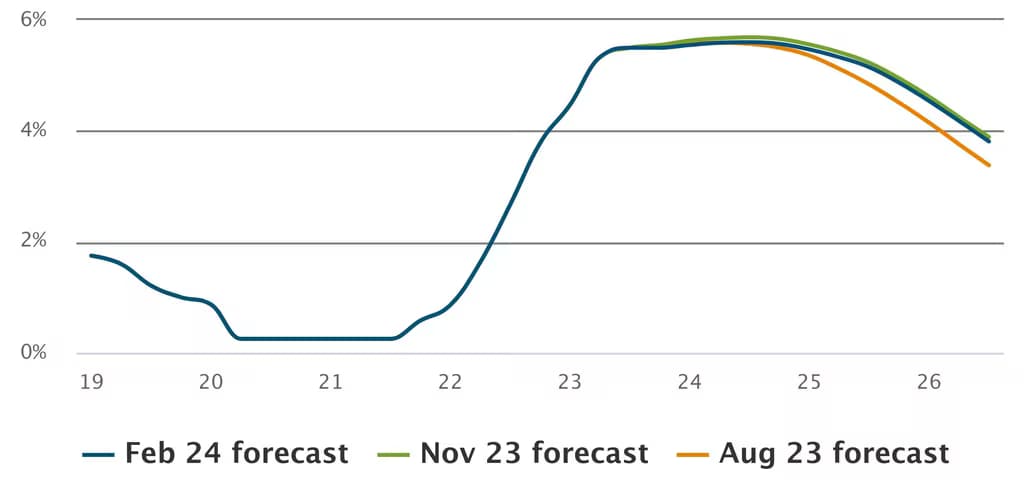
- The Bank’s OCR forecast track is slightly lower than in the November 2023 Monetary Policy Statement, peaking at 5.60% rather than 5.69% in the September 2024 quarter. The fact that the near-term track still lies above 5.5% indicates there is some risk that the OCR needs to be raised further, and the Bank stated that with inflation still outside the target band, it is “limiting the committee’s ability to tolerate upside inflation surprises.”
- The Bank’s inflation forecasts are lower throughout the next 6-9 months than in November. This revision partly reflects previous lower-than-expected inflation outcomes, as well as a slightly lower starting point for capacity pressures in the New Zealand economy.
Slightly less hawkish, but rate cuts will take time
Comparison of Reserve Bank OCR forecasts
...and our reaction
- Hawkish comments in a recent speech by Reserve Bank Chief Economist Paul Conway, combined with labour market data that was not as weak as expected, had seen financial markets speculating on the potential for further interest rate hikes by the Bank, possibly even at today’s review. However, the balanced tone of today’s statement suggests that the Bank was pushing against market positioning that had seen three rate cuts priced in before the end of this year, more than preparing the ground for another rate rise. In our view, that approach was a sensible and practical one that we completely agree with.
- Upside inflationary risks noted by the Bank include demand pressures associated with migration (although these pressures seem to be outweighed by the improved labour supply implications, at least at an economy-wide level), as well as geopolitical risks such as the attacks on shipping in the Red Sea. At this stage, these risks are counterbalanced by the softer global economy, reflecting weaker Chinese growth as well as continuing restrictive monetary conditions overseas.
- The Bank’s interpretation of recent labour market data is important. The Bank stated that with “high immigration and weaker demand growth, capacity constraints in the labour market have eased”, as well as noting “that variations in labour demand lag broader economic activity.” In other words, the Bank is comfortable enough with the labour market easing to date and expects to see more in coming quarters, further reducing cost pressures.
- The Bank’s OCR forecasts suggest that a rate cut could still be as far away a mid-2025, by which time headline inflation would have been around 2.5%pa for almost a year. Given our view that any OCR of above 4% is restrictive for the economy, we remain of the view that the Bank could start to gradually ease from August this year, although it will want to avoid signalling this possibility too far in advance. We acknowledge the risks to this forecast are for a later start to the easing cycle.
- We don’t see today’s Statement as dovish, but instead practical, in the sense that market pricing has been leaping at shadows recently. The Bank has worked hard to shut down overzealous market expectations of swift OCR cuts in 2024, and it won’t want to give any ability for the market to go back to predicting a rapid easing cycle. In our view, the Bank has managed that goal aptly, without needing to jawbone the market.
Latest updates
Premium

Monetary policy review
OCR up for first time in three years, as expected
Wed 8 Jul 2026
 2.5% Official cash rate from 2.25%Inflation now expected by the Bank to peak at 3.9%pa
 Further rate rises likely but uncertainty about the timing
Premium
Monetary policy review
Split decision keeps OCR at 2.25% for now
Wed 27 May 2026
2.25% Official cash rate unchangedCasting vote made by Governor with a 3-3 vote split among Committee membersRBNZ forecast OCR to reach 3% by end of 2026Monetary policy review
Reserve Bank holds at 2.25%, but watches vigilantly
Wed 8 Apr 2026
2.25% Official cash rate unchangedBank places more emphasis on potential inflationary risks4.2% Annual inflation forecast to accelerate by June this yearMonetary policy review
OCR on hold, but set to lift slightly quicker
Wed 18 Feb 2026
2.25% Official cash rate (OCR) unchangedDec-26 qtr First OCR rise now expected a quarter earlier than last MPS Sep or Oct Financial markets picking for the first increase