
Our take on the latest Monetary policy review (Wed 29 Nov 2023)



OCR stays at 5.5%
Demand pressures adding to inflation risks
Probability of another rate hike has increased
The key numbers...
- The Reserve Bank kept the official cash rate (OCR) at 5.5% at today’s review, as predicted, but the tone of its statement and accompanying forecasts was more hawkish than was expected. In particular, the Bank stated that “if inflationary pressures were to be stronger than anticipated, the OCR would likely need to increase further.”
- The Bank’s statement focused on demand across the New Zealand economy failing to ease as much as had been expected, with the prospect of record-high net migration maintaining demand pressures through into 2024 and keeping inflation higher for longer.
- The Bank is broadly comfortable about the labour market’s trajectory, given the improved labour supply thanks to the migration inflows. However, the Bank sees increased risks of more persistent inflation from higher rents, higher house prices boosting household spending, and possible construction cost increases given associated housing demand.
- The Bank’s forecasts show economic activity holding about a percentage point higher throughout the forecast period compared to its August forecast. Although some of this lift is driven by increased supply, with higher net migration increasing lifting New Zealand’s productive capacity, resilient economic momentum and higher demand means there will be less spare capacity going forward than previously hoped.
- Although inflation was below forecast in the September 2023 quarter, concerns about more persistent demand pressures have seen the Bank revise up its inflation forecasts in the second half of next year.
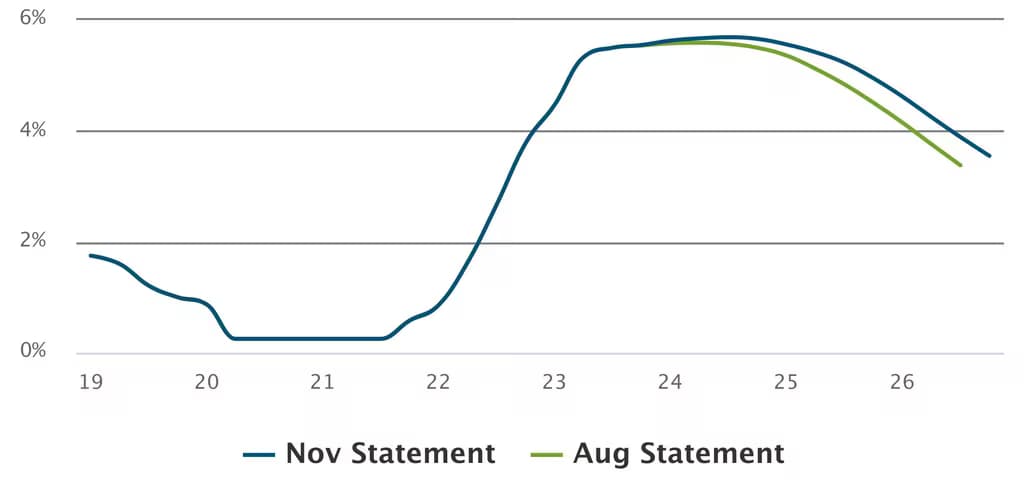
- Given the near-term demand pressures and inflationary risks, the Bank has also revised up its forecast peak in the official cash rate (OCR) to 5.69% in the September 2024 quarter. This change implies that the Bank now sees another rate hike as more likely than not. The timing for the OCR to be cut below 5.5% has also been pushed out from early 2025 to the middle of that year.
OCR should stay higher for longer
Reserve Bank official cash rate forecasts, quarterly average
...and our reaction
- Today’s statement represents another significant change of tone from the Bank’s previous statement in early October, which seemed to be shying away from further interest rate increases. This statement puts financial markets on notice over summer, and persistent strength in demand between now and the next review on 28 February could lead to a rate hike in early 2024.
- In part, the statement is probably designed to push back against financial markets’ dovish expectations, which had been pricing in cuts to the OCR from mid-2024. Given the strength of some domestic indicators, the Reserve Bank will want to limit stimulation to the economy from declining wholesale rates feeding through into lower mortgage rates.
- The Bank’s forecast easing in net working-age migration from 101,000pa in September 2023 to 51,400pa by the end of 2024 is less sharp than our forecast slowdown. However, we note the Bank’s relatively subdued house price forecast, with growth peaking at 5.5%pa in mid-2024, as well as a 1.4% fall in private consumption spending in the second half of 2023. Stronger outcomes for these variables could be the catalyst for another lift in the OCR early in 2024.
- We also note the Bank’s concern about the stickiness of inflation expectations, and the fact that the weaker inflation result in the September quarter was driven by tradable inflation, which the Bank said “can be volatile and cannot be relied upon to achieve [the] inflation target.”
- At this stage, our view is that the Bank is “jawboning” markets and is trying to ensure that interest rate cuts are not priced in by the market prematurely. We are sticking to our forecast that the OCR is at its peak of 5.5%, but the possibility of another rate hike or two in 2024 is a much more “live” option than the Bank implied in October.
Latest updates
Premium

Monetary policy review
OCR up for first time in three years, as expected
Wed 8 Jul 2026
2.5% Official cash rate from 2.25% Inflation now expected by the Bank to peak at 3.9%pa
 Further rate rises likely but uncertainty about the timing
Premium
Monetary policy review
Split decision keeps OCR at 2.25% for now
Wed 27 May 2026
2.25% Official cash rate unchangedCasting vote made by Governor with a 3-3 vote split among Committee membersRBNZ forecast OCR to reach 3% by end of 2026Monetary policy review
Reserve Bank holds at 2.25%, but watches vigilantly
Wed 8 Apr 2026
2.25% Official cash rate unchangedBank places more emphasis on potential inflationary risks4.2% Annual inflation forecast to accelerate by June this yearMonetary policy review
OCR on hold, but set to lift slightly quicker
Wed 18 Feb 2026
2.25% Official cash rate (OCR) unchangedDec-26 qtr First OCR rise now expected a quarter earlier than last MPS Sep or Oct Financial markets picking for the first increase