
Our take on the latest Monetary policy review (Wed 4 Oct 2023)



OCR stays at 5.5%
Positive near-term risks set against negative medium-term risks
But Bank says rates could remain higher for longer
The key numbers...
- The Reserve Bank kept the official cash rate at 5.5% at today’s review, noting “that the risks to the outlook remain similar to those discussed in the August MPS” (Monetary Policy Statement).
- The risks outlined by the Bank were divided into near-term and medium-term risks. In the near-term the Bank outlined the demand effects of high migration on growth, the potential for more resilient domestic demand, upside risks to how quickly wage inflation eases, and the effects of higher global oil prices on costs.
- In contrast to these near-term upside risks, the Bank’s discussion of medium-term risks was concentrated on the downside. The Bank discussed the effects of a sharper slowdown in international growth on global inflation and import prices, and it also emphasised the risks around the sluggish Chinese economy and its effect on commodity prices and export revenue.
- Notwithstanding these risks, the Bank stated that “interest rates may need to remain at a restrictive level for a more sustained period of time”. This language is stronger than the wording used in August (“for some time” and “for the foreseeable future”), when the Bank was already preparing the ground for interest rates to stay higher for longer.
- The Bank showed few concerns about the signs of life in the housing market, stating that “house prices were slightly higher, but… on low sales volumes” and that “prices remain around estimates of sustainable levels.”
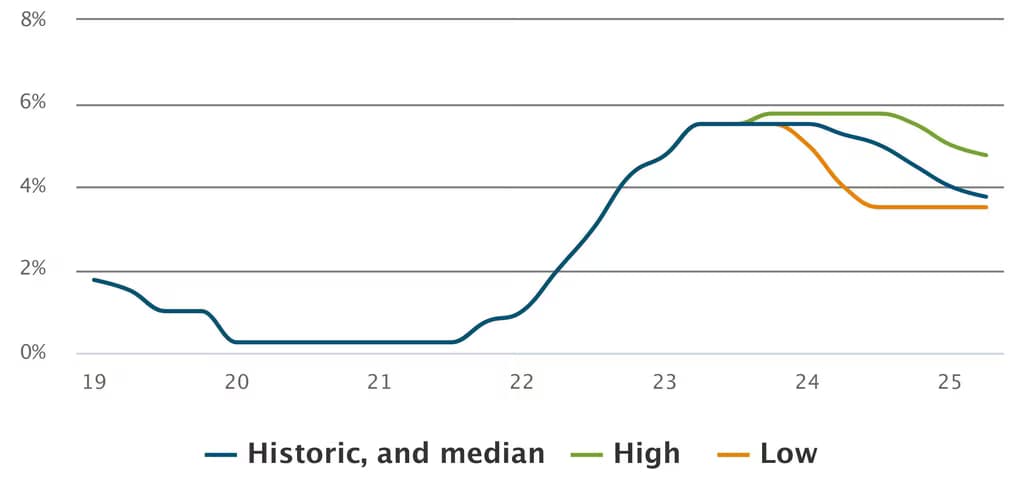
Official cash rate
Financial market expectations, end of quarter
...and our reaction
- There is little indication from the Reserve Bank that it is edging closer to an interest rate hike before the end of the year, as some forecasters have been anticipating. The Bank downplayed the stronger-than-expected June quarter GDP result, and it implied it will not be overly concerned if headline inflation picks up in the near term due to higher oil prices.
- The Bank also emphasised signs of easing capacity pressures across various surveys, including yesterday’s Quarterly Survey of Business Opinion released by NZIER. The Quarterly Survey of Business Opinion has shown a significant reduction in the difficulty of finding labour, which is now at its easiest since 2010-2012 (excluding lockdown-affected results in 2020).
- At this stage, it appears that the Bank is preparing to navigate a middle course for interest rates between the near-term upside risks and the medium-term downside risks. But we see some inconsistency in the Bank’s dogged belief that inflation will return to within the 1-3%pa target band in the second half of next year against the assertion that interest rates might stay higher for longer. We expect that an extended period of high interest rates would imply that inflation takes a longer time to return to the target band.
- The Bank’s August forecasts showed the official cash rate not being cut until early 2025, which would mean inflation was already at target before the Bank started to ease monetary settings. Possible further delays to expected rate cuts suggest that monetary policy might not be working as effectively as the Bank hopes, but it is hesitant to lift rates further now for fear of overtightening.
- Signs of resilience in the domestic economy, along with cost pressures associated with higher oil prices, had been pushing our expectations for the official cash rate towards further possible rate rises within the next six months. However, today’s hesitancy from the Bank suggests that, if further tightening is a close call, it might err on the conservative “no change” side.
Latest updates
Premium

Monetary policy review
OCR up for first time in three years, as expected
Wed 8 Jul 2026
 2.5% Official cash rate from 2.25%
 Inflation now expected by the Bank to peak at 3.9%paFurther rate rises likely but uncertainty about the timing
Premium
Monetary policy review
Split decision keeps OCR at 2.25% for now
Wed 27 May 2026
2.25% Official cash rate unchangedCasting vote made by Governor with a 3-3 vote split among Committee membersRBNZ forecast OCR to reach 3% by end of 2026Monetary policy review
Reserve Bank holds at 2.25%, but watches vigilantly
Wed 8 Apr 2026
2.25% Official cash rate unchangedBank places more emphasis on potential inflationary risks4.2% Annual inflation forecast to accelerate by June this yearMonetary policy review
OCR on hold, but set to lift slightly quicker
Wed 18 Feb 2026
2.25% Official cash rate (OCR) unchangedDec-26 qtr First OCR rise now expected a quarter earlier than last MPS Sep or Oct Financial markets picking for the first increase