
Our take on the latest Monetary policy review (Wed 12 Jul 2023)



OCR on hold at 5.50%
Questions raised about sustained high core inflation internationally
Restrictive OCR to remain, talk of cuts premature
The key numbers...
- For the first time since August 2021, the Reserve Bank kept the official cash rate (OCR) unchanged, at 5.50%, in line with all expectations.
- The Bank also made it clear that “the OCR will need to remain at a restrictive level for the foreseeable future”.
- The Monetary Policy Committee’s statement noted that its efforts to raise interest rates to limit spending and put downward pressure on inflation were working “as anticipated and required”, with household spending, residential construction activity, and the housing market all declining in recent times.
- Rising term deposit rates are also “broadening the transmission of tighter monetary policy”, meaning that the Bank thinks it is getting great cut-through on influencing spending and saving decisions.
- According to the Bank, “house prices have returned to more sustainable levels.”
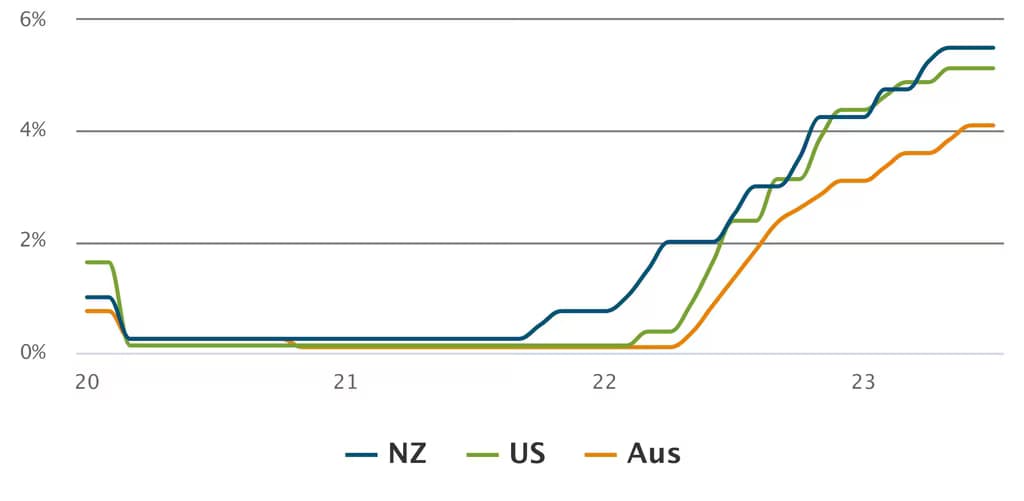
- International trends provided some concern to the Reserve Bank, with the statement noting that “globally, core inflation remains high. This has prompted some central banks to further increase interest rates recently”, although the Bank also noted that New Zealand monetary policy settings were tightened earlier and faster than in most other parts of the globe.
RBNZ leading the pack
Central bank policy rates
...and our reaction
- The Reserve Bank did exactly as expected with today’s Monetary Policy Review – it is sitting back and watching its earlier moves play out across the economy. That move was exactly the right one for now.
- Most importantly, today’s review makes it clear that any talk of interest rate cuts remains extremely premature. The Bank was at pains to highlight that not only is the OCR on hold, but that hold is in both directions. Interest rates are set to remain high for longer to ensure that inflation actually does moderate as expected.
- Following May’s Monetary Policy Statement, the Bank made it clear that it would be a “high bar” (according to Deputy Governor Christian Hawkesby) to resume OCR increases. There has been no evidence since the Bank’s last review to suggest any bar, let alone a high one, had been met.
- We expect that the current OCR of 5.50% will be the peak rate this cycle. In our view, if further increases to the OCR are considered, there won’t be enough evidence to back up a move higher until at least November 2023.
- Although the Bank underscored that trends in inflation and inflation expectations are moderating, and that economic outcomes are broadly in line with its forecasts, there seems to have been less emphasis or discussion around the labour market today. That area of the economy is still running hot, but as the Bank did comment on, “signs of labour market pressures dissipating and vacancies declining.”
- The Bank raises an interesting point around the risk of more persistent global core inflation, which reinforces concerns we have heard internationally in recent weeks. Inflation overseas might well retreat from higher levels, but will it get back in the box as quickly? Global inflation does present a risk to the inflationary outlook, but not enough to sound alarm bells yet.
- Outside of the OCR announcement today, retail mortgage rates have been rising in recent weeks without further OCR raises. This shift has been driven by higher wholesale swap rates, with international borrowing rates increasing due to concerns about global inflationary pressures. These global movements are reinforcing the Reserve Bank’s efforts to dampen demand in the New Zealand economy.
Latest updates
Premium

Monetary policy review
OCR up for first time in three years, as expected
Wed 8 Jul 2026
 2.5% Official cash rate from 2.25%
 Inflation now expected by the Bank to peak at 3.9%paFurther rate rises likely but uncertainty about the timing
Premium
Monetary policy review
Split decision keeps OCR at 2.25% for now
Wed 27 May 2026
2.25% Official cash rate unchangedCasting vote made by Governor with a 3-3 vote split among Committee membersRBNZ forecast OCR to reach 3% by end of 2026Monetary policy review
Reserve Bank holds at 2.25%, but watches vigilantly
Wed 8 Apr 2026
2.25% Official cash rate unchangedBank places more emphasis on potential inflationary risks4.2% Annual inflation forecast to accelerate by June this yearMonetary policy review
OCR on hold, but set to lift slightly quicker
Wed 18 Feb 2026
2.25% Official cash rate (OCR) unchangedDec-26 qtr First OCR rise now expected a quarter earlier than last MPS Sep or Oct Financial markets picking for the first increase