
Our take on the latest Monetary policy review (Wed 5 Oct 2022)



OCR up by 50 basis points to 3.5%
NZ dollar up half a cent against the US dollar
Bank ignores shaky global outlook
The key numbers...
- The Reserve Bank has lifted the official cash rate (OCR) by another 50 basis points to 3.5%, as expected.
- The Bank’s statement emphasised the range of factors that are fuelling inflationary pressures, leaving no doubt that further interest rate rises will occur at upcoming reviews.
- Key messages from the Bank included “global consumer price pressures remain heightened”, “New Zealand’s productive capacity is still being constrained by labour shortages and wage pressures are heightened”, and “a range of indicators [continue] to highlight broad-based pricing pressures.”
- Glaringly absent from the Bank’s statement was any mention of the downside risks to New Zealand’s growth posed by the deteriorating global economic outlook. International economic developments were briefly mentioned in the meeting summary notes, but the Bank appears to be largely unconcerned by the softening outlook because much of it is due to a necessary tightening in global financial conditions.
- The Committee debated whether to increase the OCR by 50 or 75 basis points at this meeting, but a 50-point increase was agreed on because the effects of previous policy tightening have yet to be fully seen in New Zealand’s economic outcomes.
Outlook of persistent inflation keeps Reserve Bank hiking
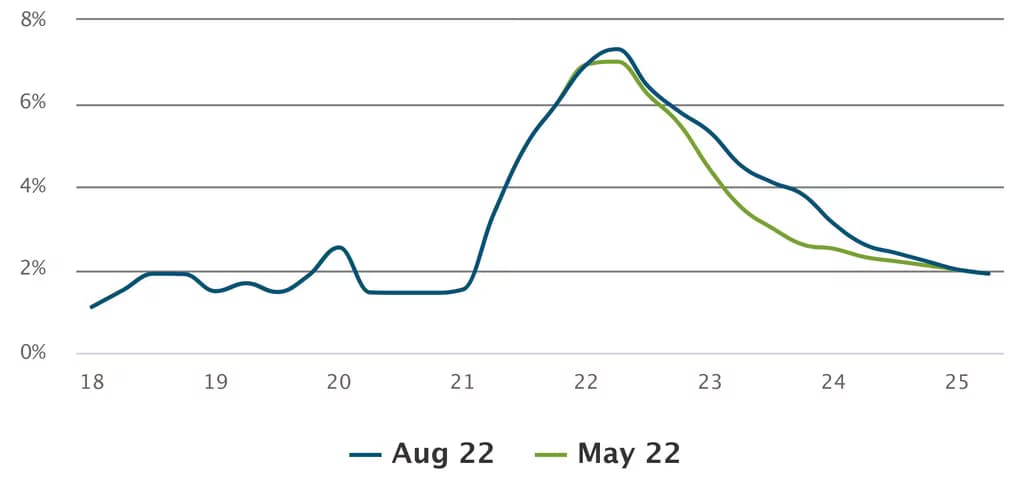
RBNZ inflation forecast comparison, annual rates
...and our reaction
- Given the deterioration in sentiment around the global economy, alongside the increasing risks being posed by the Russian invasion of Ukraine, there had been speculation that the Reserve Bank could adopt a less hawkish tone in today’s statement. Instead, the Bank has leant the other way and pointed towards the need for continued interest rate rises to get inflation back under control.
- The Bank’s attention on core, rather than headline, inflation, indicates that it will not be swayed by the CPI result in two weeks’ time, which is likely to show that headline inflation has peaked and is back below 7%pa.
- There was some concern noted by the Bank that persistent inflation could flow through into higher ongoing wage pressures. As a result, the Bank will need to see a clear softening in the labour market before it starts to relax, but we expect those signs might not appear until well into 2023.
- We still expect another 50-point increase in the OCR to 4% at the next review on 23 November. Further increases in early 2023 will take the OCR to 4.5%, which remains our forecast peak. The risks of additional rate rises will depend on a clear slowdown in economic growth (particularly domestic activity), a reduction in core inflation measures, and evidence that tightness in the labour market is starting to become less critical.
- As we get closer to the peak of the cycle, the Bank faces an increasingly challenging job to assess how much tightening is enough, and how its current decisions will have affected the economy in 12 months’ time. The Bank was too slow to react and start raising interest rates in late 2021 and early 2022. The heavy emphasis in today’s statement on current indicators, rather than looking forward, highlights the risk that the Bank continues tightening monetary policy for longer than necessary next year and causes a deeper downturn for the economy.
Latest updates
Premium

Monetary policy review
OCR up for first time in three years, as expected
Wed 8 Jul 2026
2.5% Official cash rate from 2.25% Inflation now expected by the Bank to peak at 3.9%pa
 Further rate rises likely but uncertainty about the timing
Premium
Monetary policy review
Split decision keeps OCR at 2.25% for now
Wed 27 May 2026
 2.25% Official cash rate unchangedCasting vote made by Governor with a 3-3 vote split among Committee membersRBNZ forecast OCR to reach 3% by end of 2026
Monetary policy review
Reserve Bank holds at 2.25%, but watches vigilantly
Wed 8 Apr 2026
2.25% Official cash rate unchangedBank places more emphasis on potential inflationary risks4.2% Annual inflation forecast to accelerate by June this yearMonetary policy review
OCR on hold, but set to lift slightly quicker
Wed 18 Feb 2026
2.25% Official cash rate (OCR) unchangedDec-26 qtr First OCR rise now expected a quarter earlier than last MPSSep or Oct Financial markets picking for the first increase