
Our take on the latest Monetary policy review (Wed 14 Jul 2021)


Reserve Bank plays down labour market tightness
Looming inflation spike viewed as one-off or temporary
LSAP bond purchases to finish next week
The key numbers...
- The Reserve Bank will halt its Large Scale Asset Purchases (LSAP) government bond-buying programme after next week, stating that “market conditions and functioning have improved substantially” and that “monetary stimulus could now be reduced to minimise the risk” of inflation or employment overshooting its target.
- However, the Bank remains convinced that the expected spike in inflation in the June and September quarters will simply reflect one-off factors such as high oil prices or temporary factors such as supply shortfalls and higher transport costs.
- Although the Bank noted “robust” economic data, it chose to emphasise factors that might dampen medium-term inflation, including “reported underutilisation of labour, modest wage growth, and well anchored inflation expectations.”
- The Bank reiterated its view that the official cash rate remains its preferred tool for future responses to changes in economic conditions, despite today’s decision to end LSAP conflicting with similar statements it has previously made.
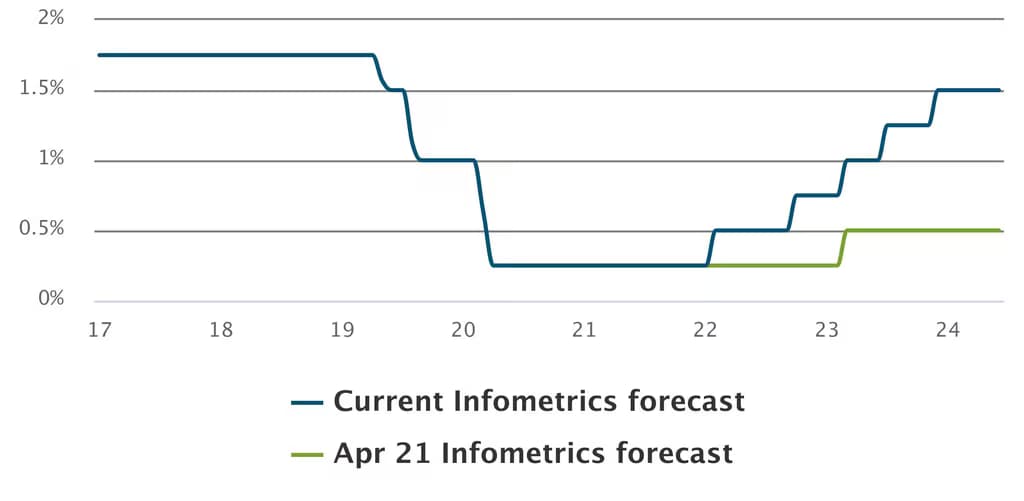
Official cash rate
Infometrics forecasts
...and our reaction
- The Reserve Bank has hosed down views of a pressing need to tighten monetary policy and lift interest rates as quickly as many were expecting.
- The Bank has largely glossed over the March quarter GDP result (which was 2.2 percentage points higher than the Bank had forecast), continued strength in spending data, and exceptionally tight labour market and pricing results from the NZIER’s latest Quarterly Survey of Business Opinion.
- Economic data over the last seven weeks has been exceptionally strong and, in our view, the Bank is being overly sanguine about the economy’s demand and supply imbalance. The strength in economic data also shows no signs of slowing any time soon.
- The chances of a lift in the official cash rate next month, as posited by some economists, are close to zero given today’s statement. Indeed, given the Committee’s dogged view of inflation over the next couple of quarters being temporary, it is hard to see what might sway it towards a rate rise even by November.
- Inflationary pressures are at their most intense in more than a decade, and the Bank is running a significant risk of having to hike interest rates more sharply the longer it errs on the side of overstimulating the economy – an outcome that is arguably now already happening.
- The Bank’s decision to stop Large Scale Asset Purchases appears to be a convenient shift towards slightly tighter monetary conditions, given the programme was running close to its mandated ceiling of 60% of government debt.
- The programme will wind up with about $53.5b of central government bonds and $1.8b of local government bonds. New Zealand’s better economic performance has meant that government debt has not increased as much as had been expected early in the pandemic, meaning that the nominated purchase limit of $100b could not be achieved in reality.
Latest updates
Premium

Monetary policy review
OCR up for first time in three years, as expected
Wed 8 Jul 2026
2.5% Official cash rate from 2.25% Inflation now expected by the Bank to peak at 3.9%pa
 Further rate rises likely but uncertainty about the timing
Premium
Monetary policy review
Split decision keeps OCR at 2.25% for now
Wed 27 May 2026
 2.25% Official cash rate unchangedCasting vote made by Governor with a 3-3 vote split among Committee membersRBNZ forecast OCR to reach 3% by end of 2026
Monetary policy review
Reserve Bank holds at 2.25%, but watches vigilantly
Wed 8 Apr 2026
2.25% Official cash rate unchangedBank places more emphasis on potential inflationary risks4.2% Annual inflation forecast to accelerate by June this yearMonetary policy review
OCR on hold, but set to lift slightly quicker
Wed 18 Feb 2026
2.25% Official cash rate (OCR) unchangedDec-26 qtr First OCR rise now expected a quarter earlier than last MPS Sep or Oct Financial markets picking for the first increase