
Our take on the latest Monetary policy review (Wed 26 May 2021)



Monetary settings left unchanged
Current inflationary pressures expected to be temporary
Bank agrees with Treasury that house prices will stall this year
The key numbers...
- The Reserve Bank has stuck to its view that it will maintain stimulatory monetary settings until inflation and employment are sustained at higher levels, and that “meeting these requirements will take considerable time and patience.”
- The Bank expects inflation to spike to 2.6%pa this year due to a range of international and domestic factors, which it has judged to be temporary. Inflation is forecast to be back at 1.5%pa by mid-2022.
- The Bank is pinning this outlook on inflation expectations that remain anchored near 2.0%pa. However, we note there has been an increase of 30-40 basis points in inflation expectations for short-term since February’s Monetary Policy Statement, suggesting there are now more inflation risks than previously.
- The Bank is forecasting a sudden halt in house prices from mid-2021, with quarterly rises of no more than 0.2% from September 2021 to September 2022 inclusive. Annual house price growth is predicted to slow from 28.5%pa in June this year to just 0.4%pa by June 2022.
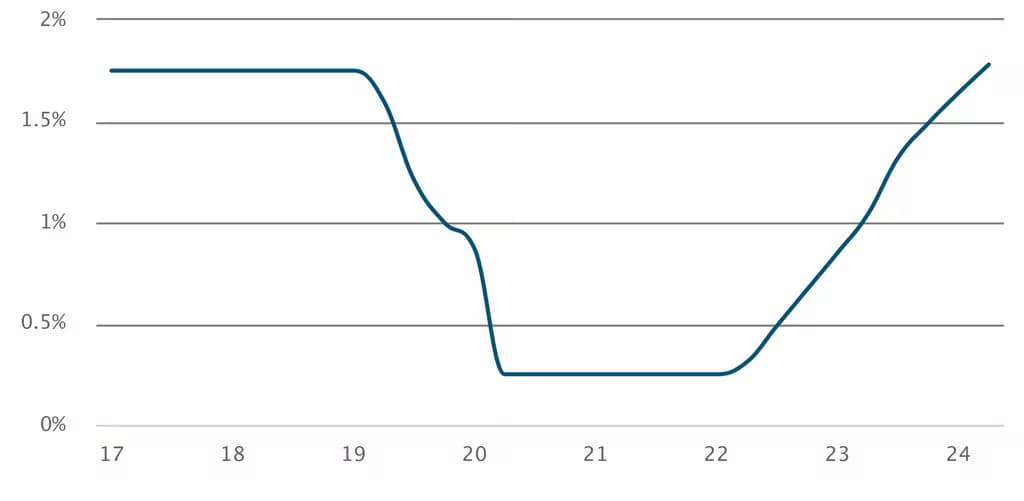
- The New Zealand dollar has jumped 0.6c against the US dollar following the Statement. Financial markets appear to have focused on the Bank’s removal of the sentence stating that the “Committee agreed that it was prepared to lower the OCR [official cash rate] if required”, as well as forecasts of the OCR showing it starting to increase by September 2022.
Official cash rate
Reserve Bank of NZ forecasts
...and our reaction
- The Reserve Bank is performing a balancing act between acknowledging near-term inflationary pressures but avoiding getting financial markets overexcited about the possibility of interest rate rises in the near future.
- The Reserve Bank has made no indication that either its Large Scale Asset Purchases or the Funding for Lending Programme will be scaled back sooner than previously stated. This signal implies a stable OCR while both programmes remain in place until mid-2022. However, the Committee also stated that “the OCR is the preferred tool to respond to future economic developments in either direction”, suggesting that OCR rises are possible even while other stimulatory measures are being pursued.
- The Bank has rightly assessed that the risks associated with some of the more extreme negative health scenarios are waning as vaccination occurs internationally. However, the Bank continues to pursue a policy of “least regrets”, preferring to err on the side of overstimulating the economy given the ongoing uncertainties and unevenness of economic activity.
- Our expectation is that the OCR will start to be increased from late 2022 or early 2023. We see risks of an earlier rise if near-term supply issues flow through into a more sustained lift in inflation, or if the labour market continues to outperform expectations and generate greater wage cost pressures. However, at this stage, the Bank’s forecast of an OCR of 1.75% by mid-2024 seems a bit high.
Latest updates
Premium

Monetary policy review
OCR up for first time in three years, as expected
Wed 8 Jul 2026
 2.5% Official cash rate from 2.25%Inflation now expected by the Bank to peak at 3.9%pa
 Further rate rises likely but uncertainty about the timing
Premium
Monetary policy review
Split decision keeps OCR at 2.25% for now
Wed 27 May 2026
2.25% Official cash rate unchangedCasting vote made by Governor with a 3-3 vote split among Committee membersRBNZ forecast OCR to reach 3% by end of 2026Monetary policy review
Reserve Bank holds at 2.25%, but watches vigilantly
Wed 8 Apr 2026
2.25% Official cash rate unchangedBank places more emphasis on potential inflationary risks4.2% Annual inflation forecast to accelerate by June this yearMonetary policy review
OCR on hold, but set to lift slightly quicker
Wed 18 Feb 2026
2.25% Official cash rate (OCR) unchangedDec-26 qtr First OCR rise now expected a quarter earlier than last MPS Sep or Oct Financial markets picking for the first increase