
Our take on the latest Monetary policy review (Wed 13 May 2020)


Large Scale Asset Purchases double in size
Negative official cash rate possible
Long-term government bond yields will be pushed lower
The key numbers...
- In its latest Monetary Policy Statement (MPS), the Reserve Bank announced it will increase the size and scope of its Large Scale Asset Purchases (LSAP) to $60b (from $33b) and will now include inflation-indexed government bonds in the programme.
- The Bank believes both the domestic and global economic conditions have worsened since it last met in March, with COVID-19 containment measures severely limiting activity. The Bank expects inflation to be below 1%pa until mid-2022, with the unemployment rate peaking at 9.0% later this year.
- The Bank stated it would prefer to take the approach of ”least regret”. In the current climate, this approach means the Bank thinks the negative effects of excessively stimulatory policy will be less harmful to the economy than the possible effects of insufficient action.
- The Bank provided mixed messages on the official cash rate (OCR), reaffirming its previous forward guidance “that the OCR will remain at 0.25 percent until early 2021” due to financial institutions not being operationally ready for a negative OCR, but also stating that reducing the OCR further is an additional tool it is prepared to use “if and when needed”..
- Other monetary policy tools that the Bank noted are at its disposal included adding other types of assets to the LSAP programme and providing fixed term loans to banks.
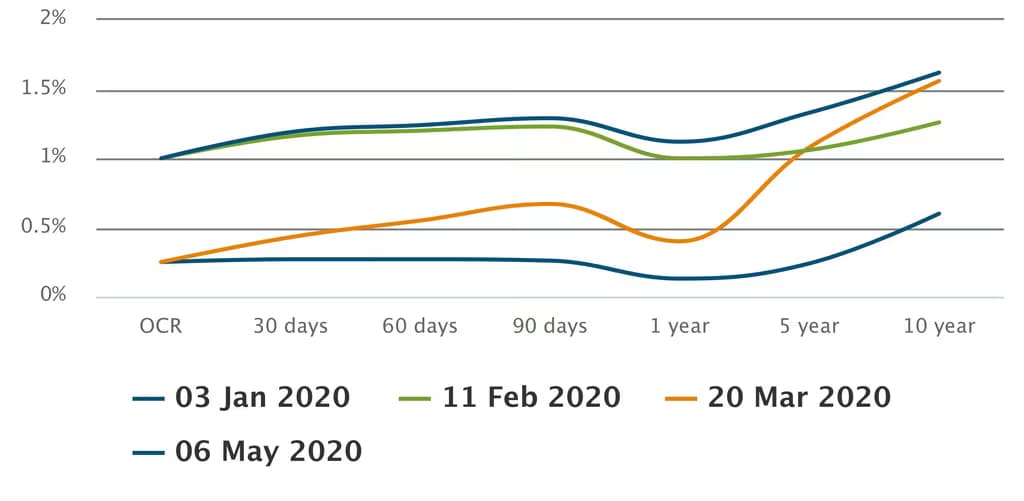
Wholesale interest rate comparison
Source: RBNZ
...and our reaction
- In current conditions, the Bank believes the LSAP is the most suitable monetary policy tool to stimulate the economy. By including inflation-indexed bonds, market function and policy efficacy should be improved.
- The interest-rate expectations implied by long-term government bond yields are now sitting significantly lower than previously, with yields on April 2037 bonds having dropped about 130 basis points since LSAP was introduced.
- The Bank believes it cannot fully stimulate the economic recovery itself, stating that fiscal policy is more suited to spark the economy back to life. Current monetary policy settings are aimed to help support fiscal policy as much as possible.
- The initial LSAP was successful in lowering long term government bond yields and improving liquidity in financial markets, but we have only seen a small amount of partial pass-through to retail interest rates. Declines in retail rates will remain limited while economic uncertainty and high bank funding costs persist.
Latest updates
Premium

Monetary policy review
OCR up for first time in three years, as expected
Wed 8 Jul 2026
 2.5% Official cash rate from 2.25%
 Inflation now expected by the Bank to peak at 3.9%paFurther rate rises likely but uncertainty about the timing
Premium
Monetary policy review
Split decision keeps OCR at 2.25% for now
Wed 27 May 2026
 2.25% Official cash rate unchangedCasting vote made by Governor with a 3-3 vote split among Committee membersRBNZ forecast OCR to reach 3% by end of 2026
Monetary policy review
Reserve Bank holds at 2.25%, but watches vigilantly
Wed 8 Apr 2026
2.25% Official cash rate unchangedBank places more emphasis on potential inflationary risks4.2% Annual inflation forecast to accelerate by June this yearMonetary policy review
OCR on hold, but set to lift slightly quicker
Wed 18 Feb 2026
2.25% Official cash rate (OCR) unchangedDec-26 qtr First OCR rise now expected a quarter earlier than last MPS Sep or Oct Financial markets picking for the first increase