
Our take on the latest Monetary policy review (Wed 13 Nov 2019)



OCR held at 1.00%
Further cut signalled if needed
Growing pressure on Government to act
The key numbers...
- The Reserve Bank held its nerve with the last official cash rate (OCR) review of 2019, keeping it at 1.0% in November – against expectations of a cut.
- A clear signal for further cuts was made that if economic conditions persist or get worse that “[The Bank] will add further monetary stimulus if needed” and that they are “prepared to act as required”.
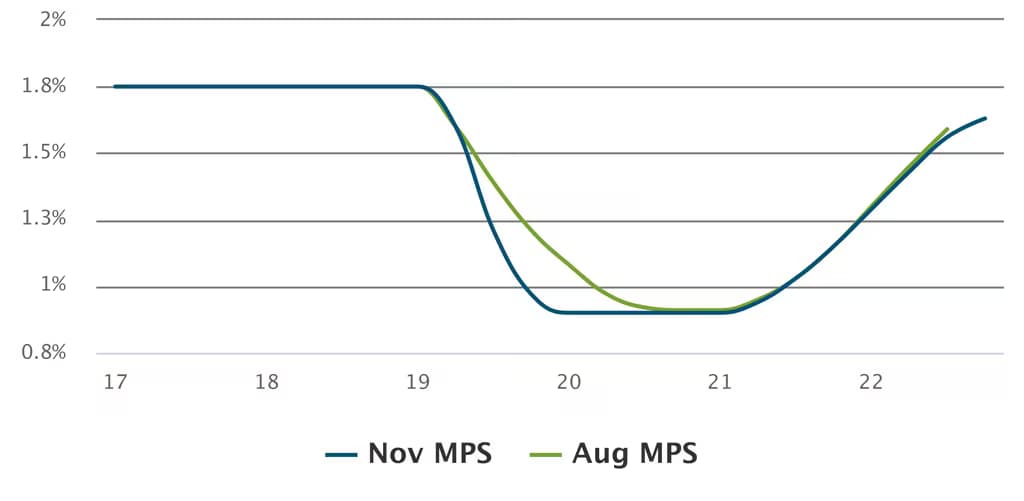
- It seems that the Bank is waiting, or more likely hoping, for August’s 50 basis point to fully take hold and stimulate the economy, noting that “it would take time to have its full effect.”
- The Bank expects a pick-up in domestically-driven activity in 2020 due to lower interest rates (via the August cut), higher wage growth, and government spending.
- Although global growth expectations have weakened further, domestic indicators like non-tradable inflation and a lower exchange rate count against a cut.
Official Cash Rate
Quarterly averages
...and our reaction
- Against expectations, the Reserve Bank appears to have changed from an aggressive stance on monetary policy, to wanting to wait and see what the effect of the August surprise will bring.
- Expectations for fiscal assistance are now locked in with the Bank anticipating “a lift in economic growth during 2020 from… stronger fiscal stimulus”, and that “fiscal stimulus could be greater than assumed.” These statements will increase pressure on the government to meet increased spending expectations.
- With the next OCR review scheduled for February 2020, the Reserve Bank will now watch domestic and global developments with intertest over the summer. Any deterioration in global or domestic expectations would lay the foundations fur a cut at this point.
- We expect the OCR will be cut to 0.50% by mid-2020, based on weaker global activity, subdued investment, below-target inflation, and slower-than-expected fiscal stimulus.
Latest updates
Premium

Monetary policy review
OCR up for first time in three years, as expected
Wed 8 Jul 2026
 2.5% Official cash rate from 2.25%
 Inflation now expected by the Bank to peak at 3.9%pa
 Further rate rises likely but uncertainty about the timing
Premium
Monetary policy review
Split decision keeps OCR at 2.25% for now
Wed 27 May 2026
2.25% Official cash rate unchangedCasting vote made by Governor with a 3-3 vote split among Committee membersRBNZ forecast OCR to reach 3% by end of 2026Monetary policy review
Reserve Bank holds at 2.25%, but watches vigilantly
Wed 8 Apr 2026
2.25% Official cash rate unchangedBank places more emphasis on potential inflationary risks4.2% Annual inflation forecast to accelerate by June this yearMonetary policy review
OCR on hold, but set to lift slightly quicker
Wed 18 Feb 2026
2.25% Official cash rate (OCR) unchangedDec-26 qtr First OCR rise now expected a quarter earlier than last MPS Sep or Oct Financial markets picking for the first increase