
Our take on the latest Monetary policy review (Wed 27 Mar 2019)



OCR unchanged at 1.75%
Expectation for the next move to be a cut
Change in stance signals more urgency
The key numbers...
- The Reserve Bank took a more decisive stance, making it clear to the market that conditions are soft enough that the expected next move is a cut, although the timing is still unclear. For a cut to be effective, it would need to occur sooner than later.
- We have commented before that, absent any external shocks to the economy, there is likely to be a lack of pass-through in interest rates and a limited stimulatory effect on investment. A cut now would also squander New Zealand’s capabilities to respond to a future economic shock. This view remains.
- Given the time taken for a lower OCR to affect investment decisions, it almost appears that this decision to signal a cut as the next move is too little too late, given business investment has been soft for the past year.
- However, the signal of a potential cut could also just be convenient timing given the Reserve Bank’s proposal to increase banks’ capital requirements, which will increase borrowing costs. A cut in the OCR in future could mitigate the effect of the increased capital requirements.
- We had recently shifted out our expectation of the first lift in the official cash rate to August 2020, given softening economic growth and benign inflation. Given today’s signal by the Reserve Bank, a rate cut in May now appears likely, although there is likely to be little effect on retail interest rates.
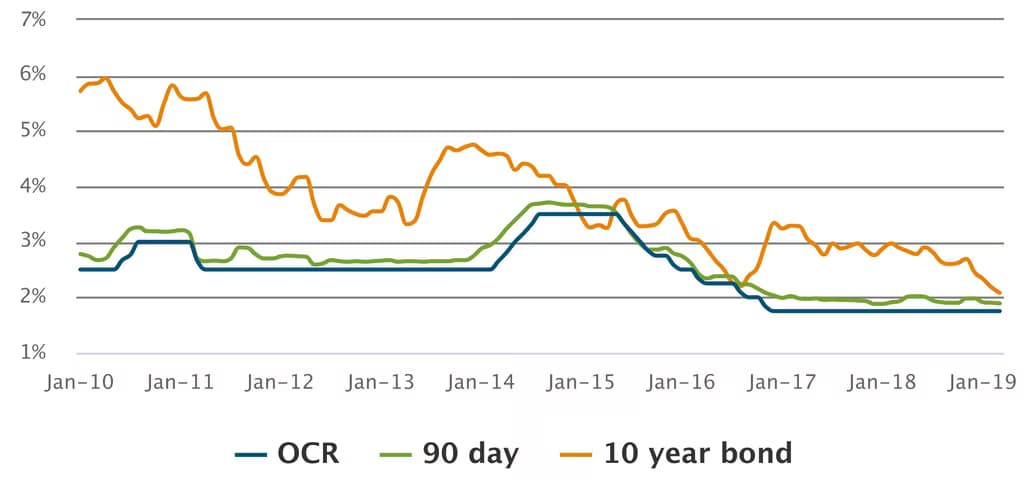
Interest rates
Monthly averages
...and our reaction
- The official cash rate remained unchanged, at 1.75%, at today’s Official Cash Rate review, the final review before the Monetary Policy Committee comes into operation.
- Reserve Bank Governor Adrian Orr made it explicit that the “more likely direction of our next OCR move is down” due to concerns around the global economic outlook and weaker domestic data.
- The Reserve Bank view is that the “balance of risks” to its inflation expectations has “shifted to the downside” as global concerns have intensified, and business sentiment remains low.
Latest updates
Premium

Monetary policy review
OCR up for first time in three years, as expected
Wed 8 Jul 2026
 2.5% Official cash rate from 2.25%
 Inflation now expected by the Bank to peak at 3.9%pa
 Further rate rises likely but uncertainty about the timing
Premium
Monetary policy review
Split decision keeps OCR at 2.25% for now
Wed 27 May 2026
2.25% Official cash rate unchangedCasting vote made by Governor with a 3-3 vote split among Committee membersRBNZ forecast OCR to reach 3% by end of 2026Monetary policy review
Reserve Bank holds at 2.25%, but watches vigilantly
Wed 8 Apr 2026
2.25% Official cash rate unchangedBank places more emphasis on potential inflationary risks4.2% Annual inflation forecast to accelerate by June this yearMonetary policy review
OCR on hold, but set to lift slightly quicker
Wed 18 Feb 2026
2.25% Official cash rate (OCR) unchangedDec-26 qtr First OCR rise now expected a quarter earlier than last MPS Sep or Oct Financial markets picking for the first increase