Consumers price index
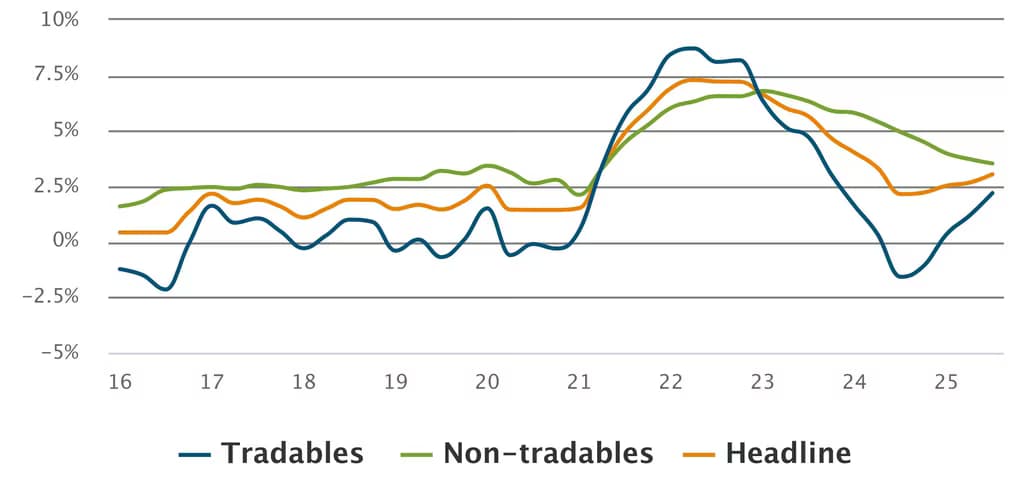
Inflation rises to 3.0%pa, hits top of the Reserve Bank's band
20 Oct 2025

Our take on the latest Consumers price index (Mon 20 Oct 2025)



Prices up 1.0% in September quarter
Non-tradable inflation eases to 3.5%pa
Highest annual electricity inflation since 1989
The key numbers...
- Inflation rose to a 15-month high of 3.0%pa in the September quarter, which was in line with the Reserve Bank’s and financial market’s expectations.
- Non-tradable inflation eased to 3.5%pa, its lowest since June 2021, as spare capacity in the New Zealand economy is continuing to moderate domestic price pressures.
- The housing and household utilities group rose by 3.5%pa, the slowest rate since March 2021. Rents were up 2.6% from a year ago, the smallest annual increase since June 2019. Compared with June across the main centres, rents were lower in Wellington (-0.7%) and up slightly in Auckland (+0.1%) and Canterbury (+0.5%). Cost growth for the purchase of new housing also moderated to 0.8%pa, the slowest increase since December 2009. However, property rates (+8.3%pa) and household energy (+11%pa) continue to prevent falls in the overall group.
- Food prices were a major contributor to the rise in headline inflation, with vegetable prices up 12% from the June quarter and meat and poultry prices up 4.0%. Food price inflation hit 4.6%pa in September, its highest since December 2023.
- Household energy costs rose 2.9% from the June quarter, as electricity (+2.9%) and gas (+1.5%) prices continue to rise following supply disruptions last year, which saw wholesale electricity and gas prices surge, as well as increased lines company charges for electricity. Annual electricity inflation of 11% in September was the highest since March 1989, when there were major electricity market reforms.
Inflation rises back up to 3.0%pa
CPI components, annual % changes
...and our reaction
- Today’s acceleration in headline inflation was expected, with it reaching the top of the Reserve Banks 1-3%pa target band. Although inflation of 3.0%pa is not good news, under the hood there seems to be some easing in tradable (imported) inflation pressures, as tradable prices less food and fuel rose just 0.4% from June and 1.4% from a year ago.
- There continues to be strong growth in household essentials, with food prices, energy costs, and local government rates still rising quickly. Increasing costs for unavoidable, essential expenses are likely to continue to limit the household spending recovery in the near term.
- Inflation at the top end of the Reserve Bank’s forecast is not expected to persist. Forecasts suggest a pull-back in the December 2025 quarter, as food prices moderate and soft demand conditions limit the ability for businesses to pass on cost increases.
- Today’s data is unlikely to change the Reserve Bank’s thinking ahead of the final Monetary Policy Statement for the year in November, as both tradable and non-tradable inflation were broadly in line with the Bank’s forecasts. We expect the official cash rate to be cut to 2.25% next month, with limited scope for a further cut in early 2026 if the economy’s recovery remains patchy. Labour market data (released on 5 November) is likely to show a further rise in unemployment, supporting the decision for a cut next month, although other high-frequency data could alter the Bank’s decision.
Latest updates
Premium

Consumers price index
More worries about broadening inflation
Thu 22 Oct 2026
Quarterly
3.7%pa Annual inflation slowed back in Sep 2026 3.0%pa Inflation excl fuel accelerated slightly3.2%pa Building costs up in Sep 2026
Premium
Consumers price index
Fuel price spike sends annual inflation to 4.1%pa
Tue 21 Jul 2026
Quarterly
4.1%pa Annual inflation rises in June 20262.9%pa Inflation excl fuel slowed1.6% Building costs up in June 2026 quarterConsumers price index
Inflation still high going into fuel price shock
Tue 21 Apr 2026
Quarterly
 3.1%pa Annual inflation unchanged in March3.5%pa Non-tradables inflation unchanged since Sep 202568% Items increasing by expenditure weight
Consumers price index
Inflation breaches the RBNZ upper band
Fri 23 Jan 2026
Quarterly
Inflation up to 3.1%paNon-tradable inflation unchanged at 3.5%paOCR expectations and wholesale interest rates likely to increase