
Our take on the latest Consumers price index (Fri 23 Jan 2026)



Inflation up to 3.1%pa
Non-tradable inflation unchanged at 3.5%pa
OCR expectations and wholesale interest rates likely to increase
The key numbers...
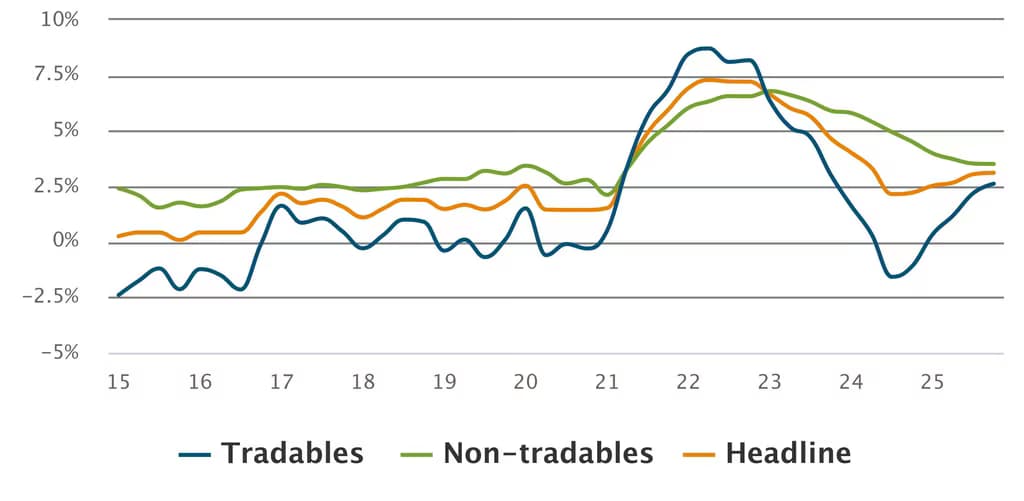
- Inflation climbed outside the Reserve Bank’s 1-3%pa target band in December, accelerating to 3.1%pa. The result was considerably higher than the Reserve Bank’s November forecast of 2.7%pa, and it was slightly above the market consensus of 3.0%pa.
- Non-tradable inflation stubbornly remained at 3.5%pa, unchanged from the September quarter, while tradable inflation accelerated to 2.6%pa, its fastest rate since the end of 2023. This tradables rise was driven by higher fuel prices.
- Household energy price increases were a major contributor to the annual increase, with electricity prices up 12%pa and gas prices up 16%pa. Rent increases were also a key contributor, owing to how important an item rent is in the CPI basket, although rental increases have slowed considerably.
- Although several groups recorded lower prices, including audio visual equipment and games, toys, and hobbies, other groups saw price rises accelerate, including building costs, accommodation services, recreation and cultural equipment, telecommunications services, and property maintenance prices.
- There appears to be a small, concentrated group of items that are increasing by larger amounts, rather than large and broad-based price increases. Stats NZ noted that although 80% of the CPI basket of the basket increased in price in 2025, which was the highest proportion in 18 months, more than half of the basket increased by 3.0% or less.
Inflation heads outside of the RBNZ target range
Annual inflation rate, by component
...and our reaction
- Inflation is moving in the wrong direction, and although there are reasons for some of these increases, the continued acceleration in inflation, despite clear spare capacity in the economy, should start to raise concerns at the Reserve Bank.
- The worry will not only be that headline inflation is now outside the Bank’s target band, but also that previous expectations of high inflation not persisting, due to soft demand conditions limiting price rises, do not appear to be coming true. If anything, the increase in prices in some areas suggests that input cost pressures are still forcing business to consider raising prices, despite poor economic conditions.
- Having headline inflation rising, and no further moderation in non-tradables inflation, is a clear concern, particularly when partial economic indicators suggest strengthening economic growth for the end of 2025 and into 2026. If inflation was accelerating when economic growth was low or negative, there is a significant likelihood that inflation could accelerate further as growth gains momentum.
- We had previously stated in 2025 that further official cash rate cuts below 3.0% would not really stimulate the economy until the second half of 2026, but that those cuts would prove hard to justify if inflationary pressures remained too hot. We also noted that strengthening growth would eventually require increases in the OCR, to 3% or higher, to remove the additional stimulus from the economy. Today’s stronger headline inflation reinforces this view.
- We expect market pricing for the official cash rate, and wholesale interest rates, to rise following today’s inflation figures The Reserve Bank’s response at next month’s Monetary Policy Statement is uncertain. Does the Bank try to wish away higher inflation, and tell the markets they’re wrong to be picking faster interest rate rises than forecast? Or does the Bank acknowledge the risk of raising interest rates sooner, given the data that’s in front of it?
- At this stage, we are holding to our view of the official cash rate starting to increase from November this year. However, strong growth and inflation numbers in the next few months, combined with a possible hawkish approach from the new Reserve Bank governor, could force interest rate rises back on the table as soon as May.
Latest updates
Premium

Consumers price index
More worries about broadening inflation
Thu 22 Oct 2026
Quarterly
 3.7%pa Annual inflation slowed back in Sep 20263.0%pa Inflation excl fuel accelerated slightly3.2%pa Building costs up in Sep 2026
Premium
Consumers price index
Fuel price spike sends annual inflation to 4.1%pa
Tue 21 Jul 2026
Quarterly
4.1%pa Annual inflation rises in June 2026 2.9%pa Inflation excl fuel slowed1.6% Building costs up in June 2026 quarter
Consumers price index
Inflation still high going into fuel price shock
Tue 21 Apr 2026
Quarterly
3.1%pa Annual inflation unchanged in March3.5%pa Non-tradables inflation unchanged since Sep 202568% Items increasing by expenditure weight