Gross domestic product
Economy contracts 0.9% as international uncertainty bites
18 Sept 2025

Our take on the latest Gross domestic product (Thu 18 Sept 2025)


0.9% fall in GDP in June quarter
Household spending up 0.4% from Mar 2025
Manufacturing activity declines 3.5% from Mar 2025
The key numbers...
- A 0.9% contraction in the economy in the June 2025 quarter came in well below market expectations of 0.3-0.5% decline. This drop follows growth of 0.9% (revised up from 0.8%) in the March 2025 quarter.
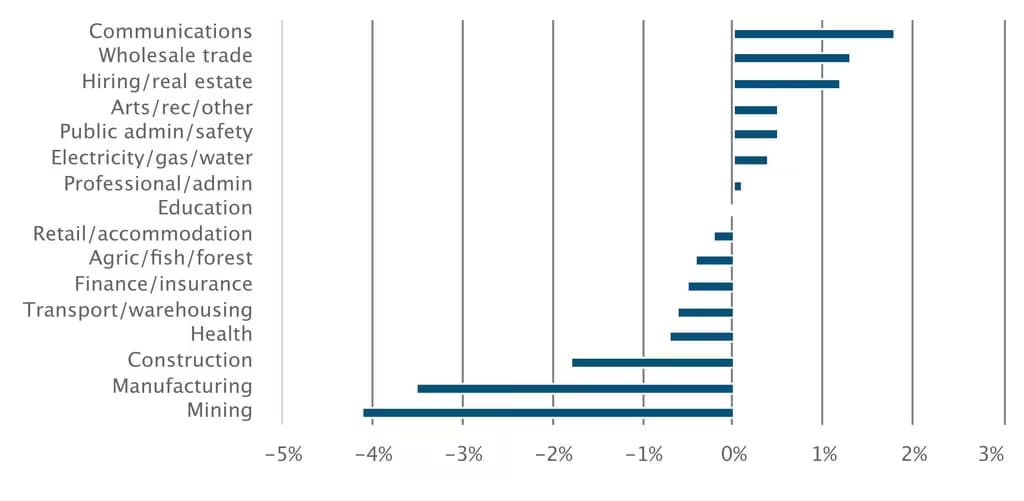
- The pull-back in quarterly economy activity was led by goods-producing industries (-2.3%), driven by manufacturing (-3.5%) and construction (-1.8%). The decline in manufacturing activity more than offset the industry’s 2.4% quarterly rise in the March 2025 quarter. Falls in transport equipment, machinery, and equipment manufacturing (-6.2%) and metal product manufacturing (-5.2%) were key contributors to the decline.
- Activity in the services sector was flat in the June quarter from March, while primary sector activity pulled back 0.7% from March. The latter fall was driven by reductions in forestry and logging (-0.8%) and fishing, aquaculture, and agricultural services (-2.8%).
- Investment spending pulled back 1.1% in the June, reversing March’s 1.5% quarterly rise, which had been the first increase since June 2023. Investment in plant, machinery, and equipment (-1.4%) and transport equipment (-5.4%) were significant contributors to the decline.
- Private consumption rose for the third consecutive quarter in June, up 0.4% from the March quarter. There was a substantial quarterly rise of 1.6% in durable goods consumption, which has now risen for four consecutive quarters. Despite recent strength in durables, volumes remain 12% below the March 2022 peak (seasonally adjusted). Non-durable goods consumption rose for the second consecutive quarter, by a more muted 0.4%.
- Government consumption fell 0.1% but follows two large quarterly rises of 1.7% and 1.8% in December 2024 and March 2025 quarters respectively (all figures seasonally adjusted).
Manufacturing and construction drive the contraction
Quarterly growth by industry, seasonally adjusted
...and our reaction
- A decline in GDP was expected by analysts, but the 0.9% contraction was much larger than anticipated. US President Trump’s Liberation Day tariffs caused chaos in financial markets in April and spread uncertainty across the global economy. As the global trade environment was shaken up, businesses have paused major capital expenditure, with slower global growth expected and goods entering the US set to face higher tariff rates.
- Although we should see a bounce back in economic activity over the next two quarters, there are some areas of weakness that could limit the rate of recovery. Export volumes of meat products fell 7.0%pa in the June quarter, while dairy product export volumes were flat. With global dairy prices also having softened somewhat in recent months, weaker trends in volumes and prices could delay or limit the extent of the primary sector-led recovery.
- Today’s result was well below the Reserve Bank’s forecast decline of 0.3% in August’s Monetary Policy Statement. The economy is now 1.1% smaller than it was a year ago. The Bank could interpret this underperformance as opening up even more spare capacity in the economy, and raises a significant chance of a 50-point cut at the next official cash rate (OCR) review on 8 October.
- If the Bank cuts the OCR to 2.5% next month, further cuts to the OCR would be likely, possibly taking it as low as 2% by February 2026.
Latest updates
Premium

Gross domestic product
Economy grew in June quarter despite fuel price disruption
Thu 17 Sept 2026
Quarterly
0.2% GDP in Jun 2026 qtr (sa) 9.5% Export volumes from Jun 20255.1% Investment spending from Jun 2025
Premium
Gross domestic product
NZ economy picking up before fuel price spike
Thu 18 Jun 2026
Quarterly
0.8% GDP in Mar 2026 qtr (sa)2.5% Business investment from Dec 2025 qtr (sa)0.5% Household spending from Dec 2025 qtr (sa)Gross domestic product
No momentum in recovery, even before Iran
Thu 19 Mar 2026
Quarterly
0.1% GDP from Sep 2025 qtr (sa) 0.1% Household spending from Sep 2025 qtr (sa)3.2% Private investment from Sep 2025 qtr (sa)
Gross domestic product
Economy bounces back 1.1% from June’s dip
Thu 18 Dec 2025
Quarterly
1.1% rise in GDP in September quarter from JuneInvestment spending up 3.2% from June 2025Manufacturing activity up 2.2% from June 2025