
Our take on the latest Gross domestic product (Thu 19 Jun 2025)



0.8% economic growth in the Mar 2025 quarter
Household spending up 1.3% from Dec 2024
Recovery might have lost momentum in the June quarter
The key numbers...
- Economic growth of 0.8% in the March 2025 quarter came in just above market expectations of 0.7%. This result follows growth of 0.5% in the December 2024 quarter (revised down from 0.7%, all figures seasonally adjusted).
- The emerging pick-up in activity was broad-based across much of the domestic economy. A 1.3% quarterly increase in private consumption spending was the biggest lift since March 2022. Government consumption recorded its second consecutive quarterly increase of over 1.0%, marking its strongest six-month stretch since September 2023. Investment spending achieved its first quarterly lift since March 2023 (up 0.6%, following a downward revision to the previous quarter’s result; all figures seasonally adjusted).
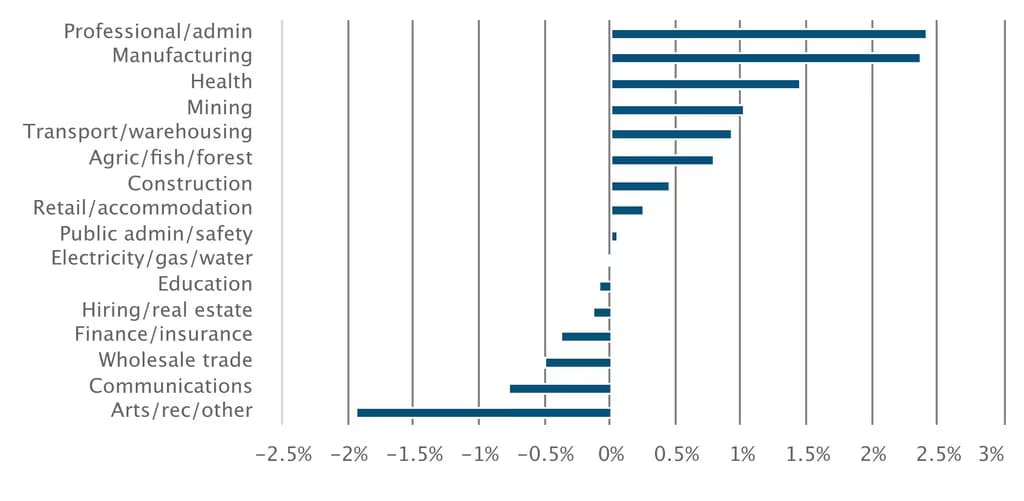
- From an industry perspective, the most significant positive contributions came from goods-producing industries, which grew 1.3%, underpinned by 2.4% growth in manufacturing activity from the December 2024 quarter. A 6.4% lift in transport equipment, machinery, and equipment manufacturing was a key contributor to manufacturing’s growth. Construction also surprisingly recorded quarterly growth of 0.5%, although it is important to note that activity was still down 9.1% from March 2024.
- Growth in the services sector was patchier, with just six of the 16 industries driving 0.4% quarterly growth. Significant increases in professional, scientific, and technical services (+2.7%), health care and social assistance (+1.5%), and administrative and support services (+1.7%) underpinned the rise, helped by a continued rebound in transport, postal, and warehousing activity (+0.9%). Further growth in the sector was prevented by declines in arts and recreation services (-7.3%) and rental, hiring, and real estate services (-0.6%).
Professional services and manufacturing lead the pick-up
Quarterly growth by industry, seasonally adjusted
...and our reaction
- As it emerges from the 2024 recession, the economy has now recorded its strongest six months of growth since the middle part of 2022. However, it is important to note that the economy is still 0.6% smaller than it was a year ago. Similarly, GDP per capita has increased 0.7% over the last two quarters, but it is still 4.1% below its September 2022 peak.
- The tension between the emerging upward momentum in quarterly figures and the still-weak annual figures is clear across several components of GDP. Despite a relatively strong six months, annual government consumption has contracted 0.7% over the last year, the biggest decline since 1991. Total investment spending has shrunk 5.3% over the same period, the largest fall since 2010.
- The improvement in household spending looks to be gaining momentum, although some caution should still be applied to the estimated split of spending between domestic consumers and international visitors. Spending on durables, services, and transport were areas that showed a consistent lift in spending across the various cuts of the GDP data.
- Strong business confidence in the second half of 2024 is consistent with higher investment spending, underpinned by a 1.2% quarterly lift in private investment, and capital equipment imports recording their first positive annual growth since mid-2023. Key quarterly rises in investment included for plant, machinery, and equipment (+4.1%) and residential buildings (+2.0%). Despite the latter increase, year-end growth in residential investment is still at -13%, its weakest since 2009.
- Perhaps most critically, today’s data reflects activity prior to President Trump’s “Liberation Day” in early April and the subsequent uncertainty on international markets. Although some of the initial uncertainty has reduced in recent weeks, we still expect GDP figures for the current June quarter to be less positive than the March data. Various indicators, including electronic card spending data, business confidence, and manufacturing indices point towards some loss of economic momentum over the last couple of months.
- Today’s result was well above the Reserve Bank’s forecast of 0.4% growth in May’s Monetary Policy Statement. This data, along with continuing inflationary concerns, suggest there is limited scope for the Bank to cut the official cash rate below 3%. However, the uncertainty and possible loss of momentum mentioned above mean that further rate cuts cannot be completely ruled out.
Latest updates
Premium

Gross domestic product
NZ economy picking up before fuel price spike
Thu 18 Jun 2026
Quarterly
0.8% GDP in Mar 2026 qtr (sa)2.5% Business investment from Dec 2025 qtr (sa)0.5% Household spending from Dec 2025 qtr (sa)Premium
Gross domestic product
No momentum in recovery, even before Iran
Thu 19 Mar 2026
Quarterly
0.1% GDP from Sep 2025 qtr (sa) 0.1% Household spending from Sep 2025 qtr (sa)
 3.2% Private investment from Sep 2025 qtr (sa)
Gross domestic product
Economy bounces back 1.1% from June’s dip
Thu 18 Dec 2025
Quarterly
1.1% rise in GDP in September quarter from JuneInvestment spending up 3.2% from June 2025Manufacturing activity up 2.2% from June 2025Gross domestic product
Economy contracts 0.9% as international uncertainty bites
Thu 18 Sept 2025
Quarterly
0.9% fall in GDP in June quarterHousehold spending up 0.4% from Mar 2025Manufacturing activity declines 3.5% from Mar 2025