
Our take on the latest Gross domestic product (Thu 18 Dec 2025)

1.1% rise in GDP in September quarter from June
Investment spending up 3.2% from June 2025
Manufacturing activity up 2.2% from June 2025
The key numbers...
- The New Zealand economy expanded 1.1% in the September 2025 quarter, with growth coming in at the top end of market expectations, and well above the 0.4% expected by Treasury and the Reserve Bank. Annual growth of 1.3% was the strongest in 18 months, but both the quarterly and annual results were boosted by particularly weak results in September 2024 (electricity crisis) and June 2025 (tariff uncertainty).
- Even so, there were pleasing signs of a broad-based improvement across several components of economic activity. Private consumption (+1.8%) and total investment spending (+3.2%) both recorded their strongest annual growth in two years. Growth in general government consumption reached a three-year high of 3.7%pa, with these results combining to drive a 2.1%pa increase in domestic economic activity, the first lift in two years and the strongest growth since late 2022.
- Despite the annual lift in private consumption, household spending remains fairly patchy, with quarterly growth of just 0.1%. Annual growth in spending on durables reached 7.3%, with Stats NZ noting the growth in durables was driven by audio-visual equipment (televisions, computers, and mobile phones) and motor vehicles. Spending on household contents and services also lifted by 7.5%pa.
- Several other household spending categories grew at their fastest rate since the second half of 2022, when figures were inflated by the previous year’s lockdown, including recreation and culture (7.5%), restaurants and hotels (3.1%), and alcohol, tobacco, and drugs (-1.9%, so just declining more slowly). A 5.9%pa fall in spending on communication services was the largest on record, while spending on low-value imports grew at its slowest rate since early 2023.
- The biggest contributor to increased investment spending was the private sector, with quarterly growth of 4.0% its largest increase since September 2022. Key increases included lifts of 16% in transport equipment, 3.8% in residential buildings, and 3.5% in infrastructure (all figures seasonally adjusted). Investment in plant, machinery, and equipment also recorded a 15% annual increase.
- The pick-up in investment was reflected in trade data, with imports of plant, machinery, and equipment up 11% from a year ago, the largest increase since 2022. Growth in imports of passenger cars reached a four-year high of 27%pa, but growth in services imports eased to 4.4%pa, the weakest result since early 2022, as Kiwi travel activity overseas has largely recovered.
Recovery occurring across most industries
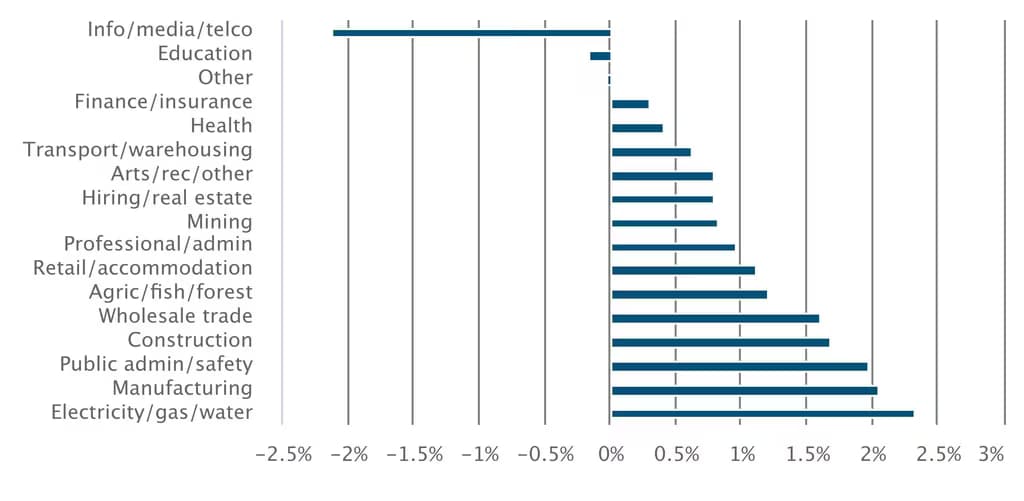
Quarterly growth by industry, seasonally adjusted
...and our reaction
- Domestic economic activity is showing signs of improvement, with more business investment in transport equipment and other plant, machinery, and equipment leading the way. This pick-up in investment is consistent with continued strong business confidence, and there is also likely to be some catch-up occurring after low levels of investment over the last couple of years. Quarterly investment volumes are still 22% and 4.5% below their 2022/23 peaks for transport and other machinery respectively.
- There are also small signs of improvement across the manufacturing sector, with food manufacturing recording its best quarter in three years (up 2.5%), and annual growth in furniture manufacturing and metal product manufacturing moving out of negative territory for the first time in 2-3 years. The low exchange rate is likely to be helping make domestic production more cost-competitive. Other industries to record good quarterly results included mining, electricity and gas, wholesale trade, and retail trade.
- Households will be looking towards the lift in business investment to be replicated in the labour market as well, an improvement in which would help to underpin a sustained and broader pick-up in consumer spending. The weaker New Zealand dollar also appears to be becoming a factor in households’ spending decisions, dampening growth in both low-value imports and imported services (which includes tourism).
- Today’s data reinforces the view that the Reserve Bank is unlikely to cut the official cash rate further from its current level of 2.25%. We continue to expect the economic recovery to become more firmly embedded during 2026, underpinned by spending in provincial areas and low interest rates. However, quarterly growth looks unlikely to match the September 2025 result, which reflects unusual weakness in the June quarter caused by uncertainty around tariffs and international trade conditions.
Latest updates
Premium

Gross domestic product
Economy grew in June quarter despite fuel price disruption
Thu 17 Sept 2026
Quarterly
 0.2% GDP in Jun 2026 qtr (sa)9.5% Export volumes from Jun 20255.1% Investment spending from Jun 2025
Premium
Gross domestic product
NZ economy picking up before fuel price spike
Thu 18 Jun 2026
Quarterly
0.8% GDP in Mar 2026 qtr (sa)2.5% Business investment from Dec 2025 qtr (sa)0.5% Household spending from Dec 2025 qtr (sa)Gross domestic product
No momentum in recovery, even before Iran
Thu 19 Mar 2026
Quarterly
0.1% GDP from Sep 2025 qtr (sa) 0.1% Household spending from Sep 2025 qtr (sa)
 3.2% Private investment from Sep 2025 qtr (sa)