Consumers price index
Stable headline inflation, but some concerns below the surface
22 Jan 2025

Our take on the latest Consumers price index (Wed 22 Jan 2025)



Annual inflation steady at 2.2%pa
Tradable prices up 0.3%, first rise in five quarters
Caution over imported inflation pressures in coming quarters
The key numbers...
- Quarterly inflation of 0.5% saw headline inflation remain at 2.2%pa in December 2024, slightly higher than market expectations.
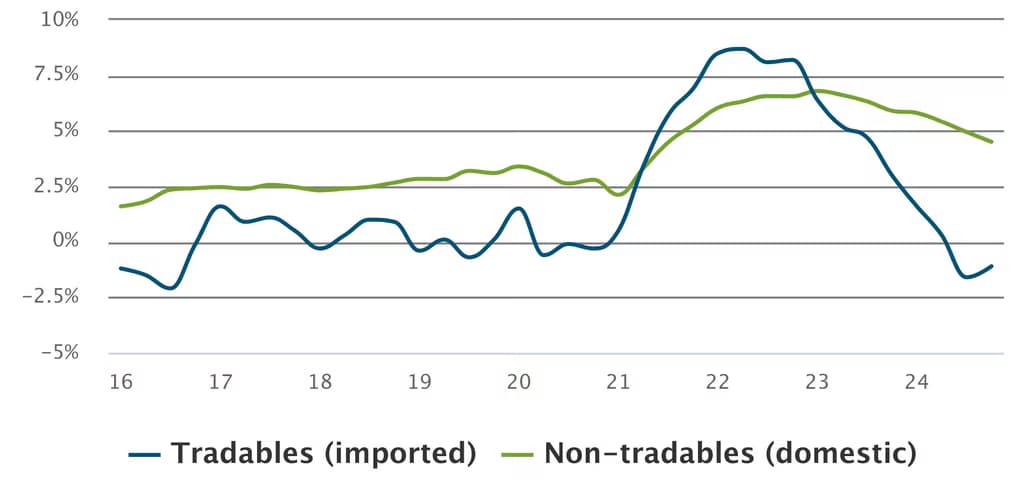
- Annual tradables inflation was -1.1%pa, less of a fall than the -1.6%pa seen in September. Non-tradables inflation was 4.5%pa, slowing back from 4.9%pa in September.
- Rents remained a key driver of higher prices, with a 4.2%pa increase in the December quarter, although this lift was the smallest since the start of 2022.
- Lower petrol prices stopped inflation popping higher, with petrol down by 9.2%pa in December – although a small part of this drop was due to the removal of the Auckland Regional Fuel Tax. Excluding petrol, annual inflation would have been 2.7%pa (also unchanged from the ex. petrol figure recorded in September).
- There were sharper increases in some food, transport, and recreation and culture prices, including dairy products, domestic airfares, and a 4.7% quarter rise in second-hand car prices.
- Services inflation underpinned the inflationary pressures that remain, with prices rising 1.4% in the quarter to push annual services inflation up slightly to 4.8%pa. In contrast, goods inflation was zero in the December quarter, with annual goods inflation at just 0.6%pa.
- More discounting occurred in the December quarter, with 17% of items discounted – the largest proportion discounted since the June 2020 quarter.
- Building costs rose 0.3% in the quarter, taking annual building cost inflation to 2.0%, the slowest annual increase since the end of 2011.
More caution over imported inflation
Annual inflation rate, by component
...and our reaction
- At a headline level, inflationary pressures appear generally contained, but there are several diverging price trends in the inflation data, complicating the outlook for pricing pressures. Previously, just about everything was rising in price, and those price increases were large. Now, there are some items with sustained larger price increases, and some items that are seeing a slight reacceleration in inflation, while at the same time several less essential items are under substantial downwards pricing pressure.
- We now have more concern about the risk of a reacceleration in inflation. The focus of this further inflationary risk has shifted towards tradables, which was previously the driver of disinflationary pressure. Tradable prices’ December quarter rise of 0.3% bucked Reserve Bank expectations of a 0.2% fall – and with a lower exchange rate, imported inflation could pick up this year more than previously expected.
- Domestic pricing pressures are still gradually easing and were better (lower) than the Reserve Bank’s pick. Yet at 4.5%, domestic inflation is still well above the 2.7%pa averaged during the 2010s.
- Given the Reserve Bank’s strong signal in November around a likely 50 basis point cut to the official cash rate at the February Monetary Policy Statement, we’re not convinced the Bank will view this inflation data as enough to shift to a more moderate 25-point cut. But caution around a possible reacceleration in inflation means there should be a debate over the merits of a 25 or 50-point cut, and there might be fewer cuts before we get to the bottom of the current interest rate cycle than had previously been expected.
Latest updates
Premium

Consumers price index
Fuel price spike sends annual inflation to 4.1%pa
Tue 21 Jul 2026
Quarterly
 4.1%pa Annual inflation rises in June 2026
 2.9%pa Inflation excl fuel slowed1.6% Building costs up in June 2026 quarter
Premium
Consumers price index
Inflation still high going into fuel price shock
Tue 21 Apr 2026
Quarterly
3.1%pa Annual inflation unchanged in March3.5%pa Non-tradables inflation unchanged since Sep 202568% Items increasing by expenditure weightConsumers price index
Inflation breaches the RBNZ upper band
Fri 23 Jan 2026
Quarterly
Inflation up to 3.1%paNon-tradable inflation unchanged at 3.5%pa OCR expectations and wholesale interest rates likely to increase
Consumers price index
Inflation rises to 3.0%pa, hits top of the Reserve Bank's band
Mon 20 Oct 2025
Quarterly
Prices up 1.0% in September quarterNon-tradable inflation eases to 3.5%paHighest annual electricity inflation since 1989