
Our take on the latest Gross domestic product (Thu 19 Dec 2024)


1.0% fall in GDP in September quarter
Manufacturing shrinks 2.6%, partly due to electricity crisis
Major revisions boost 2023 growth but amplify 2024's weakness
The key numbers...
- The latest GDP data showed a 1.0% contraction in economic activity in the September quarter, following on from a heavily revised downwards 1.1% decline in GDP in the June quarter (seasonally adjusted). Excluding the 2020 lockdown, this six-month period is the worst fall for New Zealand’s economic activity since the first half of 1991. The September quarter weakness was widely spread across the economy.
- Revisions to previous GDP figures mean the economy was as much as 2.3% larger in March 2024 than previously estimated by Stats NZ, with only one quarterly contraction recorded since the COVID lockdowns, in March 2023. This stronger starting point effectively paved the way for the more negative results over the last six months as tighter monetary and fiscal policy really started to bite, with the economy also hit by the electricity crisis that affected the country in July and August.
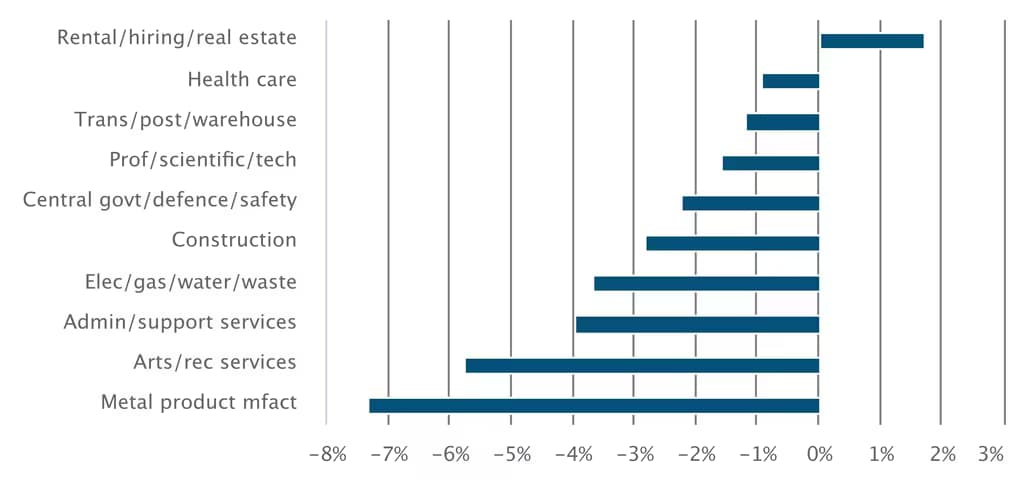
- Manufacturing activity fell 2.6%, dragged down by declines in metal product manufacturing (-7.3%), wood and paper products manufacturing (-5.7%), transport equipment manufacturing (-2.0%), and food, beverage, and tobacco product manufacturing (-1.3%, all seasonally adjusted). The first two of these declines were at least partly related to the electricity crisis. Unsurprisingly, electricity, gas, water, and waste services GDP fell 3.7%.
- Construction’s decline gathered pace, with a 2.8% decline in quarterly activity. This contraction flowed through into professional, scientific, and technical services, with less work for architects and engineers contributing to a 1.6% contraction in activity. Residential investment fell for the fifth consecutive quarter, which marks the sector’s most extended decline since 2007-08. Non-residential investment recorded its worst ex-lockdown quarterly result since 2019 (down 3.9%), and other construction shrank 1.1%, which was its largest fall since 2022 (all figures seasonally adjusted).
- Government spending cuts are showing through more sharply in the data, with central government consumption spending shrinking 2.7% over the quarter, representing the largest quarterly fall since 1992 (seasonally adjusted).
- Household spending also remains soft, with private consumption dropping for six months for the first time (ex-lockdown) since 1999/00. At 0.2%pa, year-end growth has not been weaker since 2009, with household spending on services particularly under pressure, including on restaurants and hotels, communication, housing and household utilities, and recreation and culture.
Economic activity down almost everywhere
GDP for selected industries, seasonally adjusted quarterly change, Sep 2024
...and our reaction
- Today’s data shows a much deeper recession than originally feared, and with a much broader slowdown across the economy. The reduction in economic activity was comprehensive, with falls across most sectors and industries rather than being limited to a few areas. Although this steep decline comes off an effectively stronger starting point, the drop also profiles the stark reality of the economy’s downturn over the last six months.
- Some areas of the economy will remain weak for some time to come. Trends in building consents over the last 1-2 years imply that both residential and non-residential construction remain under pressure, and this week’s Half-Year Economic and Fiscal Update paints a grim picture of the government’s scope for spending.
- There are not many bright spots in today’s GDP data, but there is hope that the worst is now behind us. Agriculture, particularly dairy farming. showed growth in the September quarter, and dairy and meat prices are continuing to rise. Rental, hiring, and real estate services was also mildly positive, as the housing market stirs in response to lower mortgage rates. Other partial data suggests that the economy might be starting to turn a corner in the latter part of the year.
- Other interesting signs in the data included year-end growth of 1.5%pa in intermediate imports, which are typically used as inputs into the manufacturing industry, and a 7.4%pa lift in consumption goods imports from the September 2023 quarter. Although higher imports are a negative for immediate GDP growth, these increases suggest that businesses are preparing for some improvement in demand conditions in coming quarters, which would align with higher business confidence over the second half of 2024.
- We note the potential for a technical bounce-back in GDP in the December quarter, with the immediate effects of the electricity crisis having passed. However, any lift is unlikely to fully make up the losses in the September quarter, given the permanent effect of mill closures in the North Island and the longer-term effects of reduced production at the Methanex plant and Tiwai Point aluminium smelter.
- Because of the major revisions to historical data, it is difficult to know how the Reserve Bank will react to this latest data. The economy has shrunk 2.1% over the last six months, but it is also 0.4% larger than it was in June, according to the previous data. At this stage, we suspect the recent significant negative momentum in the economy will hold sway in the Reserve Bank’s thinking, and we continue to anticipate a 50-point cut to the official cash rate in mid-February.
Latest updates
Premium

Gross domestic product
NZ economy picking up before fuel price spike
Thu 18 Jun 2026
Quarterly
 0.8% GDP in Mar 2026 qtr (sa)2.5% Business investment from Dec 2025 qtr (sa)
 0.5% Household spending from Dec 2025 qtr (sa)
Premium
Gross domestic product
No momentum in recovery, even before Iran
Thu 19 Mar 2026
Quarterly
0.1% GDP from Sep 2025 qtr (sa) 0.1% Household spending from Sep 2025 qtr (sa)3.2% Private investment from Sep 2025 qtr (sa)
Gross domestic product
Economy bounces back 1.1% from June’s dip
Thu 18 Dec 2025
Quarterly
1.1% rise in GDP in September quarter from JuneInvestment spending up 3.2% from June 2025Manufacturing activity up 2.2% from June 2025Gross domestic product
Economy contracts 0.9% as international uncertainty bites
Thu 18 Sept 2025
Quarterly
0.9% fall in GDP in June quarterHousehold spending up 0.4% from Mar 2025Manufacturing activity declines 3.5% from Mar 2025