Consumers price index
Inflation near the midpoint, further interest rate cuts required
16 Oct 2024

Our take on the latest Consumers price index (Wed 16 Oct 2024)



Inflation down to 2.2%pa
Non-tradable inflation slows to 4.9%pa
OCR cut of at least 50 basis points looks appropriate next month
The key numbers...
- Inflation is back within the Reserve Bank’s 1-3%pa target band for the first time since March 2021, slowing from 3.3%pa in June to 2.2%pa in the September quarter. The quarterly increase of 0.6% was slightly below both our pick and the market’s pick of 0.7%, as well as the Reserve Bank’s forecast of 0.8% published in August.
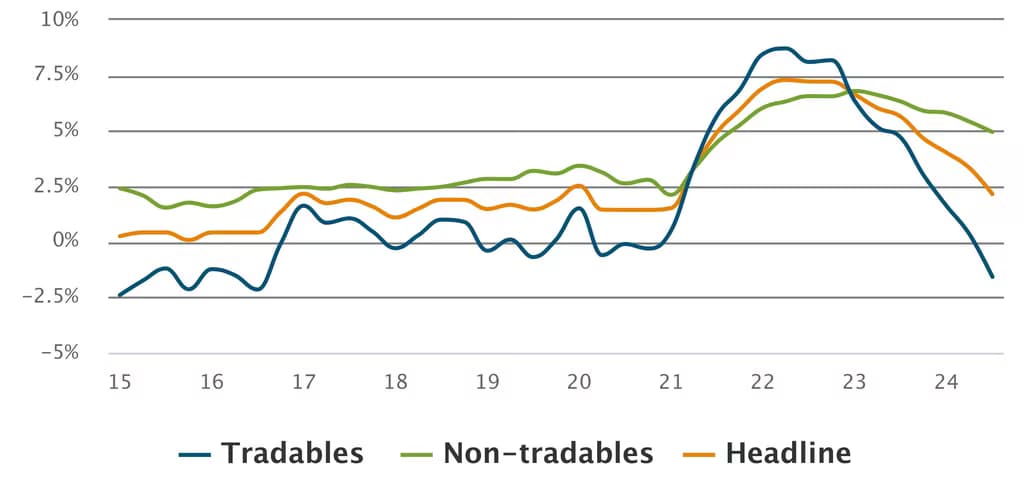
- The weaker-than-expected result was driven by non-tradable inflation slipping below 5%pa for the first time in three years. Services inflation mirrored this trend, moderating from 5.3% to 4.5%pa.
- There were a lot of changes to government-related charges in the September quarter that affected the headline result. Increases included a 12% lift in local government rates (the largest since 1990, contributing over half the quarterly increase in the CPI) and the reintroduction of prescription charges (contributing 15% of the CPI increase).
- These rises were mitigated by the removal of Auckland’s 10c/L regional fuel tax, and a 23% reduction in early childhood education costs due to the introduction of the FamilyBoost rebate. Excluding the latter policy change from the numbers would have resulted in quarterly inflation of 0.9%.
- Growth in rents remains relatively strong, at 4.5%pa, although this result represented a slight easing from 4.8% last quarter. There is considerable variation across the country, with rental inflation ranging between 6.4%pa in Canterbury and 2.0%pa in the sluggish Wellington market.
- Residential building costs recorded their smallest annual rise since 2019, at 2.5%pa. The 0.1% quarterly increase in costs was the smallest since 2011, reflecting lower timber prices and increased competition for work as demand conditions in the residential construction industry have weakened significantly.
Back within touching distance of 2%pa
CPI components, annual % changes
...and our reaction
- Inflation has rapidly shifted back towards the middle of the Reserve Bank’s target band. Although the Bank had consistently been forecasting throughout the last two years that inflation would get back below 3%pa in the second half of 2024, the moderation has been quicker than expected. For example, as recently as May, the Bank was picking September quarter inflation to be 3.0%pa.
- At 4.9%pa, non-tradable inflation remains too high, and well above its long-term average of 3.1%pa. The Bank will be keen to see non-tradable inflation moderate further in coming quarters, and there is nothing in today’s data or other economic indicators to suggest that moderation will not happen. The Bank’s own forecasts see non-tradable inflation of 2.9%pa by September next year.
- Inflation excluding central and local government charges eased from 3.1%pa to 1.5%pa, the smallest annual increase since 2020. This result suggests that, abstracting from the raft of government-related price changes this quarter, market price pressures are well under control. The proportion of items in the CPI that fell in price between June and September was 30%, the largest percentage since 2018 (excluding the lockdown-affected quarter in June 2020), with firms being forced to compete harder for the consumers dollar.
- Today’s result reinforces our forecast of an official cash rate cut of at least 50 basis points next month. Between now and then, labour market data and inflation expectations from the Reserve Bank’s survey could be key determinants of whether a larger cut occurs.
- It’s worthwhile reiterating that interest rate cuts by the Reserve Bank now will only have an affect on real economic activity in about nine months’ time. With inflation close to the midpoint of the Bank’s target, the official cash rate at 4.75% is still restricting economic activity. Until July, the Bank had expressed little confidence in its own forecasts that inflation would be brought back under control, and its limited ability to look forward when setting monetary policy means that it might now be playing catch-up to return interest rates to levels that are more appropriate given current economic conditions.
Latest updates
Premium

Consumers price index
Fuel price spike sends annual inflation to 4.1%pa
Tue 21 Jul 2026
Quarterly
 4.1%pa Annual inflation rises in June 20262.9%pa Inflation excl fuel slowed1.6% Building costs up in June 2026 quarter
Premium
Consumers price index
Inflation still high going into fuel price shock
Tue 21 Apr 2026
Quarterly
 3.1%pa Annual inflation unchanged in March3.5%pa Non-tradables inflation unchanged since Sep 2025
 68% Items increasing by expenditure weight
Consumers price index
Inflation breaches the RBNZ upper band
Fri 23 Jan 2026
Quarterly
Inflation up to 3.1%paNon-tradable inflation unchanged at 3.5%paOCR expectations and wholesale interest rates likely to increaseConsumers price index
Inflation rises to 3.0%pa, hits top of the Reserve Bank's band
Mon 20 Oct 2025
Quarterly
Prices up 1.0% in September quarterNon-tradable inflation eases to 3.5%paHighest annual electricity inflation since 1989