
Our take on the latest Gross domestic product (Thu 19 Sept 2024)



0.2% fall in GDP in June quarter
First quarterly rise in investment in 1.5 years
Major revisions provide better view of household and tourist spending
The key numbers...
- Economic activity fell 0.2% in the June 2024 quarter (seasonally adjusted), in line with our forecast of a 0.2% drop but better than the market forecast of a 0.4% drop and the Reserve Bank’s pick of a 0.5% contraction. The fall follows a 0.1% gain in March (revised down from the 0.2% increase originally recorded).
- The weakness was spread across a number of industries, with a varied patchwork of economic performance coming through. A large 10% fall in forestry and logging activity combining with a 3.7% drop in mining activity to drag the primary sector lower. The contraction in retail and wholesale trade deepened, with 1.0% and 1.3% activity drops respectively, and accommodation and food services fell back 1.9%. Construction activity fell 0.4%.
- There remain some economic bright spots, with economic growth seen across financial services, healthcare, and information media and telecommunications. Transport manufacturing rose 8.1%, the first gain for this sub-industry since the start of 2023.
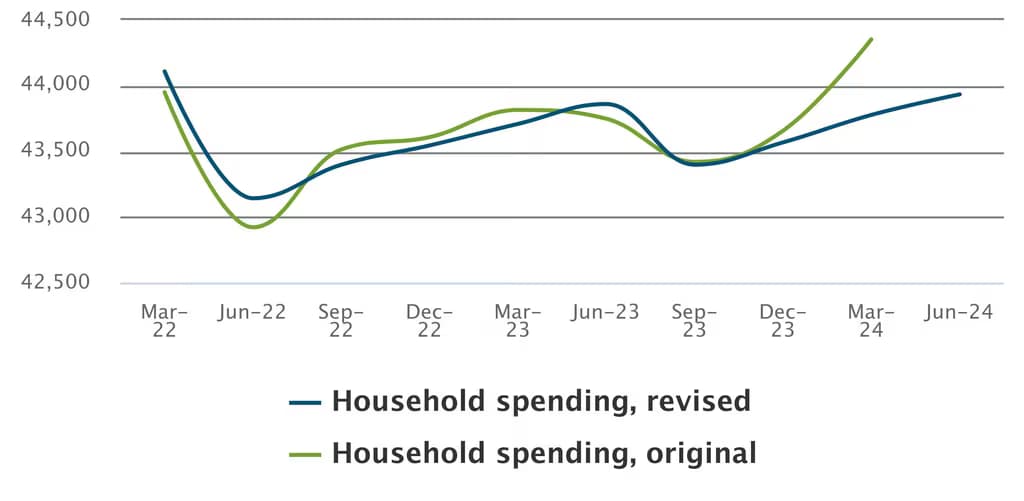
- On the expenditure side, household spending rose 0.4%, broadly in line with growth in the prior two quarters. Household spending rose for essential and consumable goods (food +2.0%, housing and utilities +0.8%), but also recreational and culture (+1.3%).
- Non-essential spending dropped, with a 3.6% fall in spending on restaurants and hotels, alongside less spending on clothing, footwear, and travel and transport.
- Investments recorded the first quarterly increase since the start of 2023, with gross fixed capital formation up 0.2% in June. This rise came despite continued falls in both residential and non-residential building activity, with a 3.1% boost in transport equipment investment, a 1.9% boost in plant, machinery, and equipment investment, and a 1.4% boost in infrastructure (“other construction”) investment.
- Exports overall fell 0.8%, with falls across most goods categories – although meat and other food exports rose. Service exports were a brighter spot, with a 3.0% rise, following substantial revisions to how spending is allocated between New Zealand consumers and tourists. Changes in service exports in the first quarter of 2024 have been revised from a 13% contraction when first published to just a 2.8% drop, and private consumption growth for the March 2024 quarter has been revised from a hefty 1.6% quarterly increase to a more subdued 0.5% quarterly gain.
Quarterly household spending
$m, 09/10 prices, seasonally adjusted
...and our reaction
- The economy remains in a weaker position, with the 0.2% contraction in economic activity reinforcing this view. However, the contraction could’ve been a lot worse, given market forecasts for a larger drop in economic activity. Below the headline figure, economic trends remain mixed, with the patchwork of economic results by industry demonstrating that there isn’t one clear and concise theme across the economy.
- The revisions to household and tourist spending are welcome and confirm our views from last quarter that household spending wasn’t that strong, and that tourism spending wasn’t that weak. But the revised figures do continue to suggest that tourism spending is restrained, as the tourism recovery slows and plateaus. Household spending growth is limited, but is still more positive than many might expect given high interest rates.
- The strength in investment activity is surprising, as the rise in investment highlights more confidence from businesses to spend and bolster capacity – a trend somewhat at odds with weaker trading conditions overall. However, there may be some catch-up in investment occurring as businesses start to prepare for better economic conditions in 2025.
- We anticipate that today’s better than expected GDP result could set the stage for a further weakening in activity in the current September quarter, given a number of still weak data flows across various indicators.
- Today’s GDP result isn’t expected to change the Reserve Bank’s view much on the economy – the economy is still contracting, and there’s enough evidence that the Bank can continue to ease interest rates over the rest of 2024 and into 2025 in line with their latest forecasts. However, the better than expected performance should reduce expectations of a larger 50 basis point cut in October which some in the market have been betting on, and we reiterate our forecast of a 25 basis point cut in the October Review.
Latest updates
Premium

Gross domestic product
NZ economy picking up before fuel price spike
Thu 18 Jun 2026
Quarterly
0.8% GDP in Mar 2026 qtr (sa)2.5% Business investment from Dec 2025 qtr (sa) 0.5% Household spending from Dec 2025 qtr (sa)
Premium
Gross domestic product
No momentum in recovery, even before Iran
Thu 19 Mar 2026
Quarterly
0.1% GDP from Sep 2025 qtr (sa) 0.1% Household spending from Sep 2025 qtr (sa)3.2% Private investment from Sep 2025 qtr (sa)
Gross domestic product
Economy bounces back 1.1% from June’s dip
Thu 18 Dec 2025
Quarterly
1.1% rise in GDP in September quarter from JuneInvestment spending up 3.2% from June 2025Manufacturing activity up 2.2% from June 2025Gross domestic product
Economy contracts 0.9% as international uncertainty bites
Thu 18 Sept 2025
Quarterly
0.9% fall in GDP in June quarterHousehold spending up 0.4% from Mar 2025Manufacturing activity declines 3.5% from Mar 2025