
Our take on the latest Gross domestic product (Thu 20 Jun 2024)



0.2% increase in GDP in March quarter
Investment spending down 4.3% from a year ago
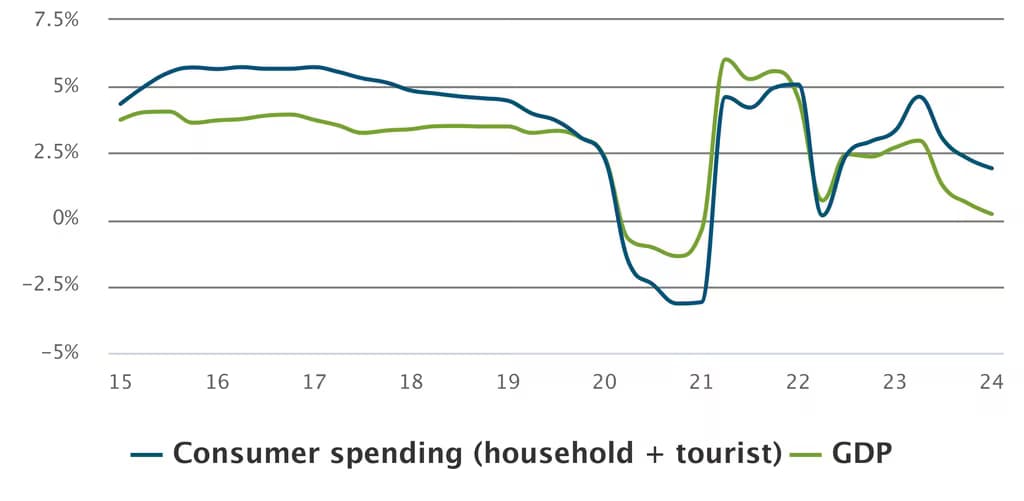
Is consumer demand being driven by household or tourist spending?
The key numbers...
- The economy crawled back out of recession in the March quarter, with a 0.2% lift in GDP (seasonally adjusted). Activity is still 0.5% below its September 2022 peak, reflecting the effects of higher interest rates bringing demand back to a more sustainable level.
- Consumer spending in New Zealand (including both residents and visitors) rose by 0.8% for the second consecutive quarter. A 20% increase in direct imports of low-value goods by households made the biggest contribution to this lift, while spending on non-durables recorded its largest increase in 18 months.
- Investment spending was weak across the board, including year-end growth for plant, machinery, and equipment at a 14-year low of -9.5%. This weakness in business activity is backed up by declines across much of the manufacturing industry, construction, and several business-focused service industries.
- Despite a 4.8% increase in goods exports from the December quarter, total exports eased by 0.4% due to a questionable 13% plunge in services exports (all figures seasonally adjusted). Agriculture and fishing primary products and dairy products made the biggest contributions to the lift in goods exports.
Tourists seem to be keeping spending growing
Year-end % changes
...and our reaction
- Today’s 0.2% quarterly growth was towards the top end of market expectations, although indicator data over the last few weeks had suggested to us the figure might have been even stronger. We ended up being surprised by the weakness of services exports and the strength of imports.
- Stats NZ has stated that its estimates of services exports and household spending are currently not as reliable, meaning that the weak services export figure might largely be a misallocation of activity between domestic household spending and tourist spending. This conclusion seems plausible given the significant increases in restaurants and hotels and recreation and culture that are currently attributed to domestic spending – we find it hard to believe tourism spending has fallen but Kiwis are suddenly spending more a lot more in the hospitality sector.
- Although this issue does not affect the overall GDP figures, it does have significant implications about the source of spending demand and, most importantly, whether the Reserve Bank’s monetary policy can have much effect on it.
- At face value, today’s figures suggest more robust household spending that could demand tighter monetary conditions for longer. However, if the demand has been misallocated to Kiwi households instead of visitors, then interest rates are still having the desired effect of slowing the economy.
- Even if the Reserve Bank can do little to affect visitor spending trends, the Bank might still be concerned about the demand implications of tourism for domestic economic activity. A speech earlier this week by Chief Economist Paul Conway highlighted the risks around the stickiness of domestic and services inflation.
- Our broad view remains that households remain under pressure, although the extent of the squeeze continues to be masked by strong population growth. Per-capita activity remains in decline, for 1.5 years now. Weak investment also indicates a pessimistic business sector.
- Even so, today’s result will not make the Reserve Bank any more confident that it’s monetary tightening has sufficiently cooled the economy. A clear moderation in non-tradable and labour cost inflation is needed before the end of this year if interest rates are to be cut from early 2025.
Latest updates
Premium

Gross domestic product
NZ economy picking up before fuel price spike
Thu 18 Jun 2026
Quarterly
 0.8% GDP in Mar 2026 qtr (sa)2.5% Business investment from Dec 2025 qtr (sa)0.5% Household spending from Dec 2025 qtr (sa)
Premium
Gross domestic product
No momentum in recovery, even before Iran
Thu 19 Mar 2026
Quarterly
0.1% GDP from Sep 2025 qtr (sa) 0.1% Household spending from Sep 2025 qtr (sa)3.2% Private investment from Sep 2025 qtr (sa)
Gross domestic product
Economy bounces back 1.1% from June’s dip
Thu 18 Dec 2025
Quarterly
1.1% rise in GDP in September quarter from JuneInvestment spending up 3.2% from June 2025Manufacturing activity up 2.2% from June 2025Gross domestic product
Economy contracts 0.9% as international uncertainty bites
Thu 18 Sept 2025
Quarterly
0.9% fall in GDP in June quarterHousehold spending up 0.4% from Mar 2025Manufacturing activity declines 3.5% from Mar 2025