
Our take on the latest Consumers price index (Wed 17 Apr 2024)



Non-tradable inflation barely changed, at 5.8%pa
Headline inflation down to 4.0%pa
Services inflation accelerates from 4.7% to 5.3%pa
The key numbers...
- Annual inflation eased from 4.7% to 4.0% in the March 2024 quarter, in line with market expectations. The result was above the Reserve Bank’s pick in February of 3.8%.
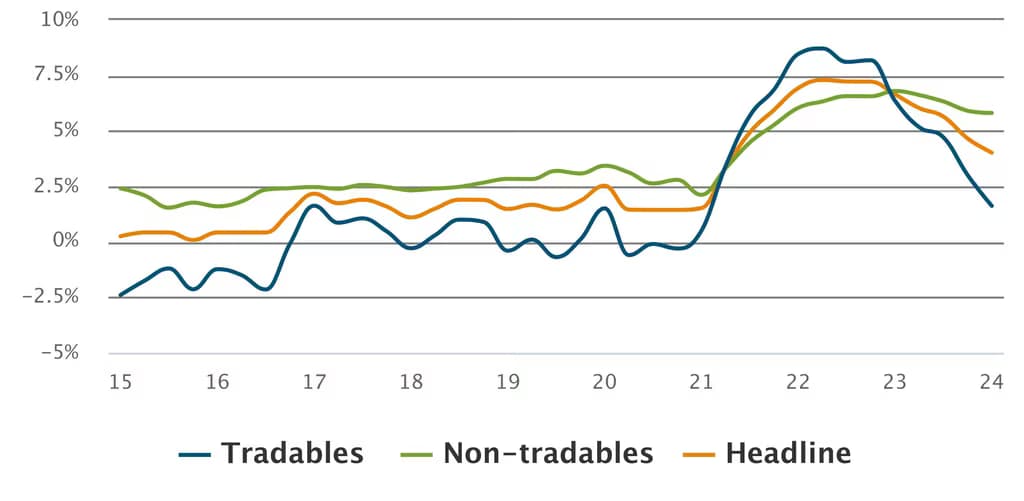
- There was a marked divergence between tradable and non-tradable prices. Tradable prices fell 0.7% between December 2023 and March 2024, but non-tradable prices jumped 1.6%, which was the largest quarterly jump in a year.
- The biggest contributions to the quarterly result came from alcoholic beverages and tobacco (up 3.4%, as cigarettes went through their usual annual excise increase), recreation and culture (up 2.4%, due to higher prices for accommodation and, to a lesser extent, recreational and cultural services), and housing and household utilities (up 0.7%, due to higher rents and residential construction costs).
- These elements were also reflected in the annual figures, with the large increases outlined above joined by property rates and related services (up 9.6% from a year ago), other recreational equipment and supplies (up 3.6%), and alcoholic beverages (up 5.0%).
- Transport prices were 2.5% lower than in the previous quarter, largely thanks to a 10% decline in international air fares, and falls of 2-4% in petrol and diesel prices. At this stage, this fall in fuel prices looks like it will reverse out in the June quarter.
Domestic price pressures persist
CPI components, annual % changes
...and our reaction
- Today’s headline inflation result is a good one, but the persistence of domestic price pressures will have captured the Reserve Bank’s attention. At 5.8%pa (compared to the Bank’s pick of 5.3%pa), non-tradable inflation is proving stubborn, and it is still higher than at any time between June 1991 and December 2021.
- As indicated in its recent statement, the Bank is acutely aware of other significant price increases occurring that will keep non-tradable inflation elevated this year, including local government rates, insurance, and utility costs. These factors could also slow the easing in headline inflation and inflation expectations.
- Although record high migration has eased labour market pressures, the effect on the housing market is also significant, with the 4.7%pa increase in rents the fastest in this series since about 1997. Recent immigration policy changes announced by the government will take some time to reduce these housing market pressures.
- After a sizable lift in the proportion of items decreasing in price over the second half of 2023, there were fewer price falls again in the March 2024 quarter. The proportion of items increasing in price is still above pre-COVID norms, suggesting that there continues to be more acceptance of price rises than the Reserve Bank would be comfortable with.
- Long story short – headline inflation falling is good, but core inflation and the inflation the Reserve Bank can influence is still too hot.
- In the last month, we have pushed out our expected timing of the first official cash rate from August to November this year. Today’s data reinforces our view that the Reserve Bank needs to see more of an easing in domestic inflation before it is comfortable easing monetary policy.
Latest updates
Premium

Consumers price index
Fuel price spike sends annual inflation to 4.1%pa
Tue 21 Jul 2026
Quarterly
 4.1%pa Annual inflation rises in June 20262.9%pa Inflation excl fuel slowed1.6% Building costs up in June 2026 quarter
Premium
Consumers price index
Inflation still high going into fuel price shock
Tue 21 Apr 2026
Quarterly
3.1%pa Annual inflation unchanged in March3.5%pa Non-tradables inflation unchanged since Sep 202568% Items increasing by expenditure weightConsumers price index
Inflation breaches the RBNZ upper band
Fri 23 Jan 2026
Quarterly
Inflation up to 3.1%paNon-tradable inflation unchanged at 3.5%pa OCR expectations and wholesale interest rates likely to increase
Consumers price index
Inflation rises to 3.0%pa, hits top of the Reserve Bank's band
Mon 20 Oct 2025
Quarterly
Prices up 1.0% in September quarterNon-tradable inflation eases to 3.5%paHighest annual electricity inflation since 1989