Gross domestic product
Recession again, as the squeeze on households continues
21 Mar 2024

Our take on the latest Gross domestic product (Thu 21 Mar 2024)



0.1% fall in GDP in Dec quarter
GDP per capita down 2.1% during 2023
Biggest per-capita fall in household spending since 1992
The key numbers...
- The economy re-entered recession in the December 2023 quarter, contracting by 0.1%. Four of the last five quarters have recorded negative growth, and the economy is now 0.7% smaller than in September 2022.
- There were no large negative results across the main parts of the domestic economy, apart from a run-down in inventory levels. However, there is ongoing softness in household spending and business investment.
- Inventories were sharply reduced for the second time in three quarters, making a -2.8% contribution to quarterly activity, as the distribution sector reverses the increased stock levels that were held during the pandemic.
- A 2.9% reduction in import volumes, the fourth consecutive quarterly decline, reflects the run-down in stocks and continued weak demand from both households and businesses.
- Key areas of weakness in household spending include alcohol and tobacco (year-end growth of -5.0%), clothing and footwear (-4.8%), communication (-2.6%), and restaurants and hotels (-8.8%). All these declines are the biggest since at least 1992 (excluding lockdowns). The 3.4% year-end decline in recreation and culture spending is the largest since 2009.
- The 6.7% year-end decline for investment spending on plant, machinery, and equipment is the largest since 2010. The downturn in residential building is in full swing, with the quarterly level of activity slipping to its lowest level since 2018. The 4.3% year-end decline in residential construction is the biggest since 2011 (all figures excluding lockdowns).
- On a more positive note, export volumes rebounded 3.2% from the previous quarter’s decline, to a new post-COVID high. Meat products and chemical products both looked particularly strong, but there was weakness in agriculture and fishing primary products.
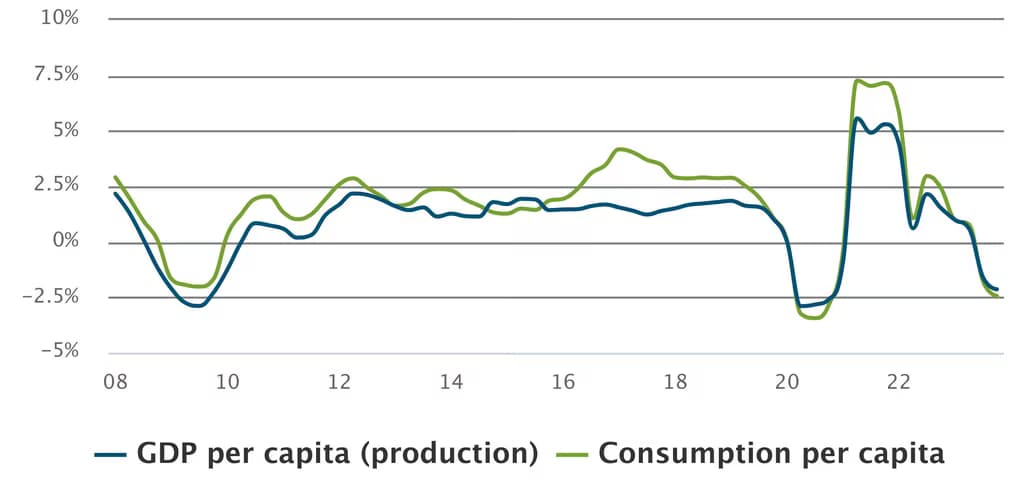
Households' retreat masked by population growth
Year-end per capita growth rates
...and our reaction
- With population growth running at 2.8%pa, New Zealand’s GDP per capita has shrunk 2.1% over the last year. This result is closing in on the 2.9% per-capita contraction recorded in 2008/09 following the Global Financial Crisis.
- The extent of the squeeze on households is even more acute, with per-capita consumption spending down 2.5% over the last year. Excluding the 2020 lockdown, this is now the largest decline in per-capita spending since 1992.
- Households are cutting their spending on the nice-to-haves, including alcohol, new clothing, hospitality, and leisure.
- Businesses have reacted less sharply, partly because their output had previously been constrained by labour shortages. However, further declines in investment spending are possible as labour shortages ease and firms react to weaker demand levels.
- Tight monetary and fiscal policy are constraining domestic growth, and sluggish international demand conditions, particularly in China, are a factor behind export volumes still being 4.2% below their pre-COVID level. A strong and sustained recovery in New Zealand’s growth is unlikely while the global economy remains weak.
- Today’s result was only slightly below the Reserve Bank’s forecast of zero growth, and so it is unlikely to affect its view of future interest rates. The Bank’s focus in setting monetary policy will be dominated by inflation and labour market outcomes over the next few months.
Latest updates
Premium

Gross domestic product
NZ economy picking up before fuel price spike
Thu 18 Jun 2026
Quarterly
 0.8% GDP in Mar 2026 qtr (sa)2.5% Business investment from Dec 2025 qtr (sa)
 0.5% Household spending from Dec 2025 qtr (sa)
Premium
Gross domestic product
No momentum in recovery, even before Iran
Thu 19 Mar 2026
Quarterly
0.1% GDP from Sep 2025 qtr (sa)0.1% Household spending from Sep 2025 qtr (sa)3.2% Private investment from Sep 2025 qtr (sa)Gross domestic product
Economy bounces back 1.1% from June’s dip
Thu 18 Dec 2025
Quarterly
1.1% rise in GDP in September quarter from JuneInvestment spending up 3.2% from June 2025Manufacturing activity up 2.2% from June 2025Gross domestic product
Economy contracts 0.9% as international uncertainty bites
Thu 18 Sept 2025
Quarterly
0.9% fall in GDP in June quarterHousehold spending up 0.4% from Mar 2025Manufacturing activity declines 3.5% from Mar 2025