Economic and fiscal update
Government starts with lower revenue and more debt
20 Dec 2023

Our take on the latest Economic and fiscal update (Wed 20 Dec 2023)


OBEGAL surplus for 2026/27 down to a razor-thin $140m
GDP per capita expected to decline for next two years
Mini-budget signals $7.5b of savings over forecast period
The key numbers...
- Treasury’s Half Year Economic and Fiscal Update (HYEFU) showed a notably weaker outlook compared to the Pre-election Economic and Fiscal Update (PREFU) in September, with lower revenue and higher debt.
- We note that the HYEFU forecasts provided by Treasury were prepared completely independently of the incoming government’s policy and intentions, being finalised in late November before the formation of government but including a range of updated datasets about the starting point for the economy.
- Treasury now expects Core Crown tax revenue over the next four years to be $1.5b less than in the PREFU, due to lower revenue from both GST and corporate tax. The HYEFU forecasts also predate the September quarter GDP result, which pointed to substantially weaker growth than expected, and means that the current economic outlook has deteriorated even further than the HYEFU suggests.
- Lower forecast tax revenue, coupled with higher than forecast debt-servicing costs, has lifted Treasury’s expectations for government bond issuance by $7b over the next four years. Net debt is now forecasted to be $4.7b higher compared to the PREFU at the end of the forecast period.
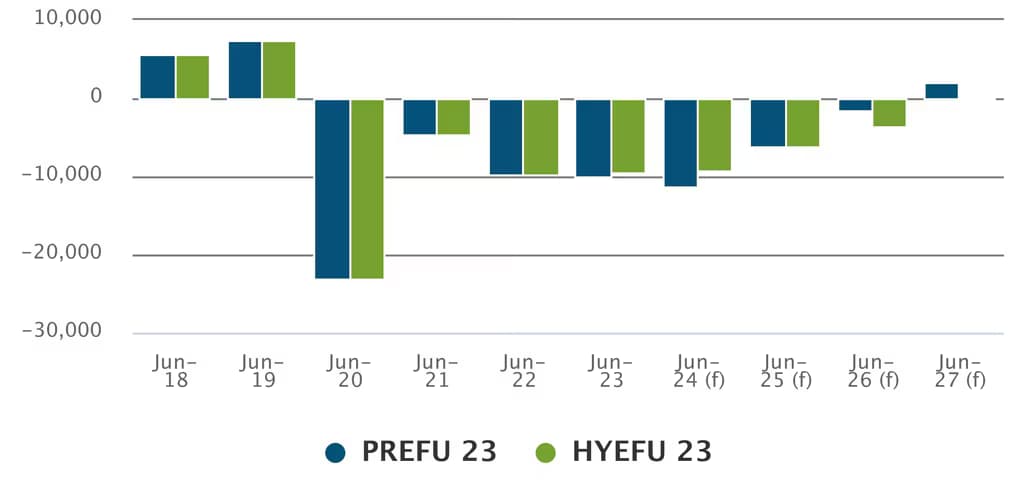
- As a result of these revenue, expenses, and borrowings requirements, the expected OBEGAL surplus for 2026/27 has been slimmed from $2.1b at PREFU to a razor-thin $140m at HYEFU.
- The government also announced a Mini-Budget today, outlining a number of immediate fiscal decisions ahead of the usual full Budget in May 2024. Included in the Mini-Budget was an initial savings programme worth $7.5b over the forecast period, with stop work instructions for several major projects (saving $2.6b), tax and income changes ($2.8b), and reprioritisation of some Emissions Trading Scheme funding ($2.0b).
- The cost of National’s income tax relief programme (expected to commence in July 2024) and reintroduction of interest deductibility for residential investors wasn’t provided (although a deductibility announcement is expected early in 2024), with these policies to be detailed at the Budget in May 2024. However, Treasury expect the government’s policy programme impact to be “broadly [fiscally] neutral”.
OBEGAL surplus slimmed to a razor-thin $140m
$b, Year-end operating balance before gains and losses
...and our reaction
- The National-led government is facing an even more challenging economic starting point than first expected, which has led to lower tax take expectations, more debt to compensate for the lost revenue, and a more difficult fiscal pathway forward.
- The PREFU in September had already showed little head room for any new spending, and today’s HYEFU showed that options for the new government are even more restricted. We expect the focus of Budget 2024 to be on keeping the lights on, delivering on core election promises of tax relief, and not a lot more.
- The first round of fiscal consolidation plans have been announced, but more will follow in 2024 once more detailed decisions are made on the nature of tax changes, government departmental spending, and other coalition commitments – although we expect that some of these commitments will need to be managed or scaled down.
- Treasury’s broader economic forecast show that economic growth between 2023 and 2025 will be entirely driven by population growth, as GDP per-capita declines.
Latest updates
Premium

Economic and fiscal update
Budget 2026: Fiscal position set to improve
Thu 28 May 2026
 $3b Surplus a year earlier in 2030
 $10.8b Higher revenue over 2026-30, relative to HYEFU$100m pa Funding for councils to invest in infrastructure
Premium
Economic and fiscal update
OBEGALx return to surplus delayed yet again
Tue 16 Dec 2025
Core Crown revenue down $6.3b, and expenses up $0.5bReturn to surplus now in 2029/30 (OBEGALx)80% of the increase in net Core Crown debt to fund capexEconomic and fiscal update
Budget 2025: The switch-it budget
Thu 22 May 2025
Core crown revenue down $9.8b, and expenses down $3.1b Return to surplus in 2028/29Investment Boost tax incentive to drive investment
Economic and fiscal update
Return to surplus pushed out another two years
Tue 17 Dec 2024
Slower productivity growth lowers GDP growth trackGovernment spending remains above 31% of GDPReturn to surplus in 2028/29 (OBEGALx)