Gross domestic product
Broad weakness gives Reserve Bank some breathing room
14 Dec 2023

Our take on the latest Gross domestic product (Thu 14 Dec 2023)

0.3% fall in GDP in Sep quarter
4.5%pa fall in investment spending
2.0%pa fall in government consumption
The key numbers...
- The economy shrank by 0.3% in the September quarter, marking the third quarterly contraction in the last year. The result was well below market expectations of a 0.2% increase, with the lowest pick being -0.1% growth.
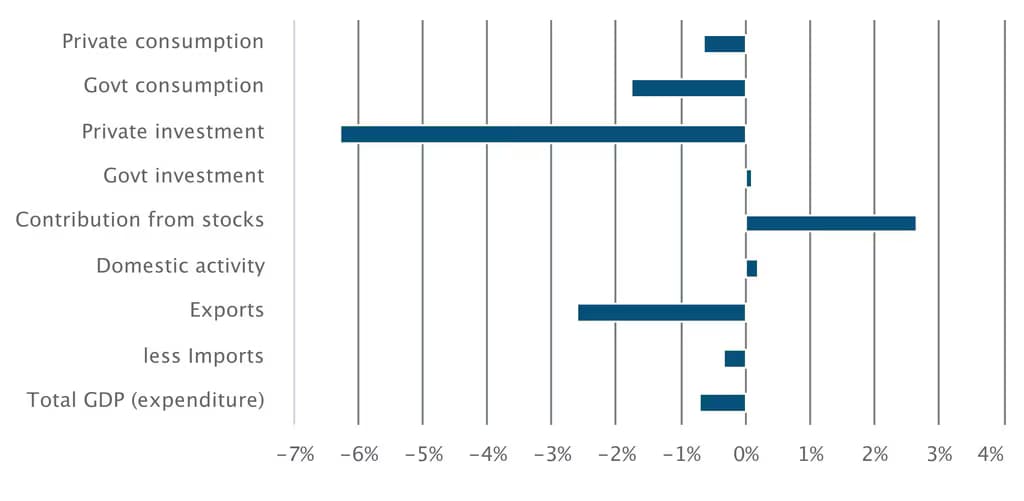
- A 4.5%pa contraction in investment spending (gross fixed capital formation) made the biggest negative contribution to GDP. This contraction was driven by a 7.8%pa fall in private sector investment – the largest decline in investment for the private sector since 2009 (excluding lockdowns).
- The fall in investment was broad-based, with non-residential construction declining 7.4% over the quarter and transport equipment plunging 27% (partly due to additional vehicle purchases in June before changes to the Clean Car Discount were implemented). Year-end growth in investment in plant and equipment and intangible assets are also both at their weakest since 2016 or 2017 (excluding lockdowns).
- Government consumption spending continues to moderate, with year-end growth at 1.5%, thanks to a 2.6% contraction in central government consumption. These declines are the largest since 1991.
- A 0.6% fall in private consumption spending points towards weakness in household demand, particularly in the context of 2.7%pa population growth. The biggest negative contributions to household spending over the year to September are household contents and services (-6.3%, the largest fall on record), food and non-alcoholic beverages (-2.6%), restaurants and hotels (-4.0%), recreation and culture (-1.6%, the largest fall since 2010), clothing and footwear (-1.8%, the largest fall since 1992, excluding lockdowns), and communications (-0.9%, the largest fall on record).
Components of expenditure GDP
Quarterly % changes
...and our reaction
- The broad-based nature of the slowdown, across businesses, central government, and households, reflects the effects of tighter monetary and fiscal policy flowing through into real economic outcomes. Exports are also sluggish due to weaker world demand and production being hit by difficult weather conditions.
- Businesses are investing less across the board, consistent with higher interest rates limiting further borrowing as well as concerns about weaker demand limiting future expenditure. Households are spending less, and the government isn’t adding as much demand into the economy either. Taken together, today’s data highlights that there is less intense demand across the economy and therefore less sustained upwards pricing pressure than before.
- Alongside the latest quarterly growth figure coming in 0.5 percentage points below market expectations, downward revisions to previous quarters mean the economy in the September quarter was about 1.7% smaller than analysts had been expecting.
- The Reserve Bank had estimated the economy was producing 0.8% above sustainable potential in the September quarter. The data revisions could also see revisions to the Bank’s estimate of potential output, but the latest data suggests that demand pressures are less acute than the Bank had feared at its recent Monetary Policy Statement.
- We retain our view that the official cash rate has peaked at 5.5%. Although the interest rate risks remain to the upside at the moment, next year we expect to see persistent weakness across household spending and business investment. This outcome will be driven by higher interest rates continuing to bite, more downward pressure on government spending following the change in government, and exports struggling in the face of the weak Chinese economy.
- Nevertheless, the Bank will still be looking forwards in its decision-making around monetary policy. Record high net migration and upward momentum in the housing market mean the Bank is likely to remain nervous about inflationary risks. There’s nothing in today’s data to suggest the need for a further raise, but equally there’s not enough to consider bringing forward rate cuts either.
Latest updates
Premium

Gross domestic product
NZ economy picking up before fuel price spike
Thu 18 Jun 2026
Quarterly
 0.8% GDP in Mar 2026 qtr (sa)2.5% Business investment from Dec 2025 qtr (sa)
 0.5% Household spending from Dec 2025 qtr (sa)
Premium
Gross domestic product
No momentum in recovery, even before Iran
Thu 19 Mar 2026
Quarterly
0.1% GDP from Sep 2025 qtr (sa) 0.1% Household spending from Sep 2025 qtr (sa)3.2% Private investment from Sep 2025 qtr (sa)
Gross domestic product
Economy bounces back 1.1% from June’s dip
Thu 18 Dec 2025
Quarterly
1.1% rise in GDP in September quarter from JuneInvestment spending up 3.2% from June 2025Manufacturing activity up 2.2% from June 2025Gross domestic product
Economy contracts 0.9% as international uncertainty bites
Thu 18 Sept 2025
Quarterly
0.9% fall in GDP in June quarterHousehold spending up 0.4% from Mar 2025Manufacturing activity declines 3.5% from Mar 2025