
Our take on the latest National population estimates (Thu 16 Nov 2023)
Total NZ population estimate
5,269,200

As at September 2023
Population growth accelerates to 2.7%pa in the September quarter
Annual net migration lifts to 118,900
The key numbers...
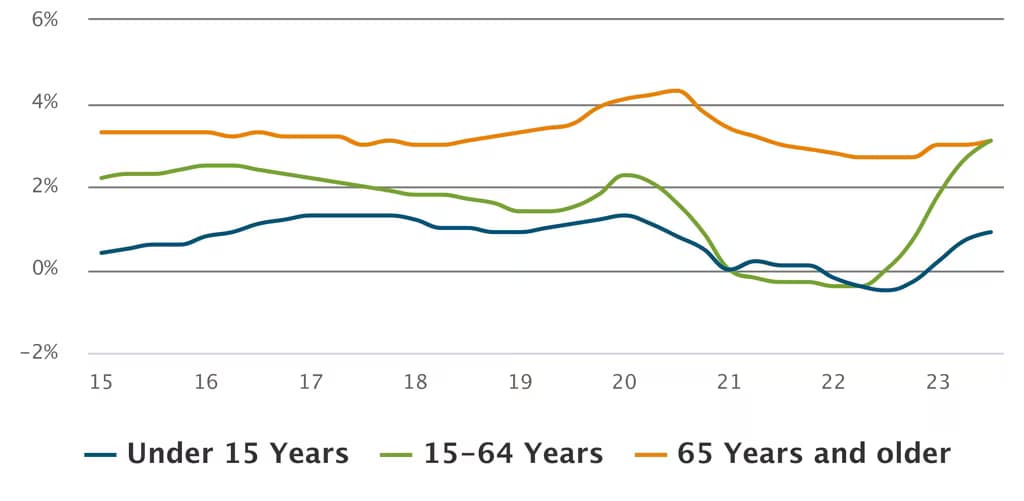
- The resident population of New Zealand was estimated at 5,269,200 in the September 2023 quarter, up 2.7%pa from the September 2022 quarter. This increase represents New Zealand’s fastest population growth since 1952.
Working-age population growth rivals 65+
Annual % change, NZ population
...and our reaction
- The population continues to grow at a remarkable rate, buoyed by further rises in net migration from already record levels. Record-high net migration pushed population growth to its highest since 1952, when New Zealand was experiencing the combination of the post-WWII baby boom and strong net migration. Unlike 1952, natural increase in 2023 has been muted, with an elevated number of deaths coupled with weak births. We expect natural increase to bounce back a little in the next year or two, although the long-term outlook is for it weaken as the population ages.
- Foreign migrant arrivals continue to drive the net migration gain, with 210,600 non-citizens arriving in New Zealand in the year to September 2023, for a net gain of 163,600 non-citizens. The immigration Green List has been a key enabler of these flows – and is more permissive for transition to residency – meaning a greater share of recent migrants will be able to stay than those in the last non-citizen migration surge of 2014-2017. The flipside of this work-oriented migration gain is that it is likely to dry up quickly as vacancies become filled. Job ads declined 26%pa in October 2023, so net migration is likely at or near its peak.
- New Zealanders continue to seek fresh pastures, with net migration losses of New Zealand citizens deepening to 44,700 in the year to September 2023, the worst on record. Data up to March 2023 indicated that just over half of this flow was going to the browner pastures of Australia. Because international migrants tend to settle in major urban areas, the spoils of record net migration have been shared unevenly – population growth has accelerated in cities and tourism hotspots, and eased in regions with more of a domestic migration focus. It appears that for those looking to move, moving overseas is a better option than switching regions for now.
Latest updates
Premium

National population estimates
Slight pick-up in population growth
Tue 18 Aug 2026
Quarterly
 5,357,300 Total NZ population estimate as at June 2026
 0.7%pa Population growth in June 2026 quarter17,600 Net migration gain over the year to June 2026
Premium
National population estimates
Population growth lifted by increasing migration
Mon 18 May 2026
Quarterly
5,361,300 Total NZ population estimate as at March 20260.8%pa Population growth in March 2026 quarter24,200 Net migration over the year to March 2026National population estimates
Population growth steady at 0.6%pa
Tue 17 Feb 2026
Quarterly
5,342,000 Total NZ population estimate as at December 2025 0.6%pa Population growth in December 2025 quarter14,200 Net migration over the year to December 2025
National population estimates
Population growth steady at 0.6%pa
Mon 17 Nov 2025
Quarterly
5,334,200 Total NZ population estimate as of September 2025
Population grows 0.6%pa in September 2025 quarterNet migration edges up to 12,500 for year ending September 2025