Consumers price index
Inflation slows to 5.6%pa, but domestic pressures persist
17 Oct 2023

Our take on the latest Consumers price index (Tue 17 Oct 2023)


Annual inflation slowed to 5.6%pa in September quarter
Domestic inflation eased to 6.3%pa
Proportion of items rising in price was 10 percentage points less than in June
The key numbers...
- The Consumers Price Index (CPI) rose by 5.6%pa in the September 2023 quarter, a considerably softer result than market expectations.
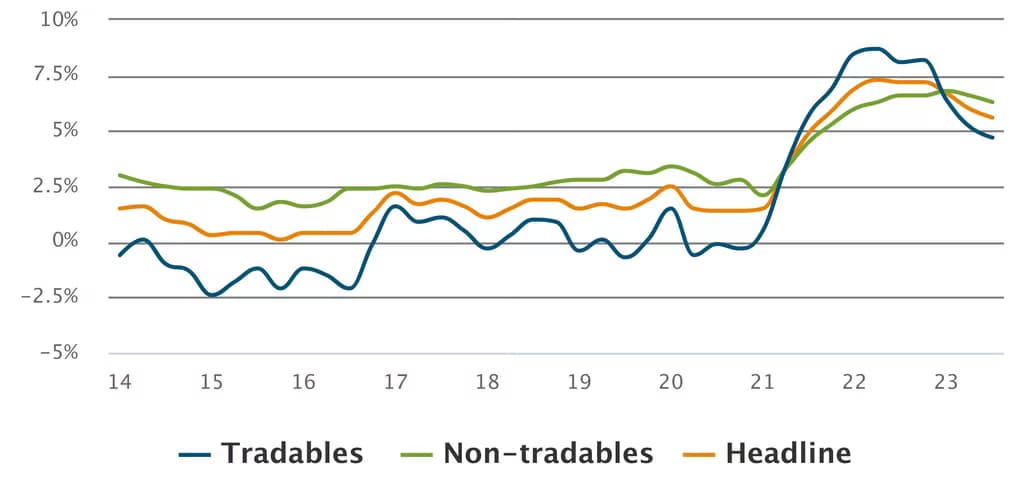
- Tradable (overseas based) inflation slowed from 5.2%pa in June to 4.7%pa in September, despite surging fuel prices. Non-tradable (domestically based) inflation eased slightly to 6.3%pa, but this result marked its seventh consecutive quarter above 6.0%pa.
- Services based inflation eased to 5.6%pa, reflecting how high migration has helped reduce labour shortages and is starting to provide some relief to wage pressures.
- Food price inflation eased to 8.8%pa, with a marked slowdown in fresh food prices.
- Residential building cost inflation continued to slow, easing to 5.0%pa.
- In contrast, transport costs rose a massive 7.1% from the June 2023 quarter, lifting annual transport inflation to 4.6%pa.
- Rental inflation accelerated slightly from June, rising to 4.4%pa, as high migration continues to increase demand for housing. Household energy costs also accelerated on annual basis, rising 5.1%pa.
Softer tradable inflation drives CPI slowdown
CPI components, annual % changes
...and our reaction
- Headline inflation continued to soften in September, another step in the right direction. However, concerns remain around the stickiness of non-tradable inflation, and the potential flow-on effects of higher transport costs into prices for other goods and services during 2024.
- Easing tradable inflation was the primary driver of today’s result, with electronic and medical equipment prices recording sizable declines.
- Fuel prices were expected to rise sharply, due to the return of the fuel excise duty and full-price public transport fares. However, the spike in global oil prices throughout the quarter provided for a more pronounced increase than anticipated.
- Although the Reserve Bank is unable to influence fuel prices, we expect the Bank will monitor them closely – the possibility of higher transport costs for businesses being passed onto consumers presents an additional inflationary risk.
- Inflation is generally slowing across important categories such as food, building costs, and health. The proportion of items in the CPI still increasing in price eased to 58%, indicating that the base of price pressures is narrowing. However, several domestic components of inflation have remained stubborn, including accelerating growth for rents and property rates.
- The September quarter result was definitely good news, but was largely due to softening overseas-based inflation. With non-tradeable inflation still above 6.0%pa and relatively strong, the Bank cannot be entirely confident yet that domestic price pressures are under control.
- We do not expect the official cash rate to rise further from here, as long as domestic inflation shows more definite signs of slowing in coming quarters, and the extreme tightness in the labour market continues to ease.
Latest updates
Premium

Consumers price index
Fuel price spike sends annual inflation to 4.1%pa
Tue 21 Jul 2026
Quarterly
 4.1%pa Annual inflation rises in June 20262.9%pa Inflation excl fuel slowed1.6% Building costs up in June 2026 quarter
Premium
Consumers price index
Inflation still high going into fuel price shock
Tue 21 Apr 2026
Quarterly
 3.1%pa Annual inflation unchanged in March3.5%pa Non-tradables inflation unchanged since Sep 2025
 68% Items increasing by expenditure weight
Consumers price index
Inflation breaches the RBNZ upper band
Fri 23 Jan 2026
Quarterly
Inflation up to 3.1%paNon-tradable inflation unchanged at 3.5%pa OCR expectations and wholesale interest rates likely to increase
Consumers price index
Inflation rises to 3.0%pa, hits top of the Reserve Bank's band
Mon 20 Oct 2025
Quarterly
Prices up 1.0% in September quarterNon-tradable inflation eases to 3.5%paHighest annual electricity inflation since 1989