Economic and fiscal update
PREFU shows short-term borrowing at long-term cost
12 Sept 2023

Our take on the latest Economic and fiscal update (Tue 12 Sept 2023)


Economic performance broadly unfolding as expected
Additional $7b in expenditure over forecast period
Net debt to be $13b higher by 2027
The key numbers...
- Latest Treasury forecasts indicate that the economy is broadly performing as expected in the Budget Economic and Fiscal Update (BEFU) in May. Expectations for key indicators such as unemployment and wage growth over the next four years were quite consistent with BEFU forecasts. High net migration and stabilising house prices are continuing to support the economy, but interest rates will remain elevated to dampen demand and bring it closer in line with supply.
- However, the fiscal outlook is considerably more challenging than expected at the Budget.
- Tax revenue expectations are lower during every year of the forecast period, driven by a limited corporate tax take. However, the outlook for overall core Crown revenue is less downbeat. Projected core Crown revenue was revised lower for the 2024 and 2025 fiscal years, and higher over 2026-27, leaving the total take over the forecast period $632m higher than expected in May.
- The real risk to the government’s fiscal position is consistently higher spending. Despite the Finance Minister signalling a $4b reduction in expenditure over the forecast period prior to today’s pre-election update, forecasts of core Crown expenditure in fact rose by $7b.
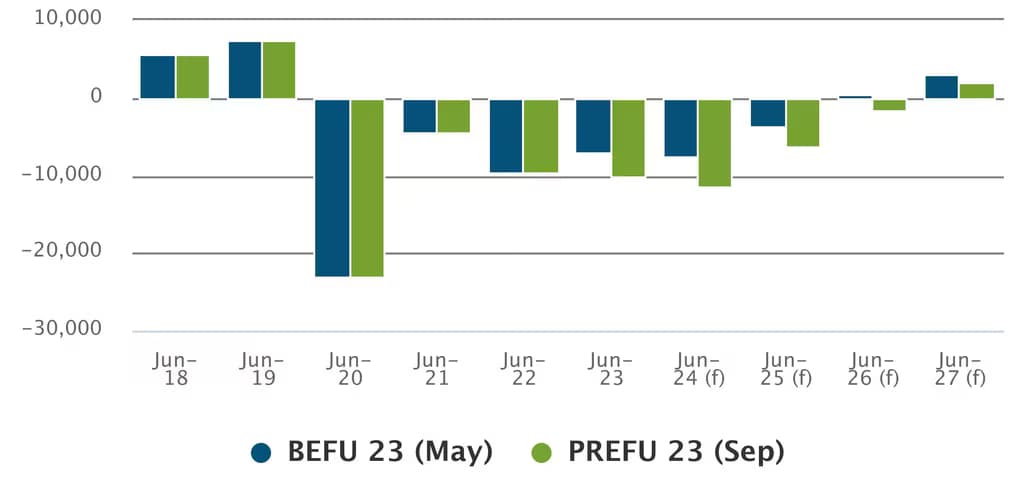
- Significantly higher expenditure with more subdued revenue growth has pushed expectations for the OBEGAL’s return to surplus out another year, to 2027. The OBEGAL deficit is expected to be $2-4 larger each year in the near-term, and the expected surplus in 2027 was pared back from $3b to $2b.
- Larger deficits and a slower return to surplus will require more borrowing, meaning net debt in the 2027 fiscal year is now expected to be $13b higher than previous forecast.
Fiscal surplus expected to come later
OBEGAL, $m, Treasury forecasts
...and our reaction
- The PREFU showed that costs have risen significantly for the government, while tax revenue is being squeezed by rising business costs and slowing demand.
- The $7b in increased expenditure is driven primarily by higher debt-servicing costs, higher transport investment, and higher levels of benefit payments. An extra $0.3b is expected to be spent over the forecast period on the North Island extreme weather events (compared to Budget 2023), which is a small proportion of overall cost pressures, despite being cited by politicians as a key driver.
- Although net debt will be maintained below 30% of GDP, a higher peak of 23% in the 2025 fiscal year means future governments will take on a tougher challenge than was indicated at the Budget.
- Essentially, today’s update showed that future Kiwis face a higher debt burden in order to keep the lights on today. The operating allowance is sufficient for funding the rising cost of current public services, but there is little head room for any new spending going forward.
Latest updates
Premium

Economic and fiscal update
Budget 2026: Fiscal position set to improve
Thu 28 May 2026
 $3b Surplus a year earlier in 2030$10.8b Higher revenue over 2026-30, relative to HYEFU
 $100m pa Funding for councils to invest in infrastructure
Premium
Economic and fiscal update
OBEGALx return to surplus delayed yet again
Tue 16 Dec 2025
 Core Crown revenue down $6.3b, and expenses up $0.5bReturn to surplus now in 2029/30 (OBEGALx)80% of the increase in net Core Crown debt to fund capex
Economic and fiscal update
Budget 2025: The switch-it budget
Thu 22 May 2025
Core crown revenue down $9.8b, and expenses down $3.1bReturn to surplus in 2028/29Investment Boost tax incentive to drive investmentEconomic and fiscal update
Return to surplus pushed out another two years
Tue 17 Dec 2024
Slower productivity growth lowers GDP growth trackGovernment spending remains above 31% of GDPReturn to surplus in 2028/29 (OBEGALx)