Gross domestic product
Economy emerges from recession more strongly than expected
21 Sept 2023

Our take on the latest Gross domestic product (Thu 21 Sept 2023)


0.9% GDP growth in the June quarter
5.0% quarterly growth in exports
2.0% quarterly decline in imports
The key numbers...
- GDP growth of 0.9% in the June quarter was stronger than the market’s pick of 0.5%, and it means the recession that started in late 2022 has come to an end – if it was there at all. The previous March quarter’s growth was revised from -0.1% to 0.0%, and is only marginally negative at a deeper level of detail.
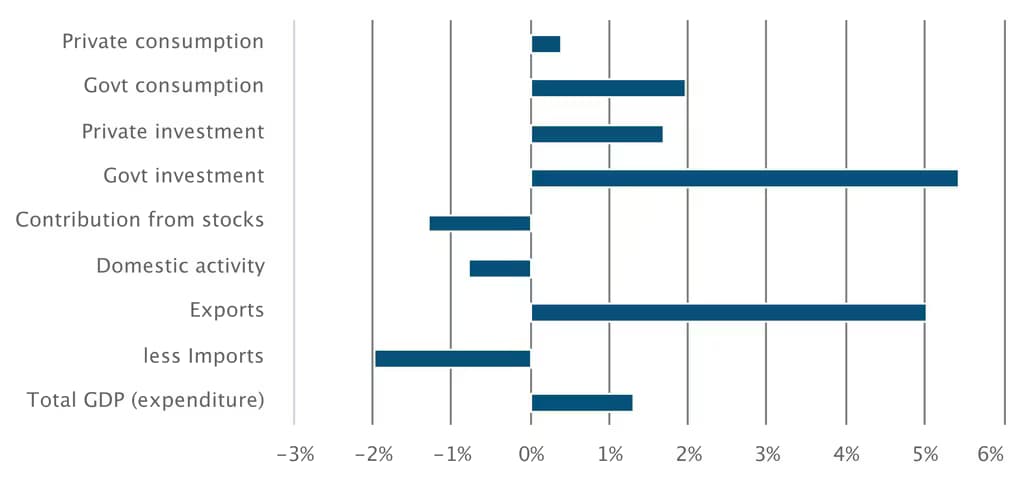
- Export volumes jumped 5.0% between March and June, including a 3.9% increase in goods exports (all figures seasonally adjusted). The largest contribution to this growth was a 15% quarterly lift in dairy products exports, with sizable increases also recorded by forestry primary products, meat products, and mining exports.
- In contrast, import volumes recorded their largest quarterly decline in 15 months. Imports of capital equipment declined sharply, while imports of intermediate products (which are often inputs into domestic manufacturing) are also coming under pressure.
- Both the higher exports and lower imports link in with the largest run-down of inventories, compared to a year earlier, since 2009. As international supply chains return towards normal, and domestic demand softens, firms are keeping less stock on hand, particularly in the distribution sector.
- Government consumption increased 2.0% over the quarter, the strongest quarterly growth after 18 months of relative restraint.
- Household spending edged up 0.4% from March, a result that was stronger than retail data might have suggested. A 3.3% lift in spending in durables was particularly surprising given the budgetary pressure that households are feeling.
Components of expenditure GDP
Quarterly % changes
...and our reaction
- There were expectations of a rebound in GDP in the June quarter, as activity in some areas recovered from Cyclone Gabrielle in February, and strong population growth helped boost demand. However, the fact that per-capita GDP increased by 0.2% compared with March is, on balance, a surprisingly strong result.
- Signs of a rebalancing in economic activity, with more exports and fewer imports, is heartening, and aligns with yesterday’s balance of payments figures showing the current account deficit has shrunk from 8.8% to 7.5% of GDP since the end of 2022.
- However, the fact that some of this export growth has been achieved by running down stock levels suggests it might not be sustained. On a production basis, GDP levels for agriculture, forestry, wood manufacturing, and non-metallic mineral manufacturing were all at their lowest in several years (excluding 2020’s lockdown-affected quarter).
- On its own, today’s result is unlikely to significantly change the Reserve Bank’s outlook for the official cash rate. However, the glimpses of lingering demand pressures in some areas, such as durables spending and government consumption, could cause some concern when taken alongside the persistence of inflationary pressures implied by the recent surge in transport costs, and the lack of any significant easing in the labour market to date.
- The official cash rate will remain at 5.5% at the next review in early October. The Reserve Bank will be keenly watching inflation and labour market data over the following weeks, as well as the signalled trends in fiscal policy following the election.
Latest updates
Premium

Gross domestic product
NZ economy picking up before fuel price spike
Thu 18 Jun 2026
Quarterly
0.8% GDP in Mar 2026 qtr (sa)2.5% Business investment from Dec 2025 qtr (sa) 0.5% Household spending from Dec 2025 qtr (sa)
Premium
Gross domestic product
No momentum in recovery, even before Iran
Thu 19 Mar 2026
Quarterly
0.1% GDP from Sep 2025 qtr (sa) 0.1% Household spending from Sep 2025 qtr (sa)3.2% Private investment from Sep 2025 qtr (sa)
Gross domestic product
Economy bounces back 1.1% from June’s dip
Thu 18 Dec 2025
Quarterly
1.1% rise in GDP in September quarter from JuneInvestment spending up 3.2% from June 2025Manufacturing activity up 2.2% from June 2025Gross domestic product
Economy contracts 0.9% as international uncertainty bites
Thu 18 Sept 2025
Quarterly
0.9% fall in GDP in June quarterHousehold spending up 0.4% from Mar 2025Manufacturing activity declines 3.5% from Mar 2025