
Our take on the latest Gross domestic product (Thu 15 Jun 2023)


GDP fell 0.1% from the December quarter (seasonally adjusted)
Household spending down 0.2% from a year ago
Exports hit by cyclone, down 2.5% from December (seasonally adjusted)
The key numbers...
- There was a marginal contraction of 0.06% (officially reported as -0.1%) in GDP in the March quarter, confirming that New Zealand has entered its first non-lockdown recession since 2010.
- The biggest negative contribution came from a run-down of stocks, which knocked 1.5 percentage points off quarterly economic growth. The distribution sector has reduced its inventory levels as supply chain disruptions have dissipated, and it is also likely to be anticipating weaker demand conditions going forward.
- Exports shrank by 2.5% from the December quarter, with forestry exports appearing to be hit by Cyclone Gabrielle and a downturn in demand from China. Log export volumes fell 14% from the December quarter, while wood and paper exports declined 12% (all figures seasonally adjusted).
- Services exports fell 1.5% from the December quarter, following three quarters of rapid growth. The stagnation in the March quarter aligns with visitor numbers that plateaued at about two-thirds of pre-COVID levels, and are matched by services exports when we compare activity to its 2019 level.
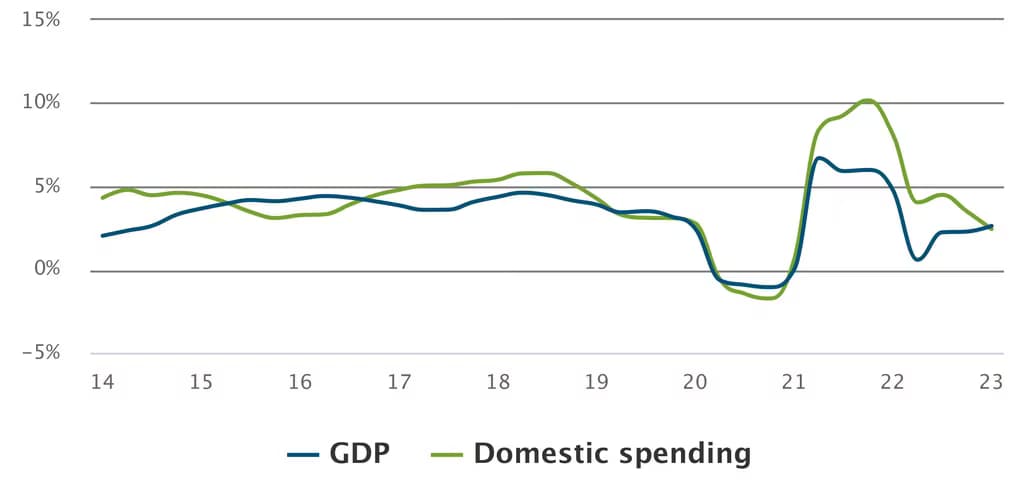
- Household spending declined 0.2% from a year earlier, providing a clear indication of the pressure on households. This annual decline was the biggest since 2009, excluding lockdown-affected quarters.
- Household spending has been hit across the board. Spending on durables is down 11% from a year ago, the largest fall since 1990, while the 6.0% annual decline in spending on non-durables is the largest on record (back to 1988, both figures excluding lockdowns).
- Annual growth rates for spending on food (-7.7%), housing and household utilities (-1.4%), and recreation and culture (-6.3%) are the lowest on record (excluding lockdowns). Spending on alcohol, tobacco, and drugs also plunged 5.2% from the previous quarter (seasonally adjusted), spending on communication is down 1.9% from a year ago, and the annual total of spending on household contents and services is 5.5% lower than the previous 12 months.
- Despite these broad signs of weakness, household spending was measured as jumping 2.4% between the December and March quarters. However, in our view this figure is misleading, and might reflect ongoing difficulties disentangling resident spending from visitor spending given the break in the seasonal pattern caused by the pandemic.
Total GDP and domestic spending
Year-end growth rates
...and our reaction
- Today’s result confirms that the Reserve Bank’s approach to dampen economic activity and therefore lower inflationary pressures is starting to work. The programme of interest rate rises over the last two years has helped soften household demand, and it will continue to do so over the next 12-18 months as mortgage-holders roll onto higher fixed mortgage rates.
- GDP per capita had averaged growth of 2.0%pa between December 2019 and September 2022, faster than any period since 2010-13, when the economy had more spare capacity to grow coming out of the Global Financial Crisis.
- During the pandemic, the economy had grown too much, due to excessive monetary and fiscal stimulus which, combined with supply limitations caused by the pandemic, had caused inflation to accelerate. Demand needed to be brought back in line with the ability to supply, so a recession is almost a necessary outcome.
- Higher inflation is still reducing people’s spending power. Although the headline inflation rate eased in the March quarter, higher prices for necessities such as food and petrol are likely to continue negatively affecting spending volumes throughout the rest of 2023.
- Cyclone effects hit exports this quarter, so some of their weakness is likely to reverse out in the June quarter. However, forestry could still be affected by the aftermath of the cyclone combined with weak international prices. Further growth in tourism exports is set to be harder to achieve than what we saw during the second half of 2022, although an emerging recovery in visitor numbers from Asia is encouraging.
- Strong net migration and population growth will prevent the headline GDP results getting as weak as they might otherwise be over the next few quarters. Although GDP has declined 0.8% over the last six months, the per-capita contraction of 2.0% is on a par with 2008/09, at the height of the Global Financial Crisis.
Latest updates
Premium

Gross domestic product
NZ economy picking up before fuel price spike
Thu 18 Jun 2026
Quarterly
 0.8% GDP in Mar 2026 qtr (sa)2.5% Business investment from Dec 2025 qtr (sa)
 0.5% Household spending from Dec 2025 qtr (sa)
Premium
Gross domestic product
No momentum in recovery, even before Iran
Thu 19 Mar 2026
Quarterly
0.1% GDP from Sep 2025 qtr (sa)0.1% Household spending from Sep 2025 qtr (sa)3.2% Private investment from Sep 2025 qtr (sa)Gross domestic product
Economy bounces back 1.1% from June’s dip
Thu 18 Dec 2025
Quarterly
1.1% rise in GDP in September quarter from JuneInvestment spending up 3.2% from June 2025Manufacturing activity up 2.2% from June 2025Gross domestic product
Economy contracts 0.9% as international uncertainty bites
Thu 18 Sept 2025
Quarterly
0.9% fall in GDP in June quarterHousehold spending up 0.4% from Mar 2025Manufacturing activity declines 3.5% from Mar 2025