Economic and fiscal update
Budget 2023: Small policies add to higher government spending
18 May 2023

Our take on the latest Economic and fiscal update (Thu 18 May 2023)


Core Crown expenses up $9.4b over 4 years
Core Crown revenue down $11b over 4 years
Fiscal impulse positive in 2024 as expansionary fiscal policy occurs post-cyclone
The key numbers...
- The government has made several small, targeted, adjustments that include a scrapping of $5 prescription co-payments, 20 hours free early childhood education extended to two-year-olds, public transport subsidies for young people, and more insulation investment.
- It also announced a $6b increase in infrastructure investment in response to weather events as part of a National Resilience Plan, alongside $71b in infrastructure investment over the next five years. An additional 3,000 public houses are also expected in 2025, a small boost in the scheme of more than 50,000pa in recent years.
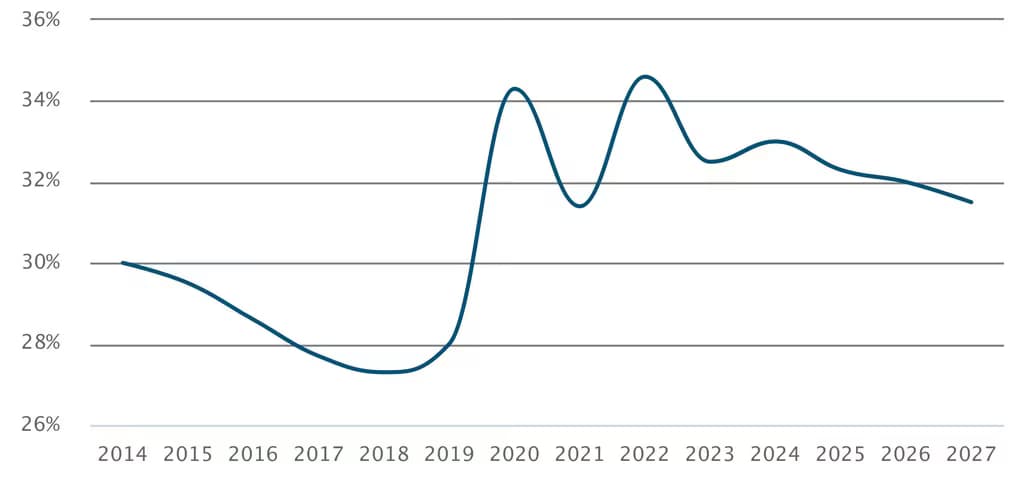
- Core Crown revenue is expected to be $10.7b lower between 2024 and 2027 compared to expectations in December at the Half Year Economic and Fiscal Update (HYEFU). Core Crown expenses are set to be $9.4b higher over the same period and will still be more than 31% of GDP in 2028, compared to a pre-pandemic share of 28% of GDP.
- This combination of lower revenue and higher expenses means a $20b gap over four years compared to earlier forecasts, which will be filled by higher debt and a slower return to surplus. Debt is also becoming more expensive to service, with core Crown finance costs set to more than double from 0.8% of GDP in 2022 to 1.8% in 2024, costing $4.6b more in annual interest payments.
- The fiscal impulse turns positive in 2023/24 for the first time since COVID-19 due to the cyclone recovery and higher government spending. That positive impulse shows government spending is expansionary in the year ahead, before turning contractionary again over the next few years.
- Overall, Treasury now expects no recession for New Zealand, but a period of softer and slower growth over the next few years. Inflation forecasts are unchanged, despite the higher level of government spending. Higher net migration is set to bolster economic growth and, paradoxically, reduces expectations for a higher unemployment rate. Treasury now expects the unemployment rate will peak at 5.3% in December 2024, instead of 5.5%. Treasury still expects annual inflation to return to the Reserve Bank’s target range of 1-3%pa by June 2025, with an inflation rate of 2.6%pa in the June 2025 quarter.
Small policies add to higher government spending
Core Crown expenses as a % of GDP
...and our reaction
- Budget 2023 at first glance appears to be a budget with no large spending initiative, but instead a collection of small, targeted supports in line with a more restrained spending focus. However, taken together, these Budget initiatives see a large increase in government spending compared to expectations.
- It’s difficult to see the decline in temporary COVID-19 spending, given that core Crown expenses remain larger than pre-pandemic throughout the entire forecast period.
- Less fiscal restraint than expected raises concerns over the inflationary outlook. The fiscal impulse shows that government spending in 2024 will be stimulatory, and risks keeping inflation higher for longer. In this respect, the Treasury’s forecasts for inflation to fall below 3%pa at the end of 2024 appear optimistic.
- Fiscal settings are becoming more difficult to operate within, with revenue lower, expenses high, and debt-servicing costs rising. Among these challenges, the higher level of investment announced is encouraging. But the lack of detail on these investments discussed in the National Resilience Plan and the Infrastructure Action Plan limits the current understanding of what investments are being prioritised.
Latest updates
Premium

Economic and fiscal update
Budget 2026: Fiscal position set to improve
Thu 28 May 2026
 $3b Surplus a year earlier in 2030$10.8b Higher revenue over 2026-30, relative to HYEFU
 $100m pa Funding for councils to invest in infrastructure
Premium
Economic and fiscal update
OBEGALx return to surplus delayed yet again
Tue 16 Dec 2025
Core Crown revenue down $6.3b, and expenses up $0.5bReturn to surplus now in 2029/30 (OBEGALx)80% of the increase in net Core Crown debt to fund capexEconomic and fiscal update
Budget 2025: The switch-it budget
Thu 22 May 2025
Core crown revenue down $9.8b, and expenses down $3.1b Return to surplus in 2028/29Investment Boost tax incentive to drive investment
Economic and fiscal update
Return to surplus pushed out another two years
Tue 17 Dec 2024
Slower productivity growth lowers GDP growth trackGovernment spending remains above 31% of GDPReturn to surplus in 2028/29 (OBEGALx)