
Our take on the latest Gross domestic product (Thu 16 Mar 2023)


GDP fell 0.6% from the September quarter (seasonally adjusted)
Household spending was flat in the December quarter (seasonally adjusted)
Export volumes fell 2.2% in the December quarter (seasonally adjusted)
The key numbers...
- GDP declined 0.6% in December 2022, after accounting for seasonal effects, which was a steeper fall in economic activity than expected.
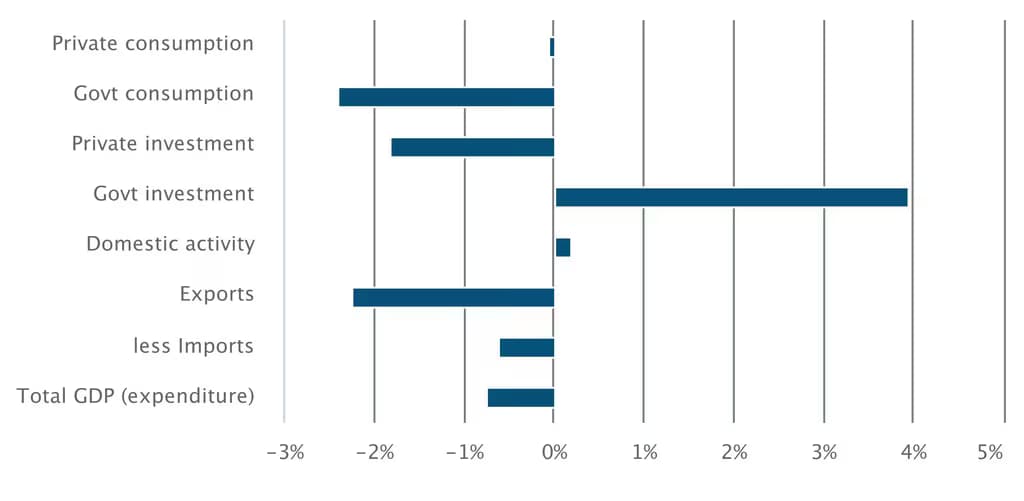
- Household consumption was flat in December 2022, with a 1.7% decline in spending on durable goods weighing on consumption. Spending on services was up 0.7% from the September quarter, and consumables spending was flat, suggesting Kiwis are putting off larger, non-essential purchases (all figures seasonally adjusted).
- Central government consumption fell 2.8% from the September quarter (seasonally adjusted), as the strong spending levels tied to the COVID-19 pandemic are wound back. Despite easing in December, central government consumption remains 16% higher than pre-pandemic levels (December 2019), compared to a 7.0% increase in total economic output.
- Total investment spending fell 1.9% in the December quarter, with key drivers being lower investment in plant, machinery, and equipment and in residential building, which declined 4.1% and 2.2% from September respectively (all figures seasonally adjusted).
- Export volumes declined 2.2% in the December quarter, driven by a 5.3% fall in goods exports, as meat and dairy export volumes weakened compared to September 2022. Service exports rose 5.7%, as international travel continues to recover. Despite a strong increase from September, service exports are still only sitting at 75% of pre-pandemic levels (all figures seasonally adjusted).
- Import volumes increased 0.6% in the December quarter, with strong imports of capital equipment, despite weaker investment in plant and equipment, driving goods imports up 1.8%. Goods imports are now 6.7% higher than pre-pandemic levels, but with goods exports having contracted 3.5% over the same period, New Zealand is currently living beyond its means (all figures seasonally adjusted).
GDP fell more than expected in December
Components of expenditure GDP, Quarterly % changes
...and our reaction
- The fall in economic activity in December 2022 was larger than anticipated, as we expected a 0.2% decline from September, and financial markets were picking a 0.1% drop, rather than the 0.6% decline reported today. The fall in GDP was driven by several factors, with government spending, total investment, and exports all weighing on economic activity.
- Flat household consumption suggests deteriorating economic conditions are starting to affect households. We expect ongoing weakness in household spending throughout 2023 and early 2024 will slowly ease inflationary pressures.
- Softer activity in the manufacturing and retail trade industries came as expected in the December quarter, with activity down 2.0% and 1.9% (seasonally adjusted) from September respectively. However, buoyancy in the non-residential building sector contributed to saw stronger-than-anticipated economic activity in the construction industry. Activity in the transport, postal, and warehousing industry was much weaker than indicators suggested.
- Less upbeat spending and investment results highlight that demand is weakening, which is a necessary evil to get inflation back under control. However, the Reserve Bank’s work is not done yet, with stable household consumption and higher goods imports in December indicating further interest rate rises will still be required to fully tame inflation.
Latest updates
Premium

Gross domestic product
NZ economy picking up before fuel price spike
Thu 18 Jun 2026
Quarterly
 0.8% GDP in Mar 2026 qtr (sa)2.5% Business investment from Dec 2025 qtr (sa)
 0.5% Household spending from Dec 2025 qtr (sa)
Premium
Gross domestic product
No momentum in recovery, even before Iran
Thu 19 Mar 2026
Quarterly
0.1% GDP from Sep 2025 qtr (sa) 0.1% Household spending from Sep 2025 qtr (sa)3.2% Private investment from Sep 2025 qtr (sa)
Gross domestic product
Economy bounces back 1.1% from June’s dip
Thu 18 Dec 2025
Quarterly
1.1% rise in GDP in September quarter from JuneInvestment spending up 3.2% from June 2025Manufacturing activity up 2.2% from June 2025Gross domestic product
Economy contracts 0.9% as international uncertainty bites
Thu 18 Sept 2025
Quarterly
0.9% fall in GDP in June quarterHousehold spending up 0.4% from Mar 2025Manufacturing activity declines 3.5% from Mar 2025