
Our take on the latest Economic and fiscal update (Wed 14 Dec 2022)



Real government consumption to fall
Fuel tax cut to end in March 2023
Treasury now expect a shallow recession in 2023
The key numbers...
- The Government has announced that the temporary reduction to Fuel Excise Duty will be fully extended until the end of February 2023, halved throughout March 2023, and fully removed at the end of March. The reduction to Road User Charges policy is unchanged and stops at the end of January 2023.
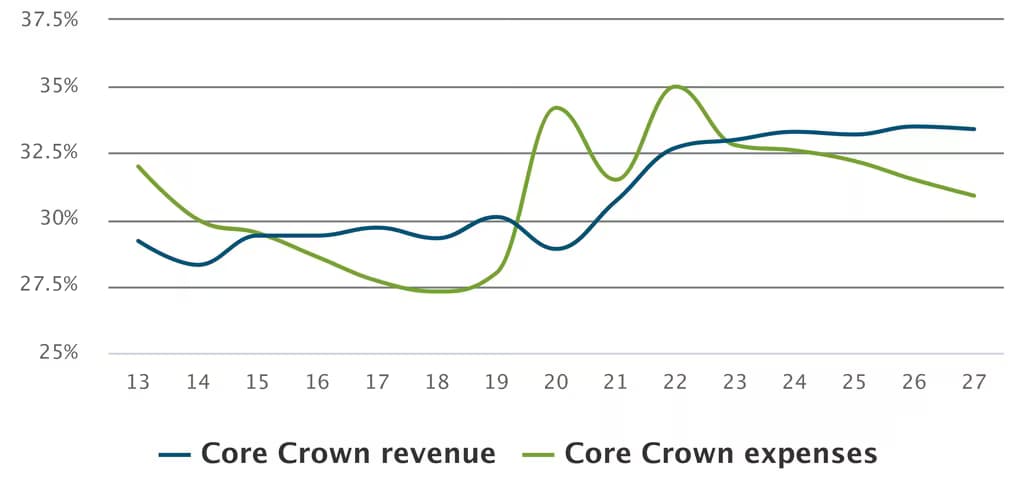
- Treasury’s Half Year Economic and Fiscal Update (HYEFU) shows the challenges of high inflation on the government’s books. Over the next four years, both Core Crown revenue and Core Crown expenses are set to increase by just over $18b, compared to the Budget 2022 update in May.
- However, government consumption is set to moderate faster than first forecast, as pandemic-related spending ends and fiscal settings tighten. Real government consumption is set to fall 8.2% from peak to trough over two-and-a-half years, the largest fall since at least 1987 according to Treasury.
- The Treasury is now expecting a nine-month recession, taking economic activity down 0.8% from peak to trough throughout 2023. The unemployment rate is set to rise to a peak of 5.5% by early 2024 and remain there throughout most of that year.
Government relative earnings and spending to remain higher than pre-pandemic
% of GDP. Source: Treasury HYEFU 2022
...and our reaction
- The government does seem to have started heeding concerns over high government spending and the influence on inflation, with a more pared back spending programme in practice. With the government leaving future Budget allowances unchanged, and more inflationary pressure on baseline budgets, the Finance Minister has made it clear that current spending levels need to be carefully assessed to reprioritise existing funds.
- The forecasts in HYEFU 2022 are a little difficult to judge, given that they were finalised before the Reserve Bank’s November Monetary Policy Statement, and so likely undercook the economic hit from higher interest rates signalled by the Bank.
- The expectation for a shallow recession is broadly in line with most views for the New Zealand economy in 2023, and there does appear to be some room, and willingness, to manoeuvre to provide additional support to the economy in 2023 if this support does not stoke further inflation. It’s worth noting that both Core Crown revenue and expenses, as a proportion of GDP, remain higher than pre-pandemic past 2027.
- The small extension to the fuel excise tax cut is likely a result of the government figuring out its preferred exit strategy and wanting to align the exit with more support that starts next financial year, rather than a pure extension. Nonetheless, it’s been a very expensive and completely untargeted policy.
Latest updates
Premium

Economic and fiscal update
Budget 2026: Fiscal position set to improve
Thu 28 May 2026
 $3b Surplus a year earlier in 2030
 $10.8b Higher revenue over 2026-30, relative to HYEFU$100m pa Funding for councils to invest in infrastructure
Premium
Economic and fiscal update
OBEGALx return to surplus delayed yet again
Tue 16 Dec 2025
Core Crown revenue down $6.3b, and expenses up $0.5bReturn to surplus now in 2029/30 (OBEGALx)80% of the increase in net Core Crown debt to fund capexEconomic and fiscal update
Budget 2025: The switch-it budget
Thu 22 May 2025
Core crown revenue down $9.8b, and expenses down $3.1bReturn to surplus in 2028/29Investment Boost tax incentive to drive investmentEconomic and fiscal update
Return to surplus pushed out another two years
Tue 17 Dec 2024
Slower productivity growth lowers GDP growth trackGovernment spending remains above 31% of GDPReturn to surplus in 2028/29 (OBEGALx)