
Our take on the latest Gross domestic product (Thu 16 Jun 2022)



GDP slipped 0.2% in the March quarter (seasonally adjusted)
Export volumes plummet 14% (seasonally adjusted)
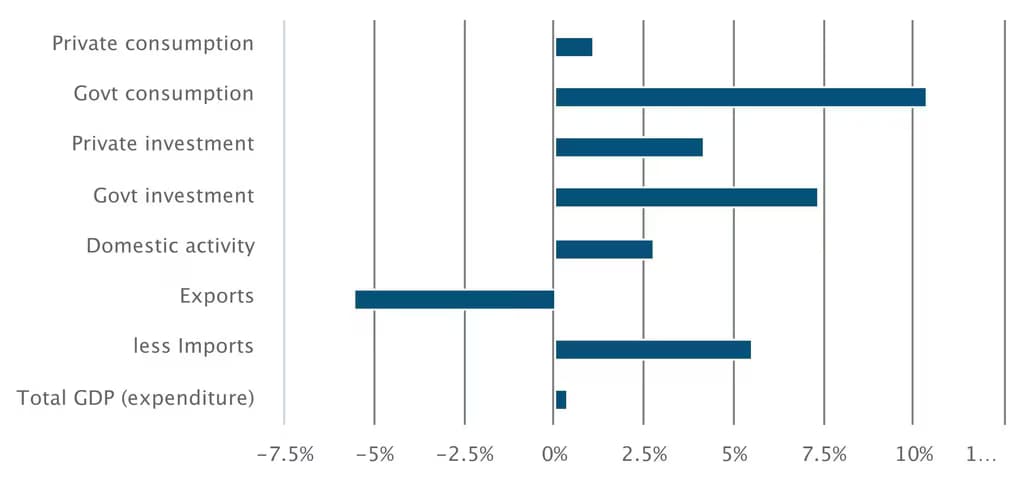
Domestic activity up 2.8% from March 2021
The key numbers...
- GDP edged 0.2% lower in the March quarter compared with December 2021 (seasonally adjusted), but domestic activity increased 2.6% over the same period as the domestic economy largely seemed to shrug off any effects of the Omicron outbreak.
- The GDP killer this quarter was exports, which recorded a 14% seasonally adjusted decline in activity. This shockingly bad result meant that export volumes were at their lowest since 2009
- The export weakness was widespread, with the biggest contributions to the quarterly decline coming from services (-25%), metal products, machinery, and equipment (-12%), dairy products (-5.6%), meat products (-10%), and agriculture and fishing primary products (-10%, all figures seasonally adjusted).
- Household spending bounced back as the COVID-19 restrictions from the second half of 2021 in the upper North Island were lifted in 2022, despite the Omicron Red setting. A 4.6% quarterly increase from December (seasonally adjusted) meant that spending in the quarter was up 1.1% from a year ago and almost back to the pre-pandemic “normal”.
- Government money continues to be a major contributor to demand. Year-end growth in government consumption reached a new post-1970s high of 10.4%, with the central government component recording its sixth consecutive result of quarterly growth over 2% (seasonally adjusted). Year-end growth in government investment is also at an eight-year high of 10.3%.
Components of expenditure GDP
Annual % changes
...and our reaction
- Although today’s GDP data was weaker than the market expected, the mix of growth will provide little comfort for the Reserve Bank in its efforts to get inflation under control. If anything, it reinforces the realities of how disruptive high inflation can be. Strength in domestic spending points to continued buoyant demand conditions and persistent domestic price pressures, at least for now.
- The export result was surprisingly weak. We are not too concerned about the services component, because COVID-19 restrictions have broken the usual seasonal pattern and appear to be exaggerating March’s weakness in what would normally be a peak quarter for tourism. Services exports were still up 6.6% from a year ago, and they are set to rebound in coming quarters as the borders reopen and visitors return.
- The weakness in agriculture exports paints a more troubling picture. It is hard to be sure what is behind the decline, but possible drivers include restricted export shipping capacity, high input costs limiting production, or a lack of available workers. These factors could be leading to conservative production decisions despite high export prices. The lack of clarity around when any of these issues start to be resolved could weigh on goods exports for some time.
- Further growth in household spending will be harder to achieve given the housing market downturn, rising interest rates, and higher prices for fuel and other key consumables. Some spending categories, including transport, restaurants and hotels, and recreation and culture still have room to grow as COVID-19 restrictions ease and international visitors return, but these categories are likely to be the exception to a trend of slowing spending growth.
- Given the ongoing intensification of inflationary pressures both internationally and domestically, the need for the government to rein in its spending is more apparent than ever. The stresses on the economy will only be exacerbated if the Reserve Bank is forced to increase interest rates further than would otherwise be necessary to offset the effects of excessive and prolonged fiscal stimulus.
Latest updates
Premium

Gross domestic product
NZ economy picking up before fuel price spike
Thu 18 Jun 2026
Quarterly
 0.8% GDP in Mar 2026 qtr (sa)2.5% Business investment from Dec 2025 qtr (sa)0.5% Household spending from Dec 2025 qtr (sa)
Premium
Gross domestic product
No momentum in recovery, even before Iran
Thu 19 Mar 2026
Quarterly
0.1% GDP from Sep 2025 qtr (sa)0.1% Household spending from Sep 2025 qtr (sa)3.2% Private investment from Sep 2025 qtr (sa)Gross domestic product
Economy bounces back 1.1% from June’s dip
Thu 18 Dec 2025
Quarterly
1.1% rise in GDP in September quarter from JuneInvestment spending up 3.2% from June 2025Manufacturing activity up 2.2% from June 2025Gross domestic product
Economy contracts 0.9% as international uncertainty bites
Thu 18 Sept 2025
Quarterly
0.9% fall in GDP in June quarterHousehold spending up 0.4% from Mar 2025Manufacturing activity declines 3.5% from Mar 2025