Economic and fiscal update
Big spending government also provides temporary cost-of-living relief
19 May 2022

Our take on the latest Economic and fiscal update (Thu 19 May 2022)


Inflation stays higher for longer
Limited cost of living support of $27pw from August to October for lower income earners; fuel relief extended two months
House prices forecast to drop until mid-2023
The key numbers...
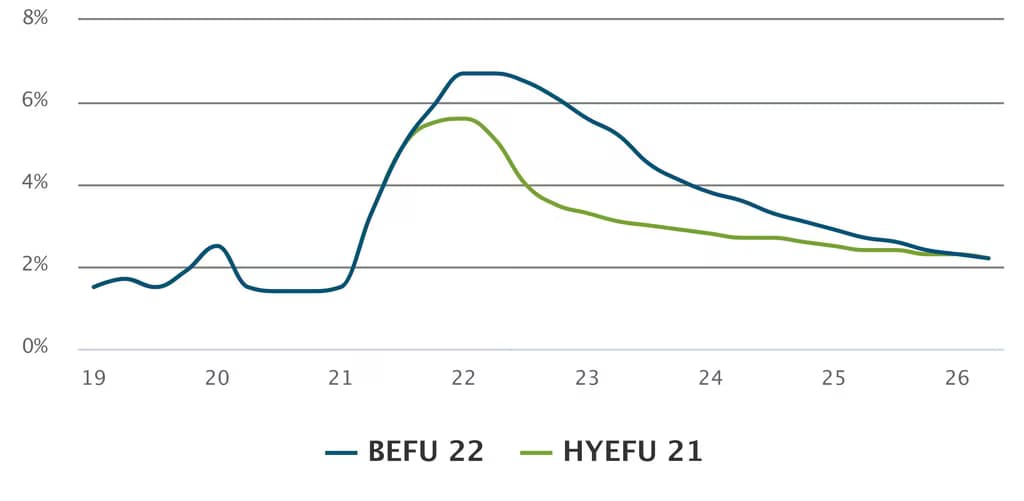
- Treasury expects higher and more persistent inflation, peaking at 6.7%pa in mid-2022 and holding above 3.0%pa until 2025 – a year longer than forecast in December.
- Unemployment is expected to remain around 3.0%pa until the end of 2022, and from there will begin to pick up as interest rates increase, limiting private investment. The unemployment rate is forecast to peak at 4.8% in the first quarter of 2025 and stabilise around that level for the next 18 months.
- Real house prices are set to decline 5.0% by the end of December 2022, with prices down 7.0% in total between the end of 2021 to the near-term low in mid-2023. However, prices at their lowest will remain 32% higher than pre-pandemic levels, compared to inflation up 16% and wages up 18% over the same period.
- Additional investment in hospitals, education, and rail assets have been announced. Over two years, $1.3b is allocated for hospitals in Whangarei, Nelson, and Hillmorton (Canterbury). Feasibility studies are also to be completed on a Northland drydock and a Manukau Harbour port.
- Crown revenue and expenses are expected to be higher than previously forecast. Revenue is expected to be $12.7b higher over the 2022 to 2025 period compared to the Half Year Forecast in December 2021. A more significant revision was made to expenses, which are expected to be $23.8b higher between 2022 and 2025, partly reflecting higher inflation.
- The Operating Balance excluding gains and losses (OBEGAL) is expected to still be in deficit until 2023/24 (a year longer than previously expected), with a surplus in 2024/25.
Treasury sees inflation staying higher for longer
Treasury inflation forecasts, annual % changes
...and our reaction
- The government finds itself in a challenging position, having to navigate higher government spending but also high inflation and a constrained ability to deliver. The government recognises these capacity constraints as a greater challenge than before, and noted a need to “calibrate our programme” of spending given limited materials and workforce capacity.
- Inflation is also hitting households, prompting the announcement of a temporary $27pw Cost of Living Payment from August to October for 2.1m lower income earners. The cut to fuel excise duty and road user charges is also extended for another two months.
- A constrained economy remains, although Treasury’s expectations on the labour market paint a different picture for the future. They expect net migration to rebound quickly from a net outflow in 2022, real wages to turn positive in 2023 and remain stronger, but also a view that the unemployment rate rises to above 4.5% in 2024. We’re less convinced so far that the current labour market tightness turns around so quickly.
Latest updates
Premium

Economic and fiscal update
Budget 2026: Fiscal position set to improve
Thu 28 May 2026
 $3b Surplus a year earlier in 2030$10.8b Higher revenue over 2026-30, relative to HYEFU
 $100m pa Funding for councils to invest in infrastructure
Premium
Economic and fiscal update
OBEGALx return to surplus delayed yet again
Tue 16 Dec 2025
 Core Crown revenue down $6.3b, and expenses up $0.5bReturn to surplus now in 2029/30 (OBEGALx)80% of the increase in net Core Crown debt to fund capex
Economic and fiscal update
Budget 2025: The switch-it budget
Thu 22 May 2025
Core crown revenue down $9.8b, and expenses down $3.1bReturn to surplus in 2028/29Investment Boost tax incentive to drive investmentEconomic and fiscal update
Return to surplus pushed out another two years
Tue 17 Dec 2024
Slower productivity growth lowers GDP growth trackGovernment spending remains above 31% of GDPReturn to surplus in 2028/29 (OBEGALx)