Gross domestic product
GDP rebounds after Delta, but growth is unsustainable
17 Mar 2022

Our take on the latest Gross domestic product (Thu 17 Mar 2022)



GDP rebounded 3.0% in Dec quarter (seasonally adjusted)
Household spending still 2.4% below Jun 2021 (seasonally adjusted)
Imbalances in economy becoming more obvious
The key numbers...
- GDP recovered by 3.0% in the final quarter of 2021 as activity across most parts of the economy bounced back from August’s Delta lockdown.
- However, extended Level 3 restrictions in Auckland and other parts of the upper North Island prevented a full return to “normal”, meaning that GDP was still 0.7% below the June 2021 result.
- Household spending was most affected by the continued COVID-19 restrictions, with a 5.2% rebound in December leaving spending 2.4% below June 2021 levels.
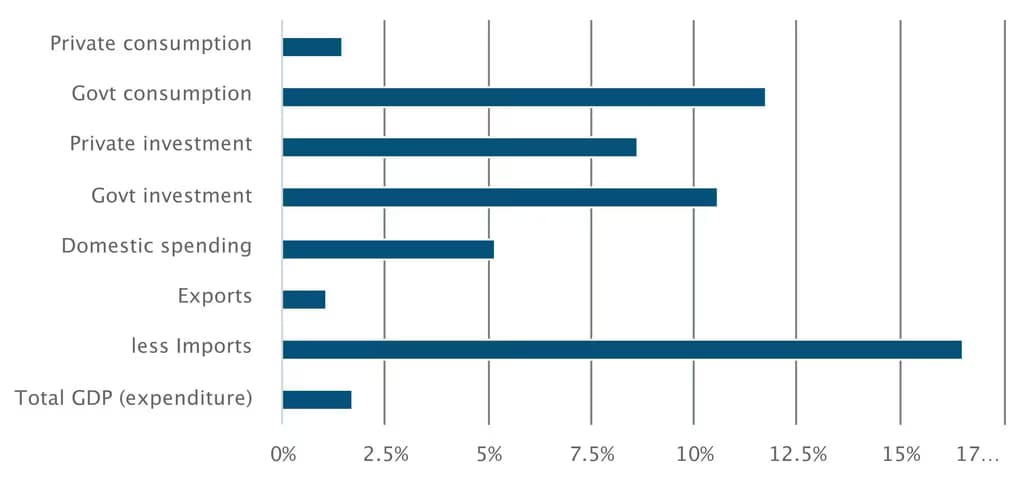
- In contrast to limitations on household activity, investment spending across both the private and public sector surged 11% and 16% respectively from the previous quarter.
- The stimulatory effect of government spending on the economy was reiterated by a record 5.0% quarterly increase in government consumption. Year-end growth in government consumption has climbed to 10% and is into double-digits for the first time since data began in 1989. Unofficial data suggests that growth in government consumption spending has not been faster since 1977/78.
- Year-end government investment grew 6.9%, which is a strong result given that growth would have been higher without the negative effect of the Delta lockdown on infrastructure projects.
- New Zealand’s international trade position continues to become more imbalanced, with import volumes growing 17% over the last year, while export volumes have only risen 1.1%.
Components of expenditure GDP
Annual % changes
...and our reaction
- Today’s data held few surprises. Recent spending numbers show the Omicron outbreak and isolation requirements are having a negative effect on activity. At this stage we expect GDP in the March quarter to be flat or slightly down from December’s result.
- Lingering weakness in household spending was most evident in the expected areas of restaurants and hotels (down 18% from June levels), transport (down 11% from June), and recreation and culture (down 6.4% from June). Omicron means that these spending categories are also struggling in the March quarter. The reopening of the borders to tourists over the next couple of months could spell the start of a more sustained recovery for these businesses.
- Demand for capital investment and household consumption (notwithstanding the Alert Level restrictions) have underpinned the surge in imports. Weakness in export volumes across several primary sector categories at the same time has caused a blow-out in the current account deficit to 5.8% of GDP, the biggest imbalance in almost 13 years.
- Strong growth in government spending highlights the clear effect of stimulatory fiscal policy since COVID-19 hit. The relatively slow levers of government policy suggest that fiscal stimulus could continue to exacerbate capacity pressures in parts of the overstretched economy for some quarters yet.
- Next month’s border reopening is likely to boost both exports and imports of services, as inbound and outbound tourism resumes. The speed of the recovery in either direction is uncertain, but we note that services export volumes have about twice as far to recover to pre-COVID levels as services imports, suggesting a net positive effect for GDP over the recovery period.
- Plunging consumer confidence, shaky spending indicators, rising interest rates, and flat or falling house prices all raise major concerns about prospects for household spending during 2022. Given that household spending represents over 60% of GDP, these concerns mean that domestic economic activity could stagnate or go backwards in the second half of this year.
Latest updates
Premium

Gross domestic product
NZ economy picking up before fuel price spike
Thu 18 Jun 2026
Quarterly
0.8% GDP in Mar 2026 qtr (sa)2.5% Business investment from Dec 2025 qtr (sa)0.5% Household spending from Dec 2025 qtr (sa)Premium
Gross domestic product
No momentum in recovery, even before Iran
Thu 19 Mar 2026
Quarterly
0.1% GDP from Sep 2025 qtr (sa) 0.1% Household spending from Sep 2025 qtr (sa)
 3.2% Private investment from Sep 2025 qtr (sa)
Gross domestic product
Economy bounces back 1.1% from June’s dip
Thu 18 Dec 2025
Quarterly
1.1% rise in GDP in September quarter from JuneInvestment spending up 3.2% from June 2025Manufacturing activity up 2.2% from June 2025Gross domestic product
Economy contracts 0.9% as international uncertainty bites
Thu 18 Sept 2025
Quarterly
0.9% fall in GDP in June quarterHousehold spending up 0.4% from Mar 2025Manufacturing activity declines 3.5% from Mar 2025