
Our take on the latest Consumers price index (Thu 27 Jan 2022)

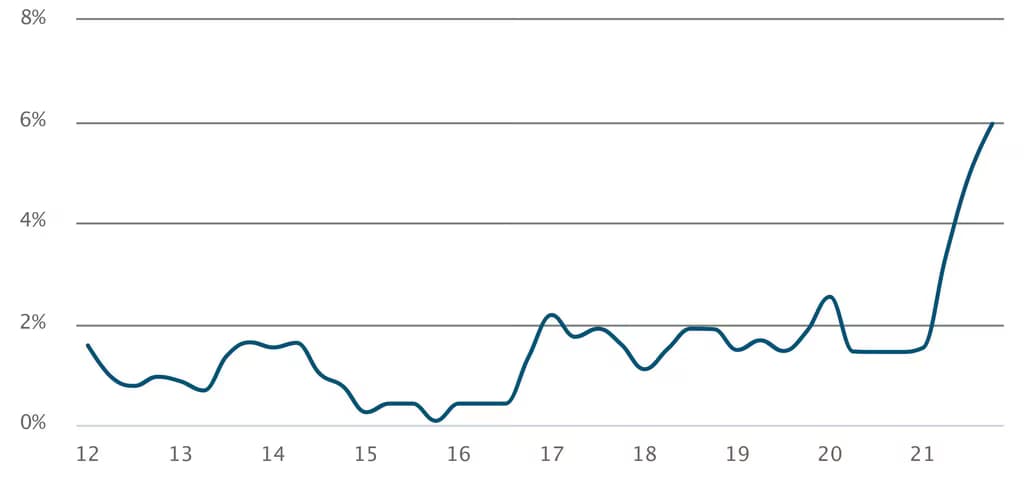
Inflation up to 5.9%pa
Transport costs up 15%pa
Housing and household utility costs up 7.6%pa
The key numbers...
- At 5.9%pa, headline inflation is now running at its fastest rate since 1990. With the 1990 result influenced by an increase in GST the previous year, pricing pressures have not been greater since 1988, before the Reserve Bank was mandated to target price stability.
- Tradable inflation is at 6.9%pa, while non-tradable rate is 5.3%pa. The former suggests we are importing a lot of inflation, while the latter indicates that domestic price pressures, which are more able to be controlled by the Reserve Bank, are also significant.
- Housing and transport costs continue to be the biggest contributors to inflation. Residential building costs are up 16% from a year ago, while petrol prices have risen 30%. These two components are responsible for more than 40% of the increase in the CPI over the last year.
- Other double-digit price rises include international airfares (up 64%), games (40%), real estate services (18%), vegetables (14%), women’s footwear (12%), used cars (12%), and domestic airfares (10%).
Consumer price inflation
Annual rate
...and our reaction
- Today’s result was a little above both market expectations and the Reserve Bank’s forecast of a 5.7% annual inflation rate. It maintains the pressure on the Bank to tighten monetary settings, possibly faster and further than previously indicated.
- We believe that the spike in international shipping costs and the effects of higher oil prices on domestic transport costs are yet to fully flow through into the CPI. Although annual inflation is now close to peaking, price pressures will remain elevated throughout 2022 and into 2023.
- The Bank has previously taken the view that much of the inflationary spike is temporary and due to one-offs to justify its gradual tightening to date. However, the Bank must be increasingly concerned about the lack of pricing discipline in the economy, in contrast to price-setting behaviour throughout the last 30 years.
- Inflation expectations have risen significantly, and firms are comfortable passing on cost increases in an environment where demand is so strong and supply lines have been disrupted or constrained.
- We expect next week’s labour market statistics will add further weight to our view that the official cash rate will need to be increased by 50 basis points at the next Monetary Policy Review on 23 February. Wage growth has yet to fully reflect the labour market’s tightness or accelerate in line with the higher cost of living, and labour costs are likely to be an increasing contributor to inflation in coming quarters.
Latest updates
Premium

Consumers price index
Fuel price spike sends annual inflation to 4.1%pa
Tue 21 Jul 2026
Quarterly
4.1%pa Annual inflation rises in June 2026 2.9%pa Inflation excl fuel slowed1.6% Building costs up in June 2026 quarter
Premium
Consumers price index
Inflation still high going into fuel price shock
Tue 21 Apr 2026
Quarterly
 3.1%pa Annual inflation unchanged in March3.5%pa Non-tradables inflation unchanged since Sep 2025
 68% Items increasing by expenditure weight
Consumers price index
Inflation breaches the RBNZ upper band
Fri 23 Jan 2026
Quarterly
Inflation up to 3.1%paNon-tradable inflation unchanged at 3.5%pa OCR expectations and wholesale interest rates likely to increase
Consumers price index
Inflation rises to 3.0%pa, hits top of the Reserve Bank's band
Mon 20 Oct 2025
Quarterly
Prices up 1.0% in September quarterNon-tradable inflation eases to 3.5%paHighest annual electricity inflation since 1989