
Our take on the latest Gross domestic product (Thu 16 Dec 2021)


GDP contracted 3.7% in September quarter (seasonally adjusted)
Household spending down 7.6% (seasonally adjusted)
Questions about effects of Alert Level 3 on December quarter activity
The key numbers...
- Economic activity in the September quarter was less affected by Alert Level restrictions than had been feared, with GDP down 3.7% from the June quarter (seasonally adjusted).
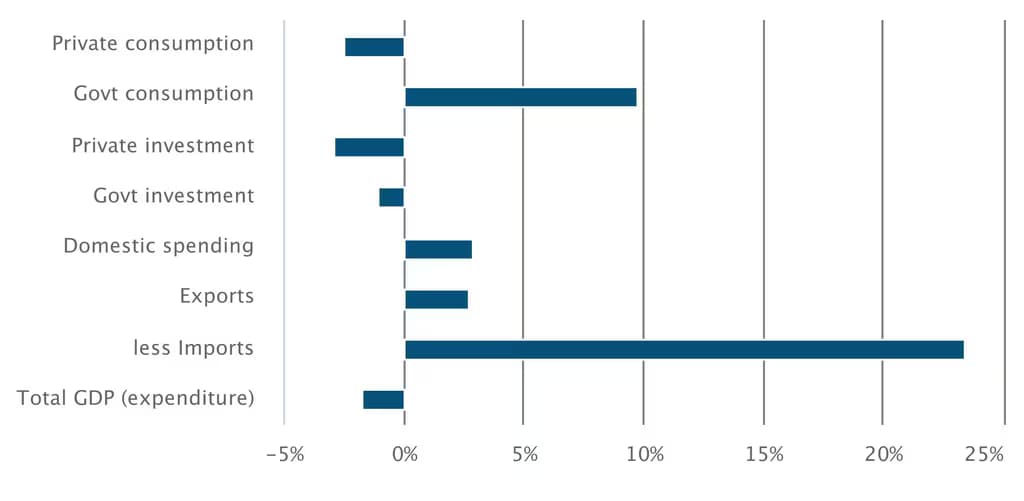
- Household spending in September plunged 7.6% from June, to be down 8.6% from the elevated levels in March (seasonally adjusted). The largest declines from June by spending type were restaurants and hotels (-27%), transport (-18%), clothing and footwear (-18%), household contents and services (-15%), and recreation and culture (-14%).
- International trade was much less affected by COVID-19 than in June last year, when shipping disruption played a major role in outcomes. Exports in September shrank 4.8% from June 2021, compared with a 17% decline in June 2020 from March 2020. In contrast, imports jumped by 5.4% in September as goods imports increased across the board.
- Although investment spending contracted 5.3% in the September quarter, this result was markedly better than the 19% decline between the March and June 2020 quarters 2020. Private investment spending implied that the latest lockdown had less of a negative effect on confidence, with firms continuing to invest in response to labour shortages and expectations of another strong rebound in the economy on the other side of lockdown.
Components of GDP
Annual % changes
...and our reaction
- Market expectations were for a 4.5% decline in GDP in the September quarter, while The Treasury’s and Reserve Bank’s forecasts were -6.2% and -7.0% respectively. Today’s numbers reinforce that, on the whole, the economy is becoming increasingly resilient to lockdowns and other restrictions, and that many businesses are now better able to operate around the disruption of COVID-19.
- Today’s result raises questions about how much below “normal” activity will be in the December quarter, given the prolonged period at Alert Level 3 for Auckland, Northland, and parts of Waikato. In general, the barriers to operating are significantly less at Level 3 than at Level 4, and the adaptability that businesses are showing suggests that activity will hold up better than we might previously have hoped.
- The relatively strong result also reiterates the need for monetary and fiscal stimulus to be wound back more quickly than either the Reserve Bank or the government have indicated so far.
- The only area of doubt on the economy’s strength is around household spending. The latest lockdown appears to have had affected some spending categories more heavily than in the June quarter last year. With consumer confidence weakening in the last couple of months, it remains to be seen how spending will perform during 2022, and whether the latest data signifies a softer growth trend, and if last year’s bounce in activity was a misleading one-off.
- Despite only a subdued decline overall, the effects of lockdown are very unevenly spread across the economy with some industries taking a harder hit. Accommodation and food services contracted 24%, arts and recreation services shrank 11%, and parts of the manufacturing industry also recorded double-digit declines in activity. The spread of outcomes reinforces the need for much more targeted fiscal support than in the past.
- However, the government also needs to be careful it does not get sucked into propping up businesses that might not be viable for an extended period given the prolonged uncertainty presented by COVID-19. In an economy that is butting up against significant labour and capacity constraints, it might be preferable to allow the resources in those businesses to be reutilised in other industries, as much as possible.
Latest updates
Premium

Gross domestic product
NZ economy picking up before fuel price spike
Thu 18 Jun 2026
Quarterly
 0.8% GDP in Mar 2026 qtr (sa)2.5% Business investment from Dec 2025 qtr (sa)
 0.5% Household spending from Dec 2025 qtr (sa)
Premium
Gross domestic product
No momentum in recovery, even before Iran
Thu 19 Mar 2026
Quarterly
0.1% GDP from Sep 2025 qtr (sa) 0.1% Household spending from Sep 2025 qtr (sa)3.2% Private investment from Sep 2025 qtr (sa)
Gross domestic product
Economy bounces back 1.1% from June’s dip
Thu 18 Dec 2025
Quarterly
1.1% rise in GDP in September quarter from JuneInvestment spending up 3.2% from June 2025Manufacturing activity up 2.2% from June 2025Gross domestic product
Economy contracts 0.9% as international uncertainty bites
Thu 18 Sept 2025
Quarterly
0.9% fall in GDP in June quarterHousehold spending up 0.4% from Mar 2025Manufacturing activity declines 3.5% from Mar 2025