
Our take on the latest Economic and fiscal update (Thu 20 May 2021)



Core Crown revenue and expenses both higher than previously forecast
Net debt to GDP peaks lower, at 48% in 2023
House price growth to collapse to just 0.9%pa in mid-2022
The key numbers...
- Budget 2021 shows a strong increase in spending by the government, backed up by a substantial upgrade to Treasury’s economic forecasts as the growth outlook continues to improve. By 2025, core Crown revenue is expected to be 4.5% higher than previously forecast, and expenses are set to be 2.0% higher than forecast in December.
- The government has announced significant benefit increases, increased infrastructure spending, increased training funding, increased health and education spending, and the exploration of a social insurance scheme, as the need for sustained economic stimulus provides an opportunity for the government to open its wallet more.
- Government capital investment over the next four years will increase to $57.3b (from $42.2b previously) with $3.9b of additional infrastructure investment in rail ($810m, including some equipment), education buildings ($634m), and health assets ($700m).
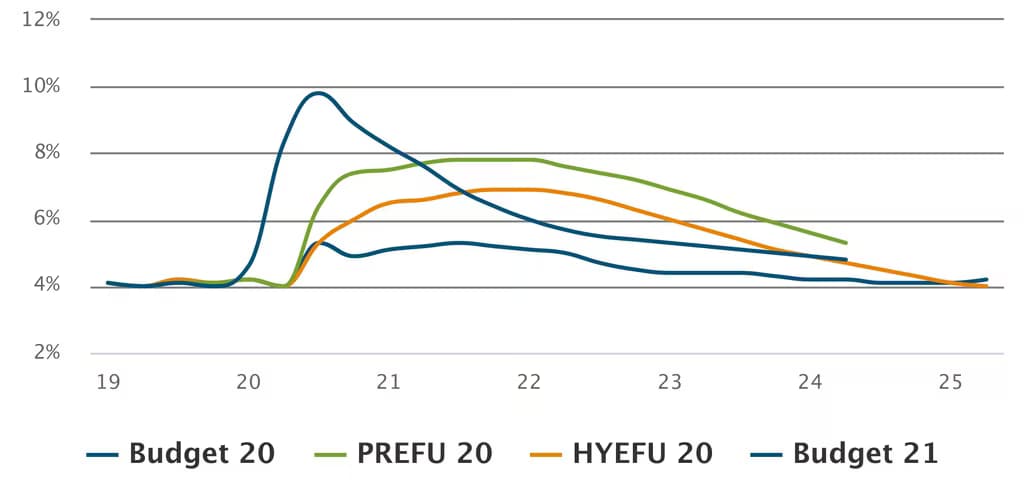
- Treasury now expects the economy to perform substantially better than it did previously, with unemployment forecast to peak at just 5.3% in September 2021 (lower than the 6.9% peak predicted in HYEFU 20). The unemployment rate is now expected to drop back below 5% by mid-2022.
- Treasury projections currently show the government books returning to surplus in 2027, compared to the decade of deficits forecast in December.
Unemployment rate set to be lower
Unemployment rate forecasts, seasonally adjusted. Source: The Treasury
...and our reaction
- Budget 2021 shows that the government is willing to start spending more, but with some restraint. The Budget is a balance between considerable funding requests across the board, the need for economic stimulus, and a focus on keeping debt in check.
- Part of the restraint on spending or investing at greater levels is the government’s ability (or inability) to actually deliver on its programme of work. High levels of investment intentions, but a slow rollout of actual activity, coupled with substantial reform programmes, mean the government is reluctant to take on more when it is already struggling to deliver.
- Increases to benefits start to address concerns about the distributional impacts of COVID-19 and are expected to provide a small boost to economic activity. However, we signal a strong concern that with incomes set to rise, the potential for rental increases to head higher is now more likely. Furthermore, the risk of inflationary pressures already in the economy could limit the real income increases eventually experienced by beneficiaries.
- Treasury expects house price growth to stall, slowing to just 0.9%pa in mid-2022. However, Treasury doesn’t expect house prices to fall as the effects of the housing package announced in March become clearer. Considerably slower house price growth is expected to soften associated growth in household consumption spending.
- Higher infrastructure spending on health and education will support public sector building activity. The budget lacks housing-related investment, and more is needed to boost investment in water infrastructure to boost housing supply. There is a substantial need for further housing policy changes to rapidly increase intensification, new land, and pre-fabrication to speed up residential construction.
Latest updates
Premium

Economic and fiscal update
Budget 2026: Fiscal position set to improve
Thu 28 May 2026
 $3b Surplus a year earlier in 2030$10.8b Higher revenue over 2026-30, relative to HYEFU
 $100m pa Funding for councils to invest in infrastructure
Premium
Economic and fiscal update
OBEGALx return to surplus delayed yet again
Tue 16 Dec 2025
Core Crown revenue down $6.3b, and expenses up $0.5bReturn to surplus now in 2029/30 (OBEGALx)80% of the increase in net Core Crown debt to fund capexEconomic and fiscal update
Budget 2025: The switch-it budget
Thu 22 May 2025
Core crown revenue down $9.8b, and expenses down $3.1bReturn to surplus in 2028/29Investment Boost tax incentive to drive investmentEconomic and fiscal update
Return to surplus pushed out another two years
Tue 17 Dec 2024
Slower productivity growth lowers GDP growth trackGovernment spending remains above 31% of GDPReturn to surplus in 2028/29 (OBEGALx)