
Our take on the latest Gross domestic product (Thu 18 Mar 2021)


GDP contracted 1.0% in Dec 2020 quarter
Import volumes jumped 9.1%
Resilient household spending increased 1.0%
The key numbers...
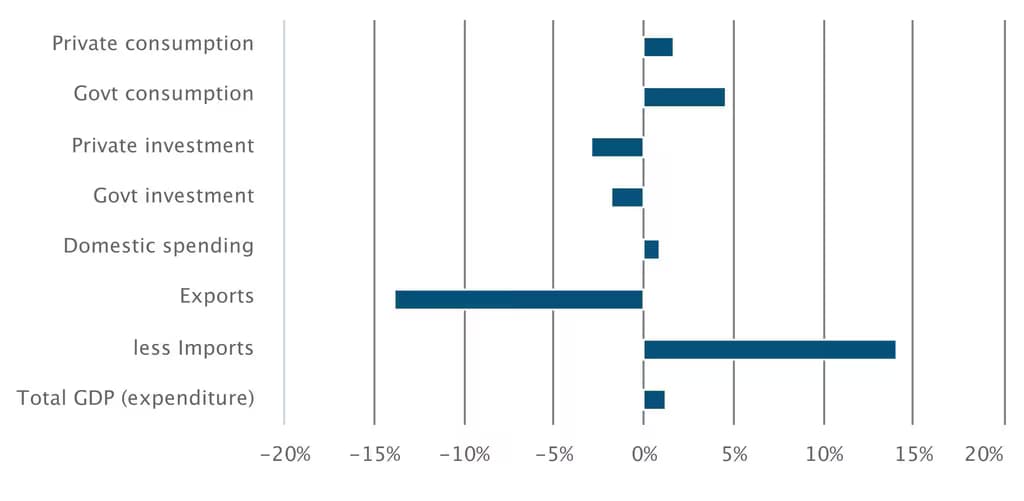
- Economic activity contracted 1.0% in the December 2020 quarter (seasonally adjusted) and was down 0.9% from its December 2019 level.
- Import volumes were heavily constrained in the September quarter by the pandemic and supply chain issues, but exports had been less affected, making GDP in the September quarter look particularly strong. Despite a 9.1% recovery in volumes during the December quarter, goods imports are still 6.4% lower than a year earlier.
- Household spending was pleasantly positive, increasing 1.0% despite weak retail activity. Spending on services was particularly strong, with consumers looking to actively support the recreation and culture sector along with restaurants and hotels.
- Some caution remains around capital expenditure, with private sector capex down 1.0% over the quarter and 2.9% from a year earlier.
- Goods exports were generally strong, up 1.8% in total from a year ago, the first positive growth since mid-2019. However, the overall export picture is being dragged down by services and the lack of international tourists, with services exports down 51% from December 2019.
Components of expenditure GDP
Annual % changes
...and our reaction
- There are elements of good news in today’s data, including continued growth in household spending. Weak retail data in November and December had suggested that the post-lockdown catch-up in spending might have run out of steam, but it appears that consumers’ spending patterns have become more service-orientated, providing some support for industries most heavily affected by the COVID-19 control measures.
- Domestic spending on restaurants and hotels was up 16% from a year ago, while spending on recreation and culture jumped 12%. A rebound in transport spending is also occurring, but activity is still 17% lower than in December 2019.
- Goods exports are also generally in healthy shape, with most primary and manufacturing categories showing solid growth in volumes. This strength in volumes is being backed up by an 11% lift in world prices for our exports over the last year according to ANZ’s commodity price index. However, a 7.7% increase in the New Zealand TWI is limiting how much of these price rises are enjoyed by exporters.
- Goods imports are still about 6-7% below normal, which largely reflects ongoing disruption to international supply chains. Although the timing of any resolution to these issues is uncertain, there is clearly scope for further strong growth in imports to weigh on quarterly GDP growth numbers throughout 2021.
- Significant variation across the performance of different industries continues to be hidden by the aggregate GDP numbers. Activity in the transport, postal, and warehousing industry is still down 26% from a year ago, with mining activity down 18%. In contrast, rental, hiring, and real estate services activity has increased 4.6%, while health care and social assistance grew 4.0%.
- Despite the negative headline number for GDP, we see enough resilience in domestic demand to believe that any further deterioration in the labour market this year will be relatively limited. There are also suggestions that a Trans-Tasman bubble could materialise as soon as next month, which would fill in part of the hole in services exports.
Latest updates
Premium

Gross domestic product
NZ economy picking up before fuel price spike
Thu 18 Jun 2026
Quarterly
0.8% GDP in Mar 2026 qtr (sa)2.5% Business investment from Dec 2025 qtr (sa) 0.5% Household spending from Dec 2025 qtr (sa)
Premium
Gross domestic product
No momentum in recovery, even before Iran
Thu 19 Mar 2026
Quarterly
0.1% GDP from Sep 2025 qtr (sa) 0.1% Household spending from Sep 2025 qtr (sa)3.2% Private investment from Sep 2025 qtr (sa)
Gross domestic product
Economy bounces back 1.1% from June’s dip
Thu 18 Dec 2025
Quarterly
1.1% rise in GDP in September quarter from JuneInvestment spending up 3.2% from June 2025Manufacturing activity up 2.2% from June 2025Gross domestic product
Economy contracts 0.9% as international uncertainty bites
Thu 18 Sept 2025
Quarterly
0.9% fall in GDP in June quarterHousehold spending up 0.4% from Mar 2025Manufacturing activity declines 3.5% from Mar 2025