
Our take on the latest Gross domestic product (Thu 17 Dec 2020)


GDP rebounded 14% in September quarter
Catch-up in household spending, activity up 0.6% from Dec 2019
Unclear whether spending and GDP can be sustained in coming quarters
The key numbers...
- Economic activity surged 14% between the June and September quarters, a remarkably strong result that took GDP to 0.2% above December 2019’s pre-pandemic level (seasonally adjusted).
- Household spending rebounded to a new record high level, underpinned by strong annual growth in spending on household contents and services (12%), recreation and culture (10%), and clothing and footwear (7.4%).
- Headline GDP has also been boosted by a much bigger annual decline in imports (-21%) than exports (-12%). Goods imports are down 13% from a year ago (compared to a much smaller 1.6% drop in goods exports), with supply chain issues keeping import volumes lower than they were prior to COVID-19.
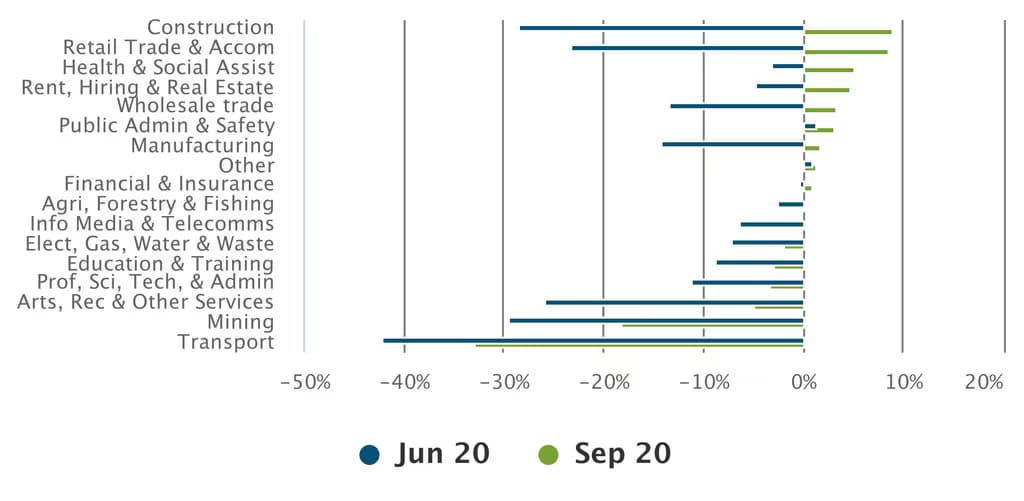
- The industries that remain the most negatively affected by the pandemic are transport, postal, and warehousing (down 33% from December 2019 levels); administrative and support services (down 19% - this industry includes travel agents); mining (down 18%); arts and recreation services (down 9.2%); and printing (down 7.4%).
- In contrast, industries where activity is well ahead of its December 2019 levels include furniture and other manufacturing (+21%); textile, leather, clothing, and footwear manufacturing (+12%); retail trade (+9.9%); non-metallic mineral product manufacturing (+9.6%); and construction (+9.0%).
Industry activity compared with December 2019
Seasonally adjusted, 2009/10 prices
...and our reaction
- Today’s data provides no guarantee that the economy is out of the woods yet, but there is no denying that the economy’s resilience in the face of the effects of COVID-19 has been remarkable.
- Some of the economy’s strength in the September quarter is likely to be a catch-up of pent-up demand from the June quarter’s lockdown. More recent partial indicators suggest this surge in spending is losing steam, raising the chances of a drop in overall spending in the December quarter.
- New Zealand’s export performance has been buoyed by strong results for agriculture and fishing primary products, meat products, and forestry primary products. The logistics issues affecting import activity do not appear to have negatively affected outcomes for goods exports.
- The uneven effect of the pandemic on different industries means that businesses in some parts of the economy are still hurting significantly. However, strong growth in other industries suggests that the effects of job losses are being mitigated by new positions becoming available elsewhere.
- We do not expect rapid economic growth to continue into 2021, as the post-lockdown surge fades, exporters grapple with overseas demand conditions weakened by COVID-19, and Reserve Bank action takes some of the heat out of the housing market.
- However, the economy’s performance to date suggests that job losses will be less pronounced than we were previously anticipating, which will limit the negative flow-on effects for household spending and economic growth.
Latest updates
Premium

Gross domestic product
NZ economy picking up before fuel price spike
Thu 18 Jun 2026
Quarterly
0.8% GDP in Mar 2026 qtr (sa)2.5% Business investment from Dec 2025 qtr (sa) 0.5% Household spending from Dec 2025 qtr (sa)
Premium
Gross domestic product
No momentum in recovery, even before Iran
Thu 19 Mar 2026
Quarterly
0.1% GDP from Sep 2025 qtr (sa) 0.1% Household spending from Sep 2025 qtr (sa)
 3.2% Private investment from Sep 2025 qtr (sa)
Gross domestic product
Economy bounces back 1.1% from June’s dip
Thu 18 Dec 2025
Quarterly
1.1% rise in GDP in September quarter from JuneInvestment spending up 3.2% from June 2025Manufacturing activity up 2.2% from June 2025Gross domestic product
Economy contracts 0.9% as international uncertainty bites
Thu 18 Sept 2025
Quarterly
0.9% fall in GDP in June quarterHousehold spending up 0.4% from Mar 2025Manufacturing activity declines 3.5% from Mar 2025