
Our take on the latest Economic and fiscal update (Wed 16 Sept 2020)



Near-term hit less than expected
But a more persistent hit to economic activity
Net debt to GDP higher, but gross debt lower
The key numbers...
- Treasury’s latest forecasts point towards the economy holding up better in the near-term, but with greater weakness expected over the next few years – a story in line with Infometrics’ forecast expectations.
- Forecasts from the Pre-Election Economic and Fiscal Update (PREFU) expect it to take until the end of 2022 for economic activity to return to pre-pandemic levels – 12 months longer than expected in May’s Budget update, but still a year sooner than our current forecasts.
- The lower levels of economic activity forecasted mean that net debt to GDP will peak higher (at 55.3% in 2024 rather than 53.3%), but actual debt values will be lower (peaking at $247b rather than $277b).
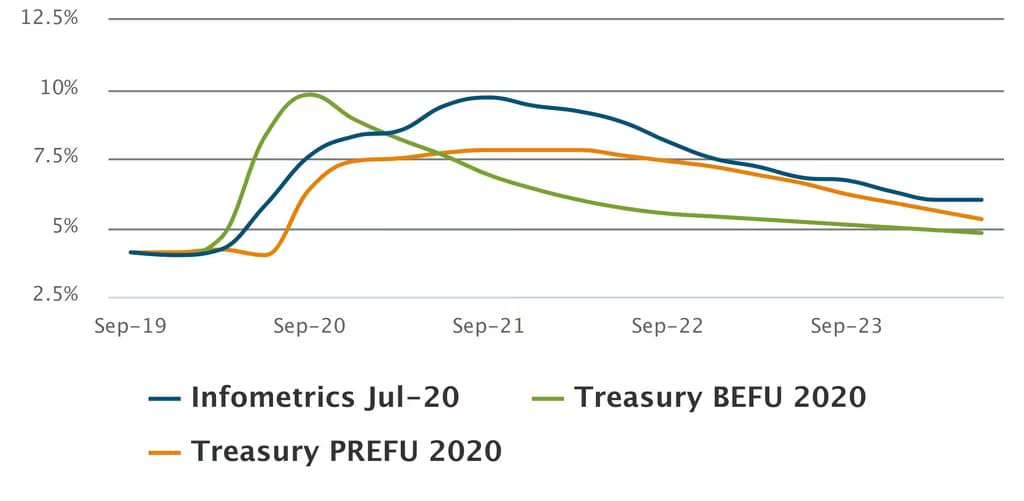
- The increase in unemployment is now expected to be less severe, but will remain at higher levels for longer, peaking at 7.8% towards the end of 2021 and not falling below 6% until the end of 2023.
Persistently higher, but peaking lower
Unemployment rate, % of labour force
...and our reaction
- The PREFU forecasts show that although the hit from COVID-19 will be spread over a longer period than initially thought, the impact will be less sharp than originally feared.
- Treasury’s latest forecasts are, in our minds, much more realistic than those presented at May’s Budget. Although Treasury’s forecasts are still more optimistic than ours, the shape of the forecasts is much more aligned to our thinking of a persistent hit to economic activity.
- Expectations for global economic activity has fallen, limiting New Zealand’s economic rebound potential, with trading partner growth expected to be weaker for the next three years.
- Uncertainty over the course of the pandemic makes charting the path ahead difficult, but it is worth noting that Treasury has assumed the New Zealand’s borders remain closed until the start of 2022 – a shift out in this assumption would reduce economic activity expectations.
- The tax take is expected to be lower than originally forecast in the near-term, reinforcing concerns over earnings potential for households and businesses.
- Although net debt as a percentage of GDP is higher over the period (due to lower economic activity), actual debt levels will be slightly lower than originally expected. The significant increase in debt loading means that changes to government spending and revenue will be an important discussion over the next few years, as we aim to rebuild New Zealand’s “pandemic insurance” that was our low debt loading.
Latest updates
Premium

Economic and fiscal update
Budget 2026: Fiscal position set to improve
Thu 28 May 2026
 $3b Surplus a year earlier in 2030$10.8b Higher revenue over 2026-30, relative to HYEFU
 $100m pa Funding for councils to invest in infrastructure
Premium
Economic and fiscal update
OBEGALx return to surplus delayed yet again
Tue 16 Dec 2025
Core Crown revenue down $6.3b, and expenses up $0.5bReturn to surplus now in 2029/30 (OBEGALx)80% of the increase in net Core Crown debt to fund capexEconomic and fiscal update
Budget 2025: The switch-it budget
Thu 22 May 2025
Core crown revenue down $9.8b, and expenses down $3.1bReturn to surplus in 2028/29Investment Boost tax incentive to drive investmentEconomic and fiscal update
Return to surplus pushed out another two years
Tue 17 Dec 2024
Slower productivity growth lowers GDP growth trackGovernment spending remains above 31% of GDPReturn to surplus in 2028/29 (OBEGALx)