
Our take on the latest Economic and fiscal update (Tue 17 Mar 2020)


Stimulus package of $12.1b
$5.1b for income support
Benefit increases and Winter Energy Payments boost
The key numbers...
- The government has announced a $12.1b stimulus package, with a focus on employment and benefit spending.
- The government has noted that this is just the first phase of a wider package to support the New Zealand economy through the downturn and into the recovery phase.
- Funding of $5.1b has been allocated for business wage subsidies, with $150,000 maximum per business that can show a 30%pa decline in revenue in any month between January and June 2020. The payment will be a lump sum covering a 12-week period and will start immediately.
- Sick leave and self-isolation payments will cost the government $126m, with $585.80 per week available per full time worker – this funding is available for people in self-isolation, or who have COVID-19, or who are caring for those with COVID-19. It does not cover those workers who can work from home anyway.
- All main benefits will rise by $25pw permanently, and the Winter Energy Payment this year will be doubled as a one-off, costing a total of $2.8b.
- Businesses are also supported by a $2.8b package of tax changes, including raising the provisional tax threshold and reintroducing building depreciation.
- Other spending includes $600m for the aviation sector, and $500m for the health system.
Economic outlook
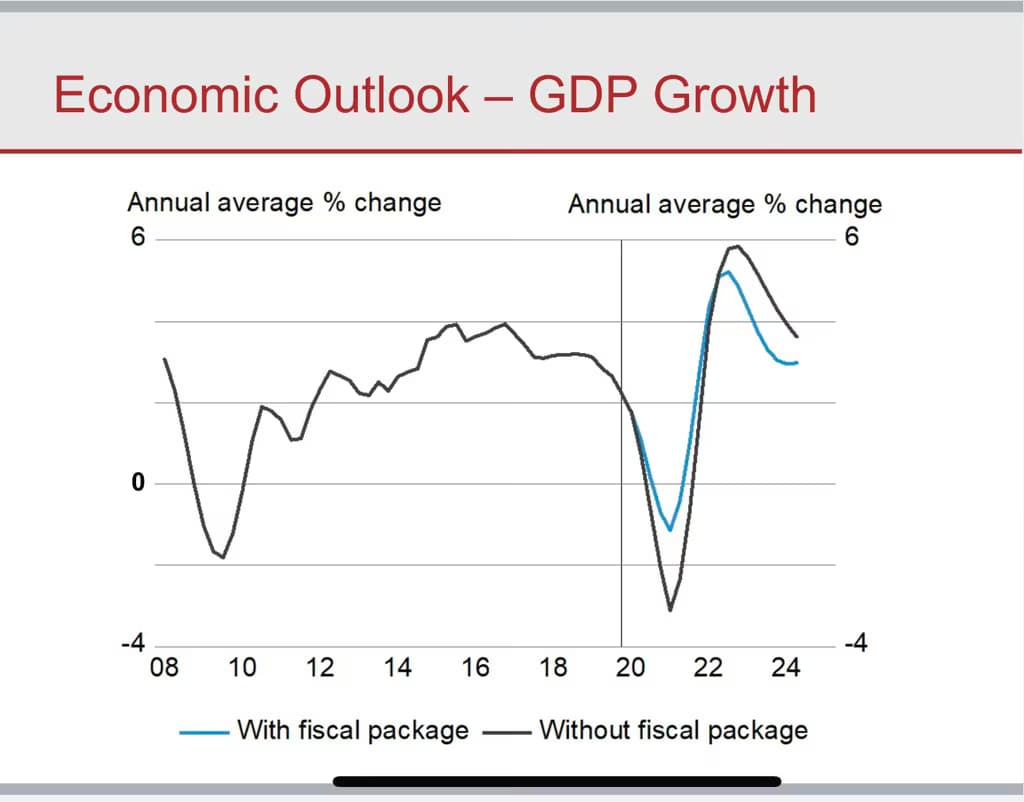
GDP, Annual average % change, prelim growth illustration, not official Treasury forecast
...and our reaction
- The government’s stimulus package is sizable and supports businesses, but it will not be enough to ward off a recession or a severe downturn in economic activity. But the scale of the economic downturn being considered is even larger.
- The focus on businesses is a bold step to support employment as we enter a downturn, and in our view is absolutely the right area to target. However, the timing of the business support package, with coverage only until June 2020, is too limited in our mind. The economic downturn will continue for longer, and so the government will need to be prepared for additional spending over a longer period.
- In many ways, the package is underwhelming as to the scope of assistance to vulnerable employees and those on lower incomes generally. Lower-income working households, whose employment is now much more precarious, will require more funding to support the economy.
- Lifting benefit payments will certainly raise spending potential, but the government needs to be paying greater attention to try and maintain employment levels as much as possible and mitigate likely job losses.
- The government retains additional spending capacity to respond to this downturn, and we expect additional measures will be announced in May. The funding announced today is the interim measure to hold over the economy until a full package can be implemented.
Latest updates
Premium

Economic and fiscal update
Budget 2026: Fiscal position set to improve
Thu 28 May 2026
 $3b Surplus a year earlier in 2030$10.8b Higher revenue over 2026-30, relative to HYEFU$100m pa Funding for councils to invest in infrastructure
Premium
Economic and fiscal update
OBEGALx return to surplus delayed yet again
Tue 16 Dec 2025
 Core Crown revenue down $6.3b, and expenses up $0.5bReturn to surplus now in 2029/30 (OBEGALx)80% of the increase in net Core Crown debt to fund capex
Economic and fiscal update
Budget 2025: The switch-it budget
Thu 22 May 2025
Core crown revenue down $9.8b, and expenses down $3.1b Return to surplus in 2028/29Investment Boost tax incentive to drive investment
Economic and fiscal update
Return to surplus pushed out another two years
Tue 17 Dec 2024
Slower productivity growth lowers GDP growth trackGovernment spending remains above 31% of GDPReturn to surplus in 2028/29 (OBEGALx)