
Our take on the latest Labour market statistics (Wed 5 Nov 2025)



Unemployment rate edges up to 5.3%
Youth NEET rate rises to 13.2% (annual average)
Labour cost growth slows to 2.1%pa
The key numbers...
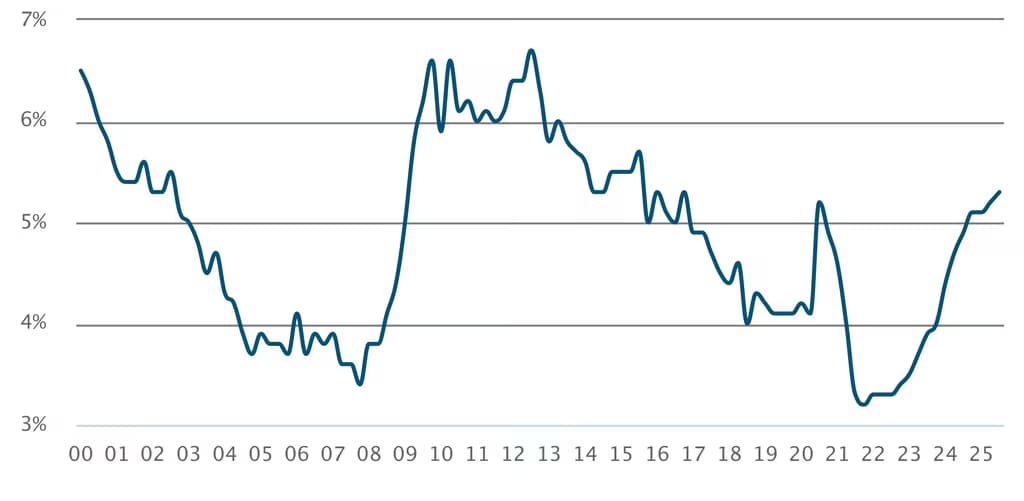
- The unemployment rate rose to 5.3% in the September 2025 quarter (seasonally adjusted), the highest rate since December 2016. The lift from 5.2% in the June 2025 was widely expected by forecasters including ourselves.
- The underutilisation rate rose to 12.9%, up from 12.8% in the June 2025 quarter (seasonally adjusted). The number of people underutilised reached its highest level ever, at 406,000 this quarter. Underutilisation includes the unemployed, underemployed, and potential labour force. Higher underutilisation dragged down the labour force participation rate, from 70.5% in June to 70.3% in September quarter, the lowest since December 2020.
- Employment was unchanged from the June 2025 quarter (seasonally adjusted), after four consecutive quarters of decline, but remains down 0.6% on an annual basis.
- QES weekly paid hours rose 0.5% in the September quarter, the first increase in a year, in agreement with the 0.9% lift in HLFS actual hours worked – adding another sign to expectations of improved economic outcomes (all figures seasonally adjusted). Hours worked remain 1.4% lower than a year ago, showing that employers continue to ‘hoard’ labour, keeping hold of and paying staff even though they don’t have a full workload for them, in anticipation of an upturn.
- Labour costs rose 2.1% in the year to September 2025, with public sector costs rising 2.4% and private sector 2.1%. Both public and private sector labour cost growth slowed to their slowest rate since 2021.
- The rate of youth not in education, employment or training (NEET) continues to rise markedly, up to an average of 13.2% in the year to September 2025, up 0.8 percentage points.
Highest unemployment rate since December 2016
Unemployment rate, % of labour force, seasonally adjusted
...and our reaction
- The labour market continues to perform in line with expectations, with the unemployment rate edging up to what we think is its cyclical peak. Employment appears to have reached the bottom of its cycle, with the decline arrested in the September quarter.
- A quarterly rise in hours worked also adds to the expectation that the labour market will improve – slowly – from here, with a lift in hours worked and paid.
- Beyond today’s release, a variety of indicators show that we are sitting on top of a (mild) turning point in the labour market. MBIE’s job advertisement index has risen for the third month in a row, and Stats NZ’s monthly employment indicators showed two months in a row of growth in filled jobs. With a mild and slow recovery expected, and further growth in the underutilised group within the labour force, New Zealand has considerable scope to recover without any pressure on the labour market.
- Young people continue to suffer the most in the labour market, with the NEET rate rising further this quarter, as employment of young people continues to fall. However, key industries for employing young people – retail and hospitality – showed promising employment growth this quarter, up 2.4%pa.
- New Zealand sits among the middle of the pack of its OECD peers, with this quarters’ 5.3% unemployment rate placing it at 18th out of 38 countries, a stable position from the June 2025 quarter.
Latest updates
Premium

Labour market statistics
Unemployment jumps higher than expected
Wed 5 Aug 2026
Quarterly
5.6% Unemployment rate in the June 2026 quarter (s.a.)70.7% Participation rate the highest in over a year0.5% Employment growth in June from March (s.a.)Premium
Labour market statistics
More people, more working, more not participating
Wed 6 May 2026
Quarterly
5.3% Unemployment rate eased slightly in the March 2026 quarter 70.4% Participation rate fell slightly0.2% Employment rose in March from December (s.a.)
Labour market statistics
Higher participation drives unemployment increase
Wed 4 Feb 2026
Quarterly
5.4% Unemployment rate December 2025 quarter (sa)70.5% Participation rate December 2025 quarter (sa)2.0%pa Labour Cost Index Year to December 2025