
Our take on the latest Labour market statistics (Wed 6 Aug 2025)



Unemployment rate edges up to 5.2%
Employment down 0.9% from June 2024
Labour cost growth slowed to 2.4%pa
The key numbers...
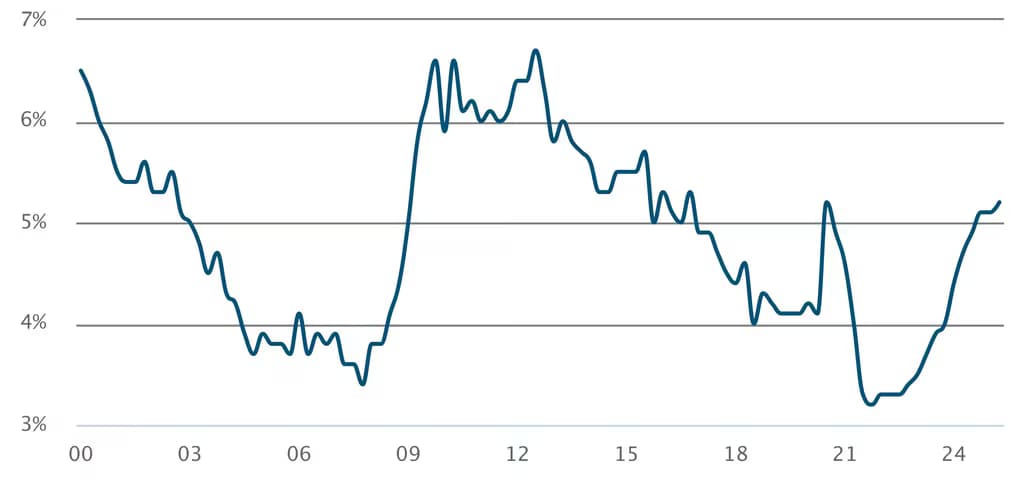
- The unemployment rate rose to 5.2% in the June 2025 quarter (seasonally adjusted) to its highest rate since the COVID-19 peak in September 2020, and before that, December 2016. The unemployment rate was slightly below market expectations of 5.3%, but in-line with our and RBNZ’s forecast.
- The underutilisation rate rose to 12.8% in the June 2025 quarter, rising from 12.4% in the March quarter, as underemployment and the potential labour force both expanded. The underutilisation rate was last this high in September 2020 when it was 13.1%.
- Employment fell 0.1% in June 2025 from March (seasonally adjusted), and is now down -0.9%pa from the June 2024 quarter. There are now around 27,000 fewer people in employment than in the June 2024 quarter.
- Labour cost growth continued to slow as more spare capacity appears in the labour market. The labour cost index rose 2.4%pa in June 2025 from a year ago, moderating from 2.9%pa in March. The moderation in the labour cost index was driven by public sector growth slowing to 2.8%pa from 4.2%, the slowest rate since March 2022. Private sector labour cost growth also slowed further, down to 2.3%pa from 2.6%pa in March, growing at its slowest rate since September 2021.
Highest unemployment rate since September 2020
Unemployment rate, % of labour force, seasonally adjusted
...and our reaction
- The increase in the unemployment rate is consistent with expectations that still-weak economic trends are clear across the economy, and supports our view that we are at or near the peak for the unemployment rate. Most analysts have been expecting the unemployment rate to reach a peak in the September 2025 quarter for this cycle.
- The weakness in the labour market is reinforced in other measures, including that the employment rate (66.8%) was at its lowest since December 2020. Total hours worked in the June quarter fell 1.0% from March, falling for the sixth consecutive quarter (seasonally adjusted). The total number of hours worked was 2.6% lower than a year ago, and at its lowest in three years (seasonally adjusted).
- The labour market downturn has hit young people particularly hard, with the participation rate and youth employment rate both falling over the last year. The number of 15-24-year-olds in education increased by 18,000 people in the year to June 2025, up 5.0% from a year earlier. Conditions in the labour market could be leading to youth people staying in education longer or entering new education to upskill.
- This trend towards training, or not seeking employment, saw the labour market participation rate falling further, from 70.7% (revised down from 70.8%) to 70.5%, the lowest rate since March 2021. There were an additional 13,000 people not in the labour force in the June 2025 quarter, compared to last quarter.
Latest updates
Premium

Labour market statistics
Unemployment jumps higher than expected
Wed 5 Aug 2026
Quarterly
 5.6% Unemployment rate in the June 2026 quarter (s.a.)70.7% Participation rate the highest in over a year0.5% Employment growth in June from March (s.a.)
Premium
Labour market statistics
More people, more working, more not participating
Wed 6 May 2026
Quarterly
5.3% Unemployment rate eased slightly in the March 2026 quarter70.4% Participation rate fell slightly0.2% Employment rose in March from December (s.a.)Labour market statistics
Higher participation drives unemployment increase
Wed 4 Feb 2026
Quarterly
5.4% Unemployment rate December 2025 quarter (sa)70.5% Participation rate December 2025 quarter (sa)2.0%pa Labour Cost Index Year to December 2025Labour market statistics
Unemployment rate rises to 5.3%
Wed 5 Nov 2025
Quarterly
Unemployment rate edges up to 5.3%Youth NEET rate rises to 13.2% (annual average)Labour cost growth slows to 2.1%pa