Building work put in place
Res construction rises for the first time in two years
5 Jun 2025

Our take on the latest Building work put in place (Thu 5 Jun 2025)


Residential volumes up 2.6% from Dec 2024 (sa)
Non-residential volumes down 3.9% from Dec 2024 (sa)
Total activity down 12% from March 2024
The key numbers...
- The volume of total building work put in place was unchanged in the March 2025 quarter from December 2024, following six consecutive quarterly declines. Lower non-residential activity (down 3.9%) was offset by a 2.6% rise in residential activity (all figures seasonally adjusted).
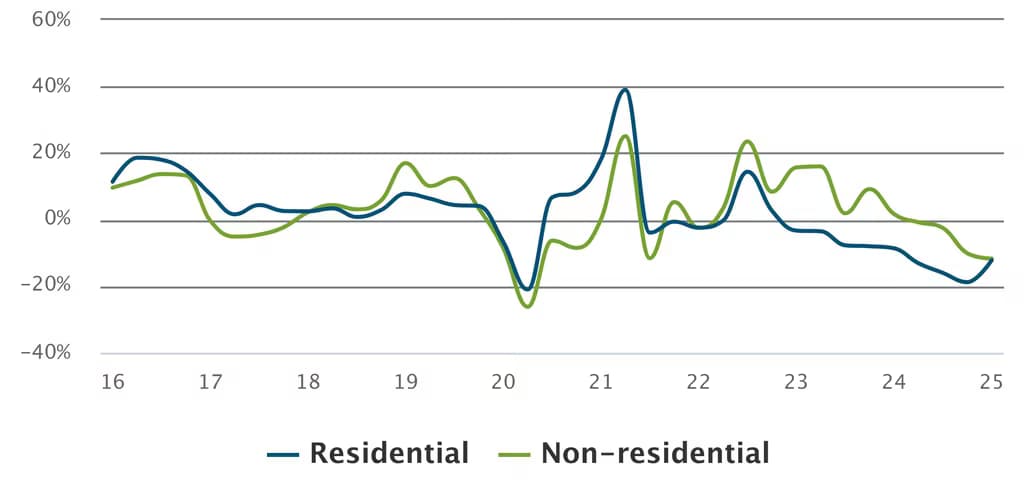
- Total building activity in the March quarter was 12% lower than a year earlier, declining for the seventh consecutive quarter in real terms. The annual decline was smaller than the 16% fall in the previous quarter, but it is still the second largest drop since September 2011 (excluding the lockdown-affected June 2020 quarter).
- Residential activity rose from the previous quarter for the first time in over two years, but despite the 2.6% lift, work put in place volumes in the March quarter were 25% below the peak in September 2023 (seasonally adjusted). The annual decline in residential activity narrowed to 12%pa, the smallest annual fall since March 2024.
- Non-residential activity declines accelerated as expected, as this build type tends to lag the economic cycle. The annual decline of 12%pa was the largest since December 2011 (excluding the June 2020 quarter). Annual growth in non-residential activity has been negative for a full year, for the first time since 2020.
Decline in residential activity moderates
Annual % changes in building work put in place volumes
...and our reaction
- Residential activity was stronger than expected in the March quarter, with activity 2.2% above our forecast. It was positive to see the first quarterly rise in residential activity since September 2022. Part of the overperformance in March could be due to timing, with a 3.2% downward revision to new dwelling activity in December 2024 pushing more work into the March quarter.
- New dwelling activity was weaker than expected, 1.3% below forecast, recording the lowest quarterly value of activity in four years. Residential additions and alterations (A&A) work continued to moderate, but was the main driver of the overperformance, $150m higher than expected. Quarterly residential A&A work was at its lowest in two years, but it remained a larger proportion (14%) of total residential activity than during the new construction boom in 2022 (12%).
- Non-residential activity also overperformed, with activity 5.9% above forecast. Overperformance was driven largely by social building ($150m higher than expected), and factories and education building were also $42m and $37m higher than expected respectively. In contrast, storage buildings were $94m lower than expected.
- All broad regions saw an annual decline in residential activity, led by Wellington (-31%pa). Non-residential weakness was widespread but uneven, with annual declines occurring across the broad regions except for Canterbury (up 6.1%pa). There was less than $1.0b of non-residential activity in Auckland (down 22%pa) for the first time since the March 2022 quarter. The second-largest decline was in the South Island (excluding Canterbury), which was down 9.5%pa. Waikato (-4.4%pa), Wellington (-2.7%pa), and the Rest of the North Island (-1.0%pa) saw more muted declines.
Latest updates
Premium

Building work put in place
Construction activity at a 10-year low
Thu 4 Jun 2026
Quarterly
13% Non-residential activity in March 2026 from March 2025 3.9% Residential activity from March 2025
 Total building activity at its lowest level (excl lockdowns) since 2015
Premium
Building work put in place
Non-residential work hammered as residential softens further
Thu 5 Mar 2026
Quarterly
6.5% Non-residential activity from September 2025 (sa)1.1% Residential activity from September 2025 (sa)Total building activity at its lowest level (excl lockdowns) since 2015Building work put in place
Non-residential activity continues to decline
Thu 4 Dec 2025
Quarterly
Residential volumes up 3.3% in September from June 2025 (sa)Non-residential volumes down 1.3% in September from June 2025 (sa)Total quarterly activity now down 5.3% from September 2024Building work put in place
Lower residential activity leads construction decline
Thu 4 Sept 2025
Quarterly
Residential volumes down 2.9% in June from March 2025 (sa)Non-residential volumes down 0.4% in June from March 2025 (sa)Total quarterly activity now down 9.6% from June 2024