
Our take on the latest Ready-mixed concrete (Mon 12 May 2025)


Concrete volumes up 1.4% from Dec 2024 (sa)
Annual concrete volumes down by 5.4%pa
Christchurch volumes 11% below Mar 2024
The key numbers...
- Ready-mixed concrete volumes rose 1.4% in the March 2025 quarter to 939,000 cubic metres. Despite the small rise, the quarterly volume was the second lowest since mid-2014 (behind last quarter, excluding lockdowns). Volumes have been under 1m cubic metres for six consecutive quarters, following three full years above 1m (excluding lockdowns, all figures seasonally adjusted).
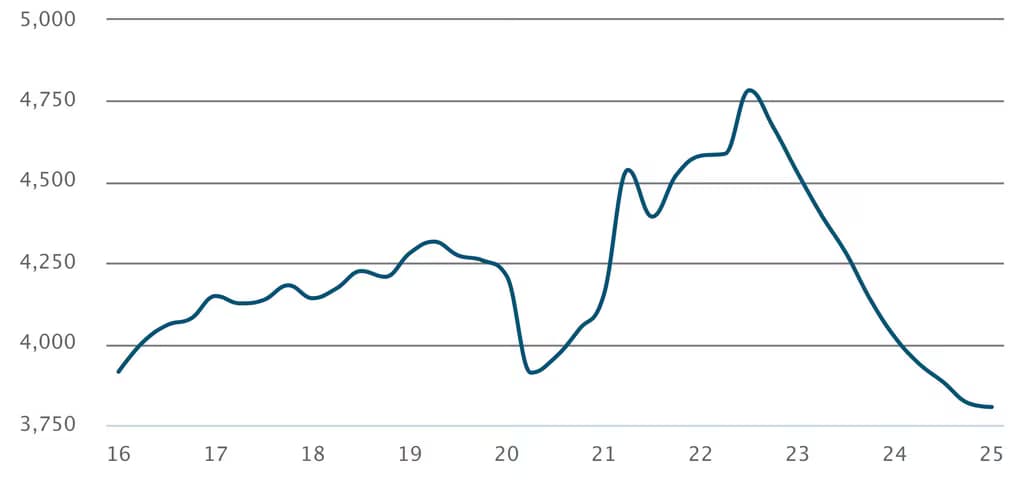
- Annual ready-mixed concrete volumes headed even lower, to 3.80m cubic metres in March 2025, down 5.4% from the March 2024 year and 20% from their peak in September 2022.Volumes have fallen to new post-2015 lows in each of the last three quarters.
- Annual ready-mix concrete volumes across all regions have been lower than a year ago for six consecutive quarters, showing the decline has been widespread. Waikato/Bay of Plenty (-12%) leads the declines, followed by Gisborne/Hawke’s Bay (-9.3%), and West Coast/Tasman/Nelson/Marlborough (-9.1%). The smallest declines were seen across Northland (-0.8%), Auckland (-2.1%), and Canterbury (-2.2%).
Annual concrete volumes head even lower
000m3, annual running totals, ready-mixed concrete volumes
...and our reaction
- The trend in concrete volumes remains largely negative, and the case for a significant turnaround in the near term is weak given lower residential and non-residential consent numbers seen over 2024. Construction activity is largely lagging the rest of the economy, which has started to turn around over the past six months.
- Residential consents have remained stable in 2025 after finding a floor during the second half of 2024. Given poor housing affordability and rental yields that remain unattractive for investors, any uptick in consent numbers in 2025 might be limited, limiting growth in residential construction activity and concrete usage over the coming years.
- In the non-residential industry, the largest falls in consents since mid-2023 have occurred for public sector building types. However, the recent announcement of an additional $400m being added to the capital allowance, bringing the total to $4.0b for Budget 2025, could see a stabilisation or improvement in public sector consents in coming quarter.
- Private sector investment in non-residential buildings could come under further pressure given uncertainty arising from the trade war. Concerns about future revenue prospects could see businesses hit pause on large scale investment.
- The government’s push to increase land available for residential building and housing supply, along with infrastructure spending, creates some upside risks to the outlook across civil and residential construction activity, which could boost the use of ready-mix concrete during 2026 and beyond.
Latest updates
Premium

Ready-mixed concrete
Further concrete rise supported by South Island growth
Wed 12 Aug 2026
Quarterly
12%pa Concrete volumes in Jun 2026 quarter 22%pa Concrete volumes in the South Island
 Volumes above 1 million m3 for the first time in 2½ years
Premium
Ready-mixed concrete
South Island drives continued growth in concrete
Tue 12 May 2026
Quarterly
1.8%pa Concrete volumes in Mar 2026 quarter1.1% Concrete volumes from Dec 2025 quarter (sa)21% Christchurch concrete volumes from Mar 2025 quarterReady-mixed concrete
A turning point for concrete volumes?
Wed 11 Feb 2026
Quarterly
0.4%pa Concrete volumes from Dec 2024 quarter2.4% Concrete volumes from Sep 2025 quarter (sa)South Island leads growthReady-mixed concrete
Concrete volumes still under pressure
Wed 12 Nov 2025
Quarterly
Concrete volumes in Sep quarter up 2.3% from Jun (sa)Annual concrete volumes down by 6.2%paAnnual concrete volumes in Otago/Southland up by 5.1%pa