Real estate statistics
House prices rise from March, annual decline narrows to 0.3%pa
15 May 2025

Our take on the latest Real estate statistics (Thu 15 May 2025)


House prices up 0.4% from March (sa)
House sales up 1.4% from March (sa)
Stock of properties for sale down 1.1% from March (sa)
The key numbers...
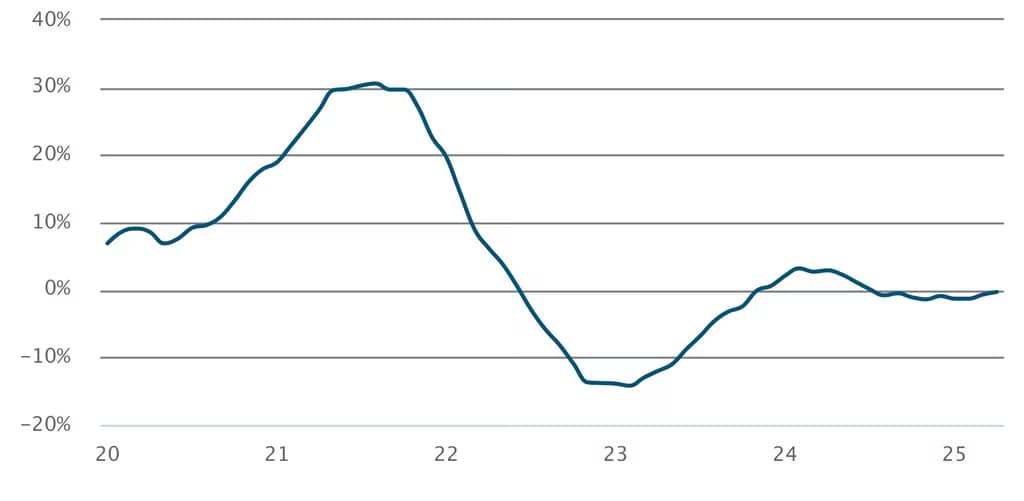
- House prices rose 0.4% in April from March, the largest month-on-month increase in six months. This rise more than offsets the 0.3% fall in March (all figures seasonally adjusted). The annual decline narrowed significantly to just 0.3%, the smallest annual fall in this recent downturn which began in early 2024. REINZ’s house price index is now at its highest level since April last year.
- House sales rose 1.4% in April from March (based on Infometrics seasonal adjustment) and were 9% higher than in April 2024, marking 10 consecutive months where sales have been higher than a year ago.
- Trends in house prices across the main centres remain mixed. House prices in Canterbury remain resilient, up 1.6%pa in April. In Auckland, house prices were unchanged from a year ago, following 10 consecutive months of declines on a year ago. However, house prices in Wellington declined further, extending the annual fall to 4.2%pa, the largest annual decline since September 2023.
- The stock of properties available for sale fell 1.1% from March, after remaining largely flat over the past three months at around 32,900. New listing numbers fell back 8.7% from March but remain high (all figures seasonally adjusted).
Annual house price decline narrowing
REINZ House Price Index, annual % change
...and our reaction
- There are signs that buyers are happier with current mortgage rate offerings over the past few months, as the two-year term became the second most popular rate for new mortgage debt in March, coupled with a notable decline in lending on the six-month rate. This shift could signal a coming uptick in demand for housing, with buyers now happier to fix longer-term.
- The median length of time to sell has been volatile over the past six months but fell by more than 3.0% in both March and April, and is down to 42 days, the shortest time since May 2024.
- Although house sales in April were up 9.5% from a year ago, they were largely unable to make a significant dent in the surplus of stock available for sale. At this level, the stock of properties available should limit the extent of near-term house price growth.
- As we are nearing the peak of the unemployment rate, the shifting labour market should help households feel more confident entering the market to purchase a property. We expect improving levels of potential buyers in the second half of this year to drive modest house price growth by the end of the year.
Latest updates
Premium

Real estate statistics
House sales and prices still falling
Thu 13 Aug 2026
Monthly
 10%pa House sales in July 20260.4%pa House prices from a year earlier
 9.3%pa Stock of homes for sale in July 2026
Premium
Real estate statistics
Conflict continues to drag on housing market in June
Wed 15 Jul 2026
Monthly
8.8% House sales between Feb and Jun 2026 (seas adj)0.8% House prices since February (seas adj)4.8% Stock of homes for sale since February (seas adj)Real estate statistics
House buyers dry up ahead of interest rate rises
Mon 15 Jun 2026
Monthly
13%pa House sales in May 20260.6%pa House prices from May 2025 Stock of homes for sale at an 11-year high
Real estate statistics
House prices and sales fall
Thu 14 May 2026
Monthly
7.9%pa House sales in Apr 20260.5% House prices from Mar 2026 (sa)1.2% Stock of homes for sale since Feb 2026 (sa)