
Our take on the latest Major event update (Fri 4 Apr 2025)


10% tariff on $9b of NZ exports to the US
Key NZ export countries have higher tariffs
US growth set to be 0.9ppts lower in 2025, global growth 0.17ppts lower
The key numbers...
- US President Donald Trump has announced sweeping tariffs, with a 10% baseline tariff for all countries, and higher tariffs of up to 50% on 60 countries with a larger trade imbalance with the US.
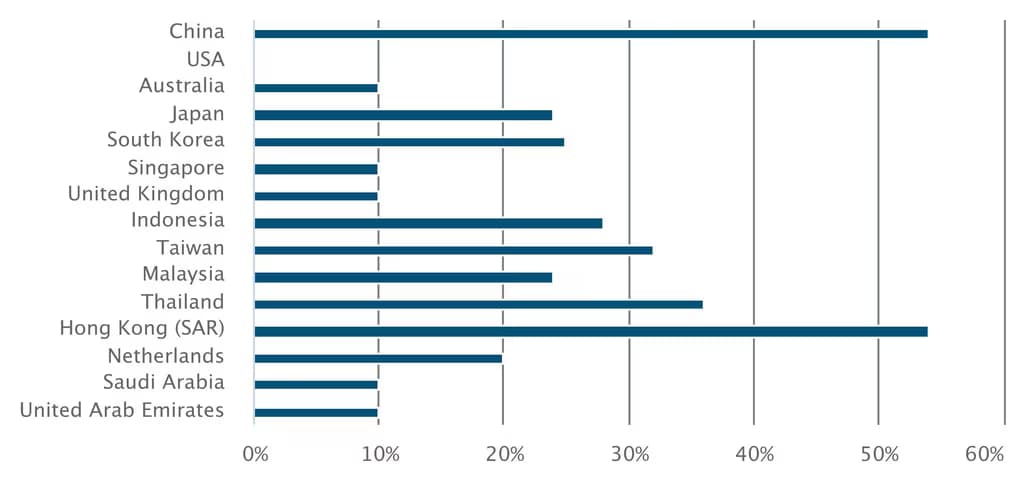
- Notable tariffs include a 46% rate on Vietnam, a 34% rate on China (on top of the 20% tariff already in place), 25% on South Korea, 24% on Japan, and 20% on the EU. New Zealand and Australia are both hit with the 10% baseline tariff, indicating that we are not being specifically targeted. However, most of New Zealand’s top 10 export partners have been levied with tariffs of 20% or above.
- The tariff rates announced by the White House are described as “discounted reciprocal tariffs”, but instead of being calculated based on tariffs charged by countries on the US, or even the highly spurious inclusion of GST/VAT in some countries, the US Trade Representative has clarified that the tariffs are based on a calculation that boils down to a country’s 2024 trade deficit with the US, divided by that country’s total trade with the US.
- Market reaction has been swift, with drops of 4-6% on major stock indexes, and around $3.1 trillion in market value wiped out. The drop looks likely to be the worst since March 2020, when COVID-19 hit markets hard. The US dollar also fell, helping push the Kiwi back above US58c.
- Analysis from The Budget Lab at Yale University suggests that consumer prices in the US will increase 2.3% this year from the announced tariffs. The tariffs will also shave nearly a percentage point (0.9ppts) off US GDP growth this year, and they could knock 0.4-0.6ppts off annual US GDP growth going forward. Global GDP is set to be 0.17ppts lower in 2025 because of the tariffs.
Key NZ export partners hit with higher tariffs
US tariff rates, combined April 2025 and earlier 2025 tariffs, by country, for NZ's top 15 export countries, ranked by 2024 goods export value
...and our reaction
- The announcement of tariffs is a disappointing, but clearly not unexpected outcome, with US President Donald Trump keen to continue along a protectionist and inward-looking track, no matter the clear economic case against it. The direct effects on New Zealand could have been worse, but that’s the only real consolation. The indirect effects on New Zealand are set to present a greater and more enduring challenge.
- An important distinction – tariffs are paid by importers, rather than by exporters. So on nearly $9b of NZ goods exports to the US last year, the cost of paying the tariffs on NZ exports would be $900m. But the cost of US tariffs on NZ exports isn’t $900m – the effects on export activity and incomes are yet to be determined, and will depend on how businesses respond, and how global growth adjusts.
- We expect (and have already heard that) some New Zealand exporters will lower prices to try and maintain the same retail price of their products, post-tariffs, and keep market share. But for many products, US consumers are set to pay more.
- There are different views around the economic and other effects of the tariffs. Some economists view the tariffs announcement as akin to a demand shock, and expect that lower economic activity will force interest rates to drop more. However, tariffs also present a supply shock, and the clear and direct effect of higher prices is of most concern in our view.
- To us, talk of lower interest rates based on the tariffs announcement is wrong and borders on irresponsible. We take the view that tariffs will act as a supply shock, and with higher prices set to occur, there’s a better chance that interest rate cuts will be limited or halted sooner rather than later. At the very least, calls for larger interest rate cuts in response to tariffs are premature at this stage.
- Although there are potentially some limited opportunities where New Zealand might benefit from tariffs in the short term, such as cheaper imports from more heavily tariffed countries, the longer-term implications are much more negative. The key worry for New Zealand is that tariffs will see lower trade flows globally, and more money going to pay for tariffs, which together would reduce global growth and limit the amount that can be spent on New Zealand exports.
Latest updates
Premium

Major event update
Fuel rationing plan simplified and only for the most severe circumstances
Mon 11 May 2026
Fuel rationing only to occur at Phase 4Prioritised access for Critical users and Food & FreightFuel supplies remain reasonable at presentPremium
Major event update
NZ-India FTA a solid deal amid global free trade retreat
Tue 23 Dec 2025
Indian tariffs reduced across 95% of NZ exportsNZ exports of sheep meat, forestry, and fruit appear to be key winners Nearly 3,000 temporary work and working holiday visas per year available to Indian nationals
Major event update
Oil prices volatile after escalating Middle East conflict
Tue 24 Jun 2025
Oil prices spiked after Israeli and US airstrikesBrent crude oil prices have since fallen back to around US$70/bl Oil price volatility could continue depending on further Iranian response